Saturday, November 10, 2018

Thought Dumps

I'm going to enjoy a little aimlessness here. Let's start with the NaNo word count: 34,477. That's twice the minimum daily average still, but I'll keep it up (and more) as much as possible. I don't hate reaching goal halfway through the month, for sure. I do have a couple of Thanksgivings to tuck in and if I'm mentally done with drafting, I can take a break or switch to editing or designing.

Moving on...

One thing that is becoming a habit is the increasing amount of time I'm spending coming up with back stories or subplots. Even as a gamer, these were always my favorite parts of gaming. The parts that were rarely ever told through action or skill-- just the emotional, intense, sometimes even vague developments that don't always reach the page. I more often use these rough events to internally explain why and how my character reacts as they do.

I'm not a stickler for the 'show, don't tell' nonsense, which I've explained before often seems too coy and just as repetitive as saying things outright. SHOW me how their feeling, don't TELL me they're happy. SHOW me the atmosphere of the bar, don't TELL me what it looks like. 
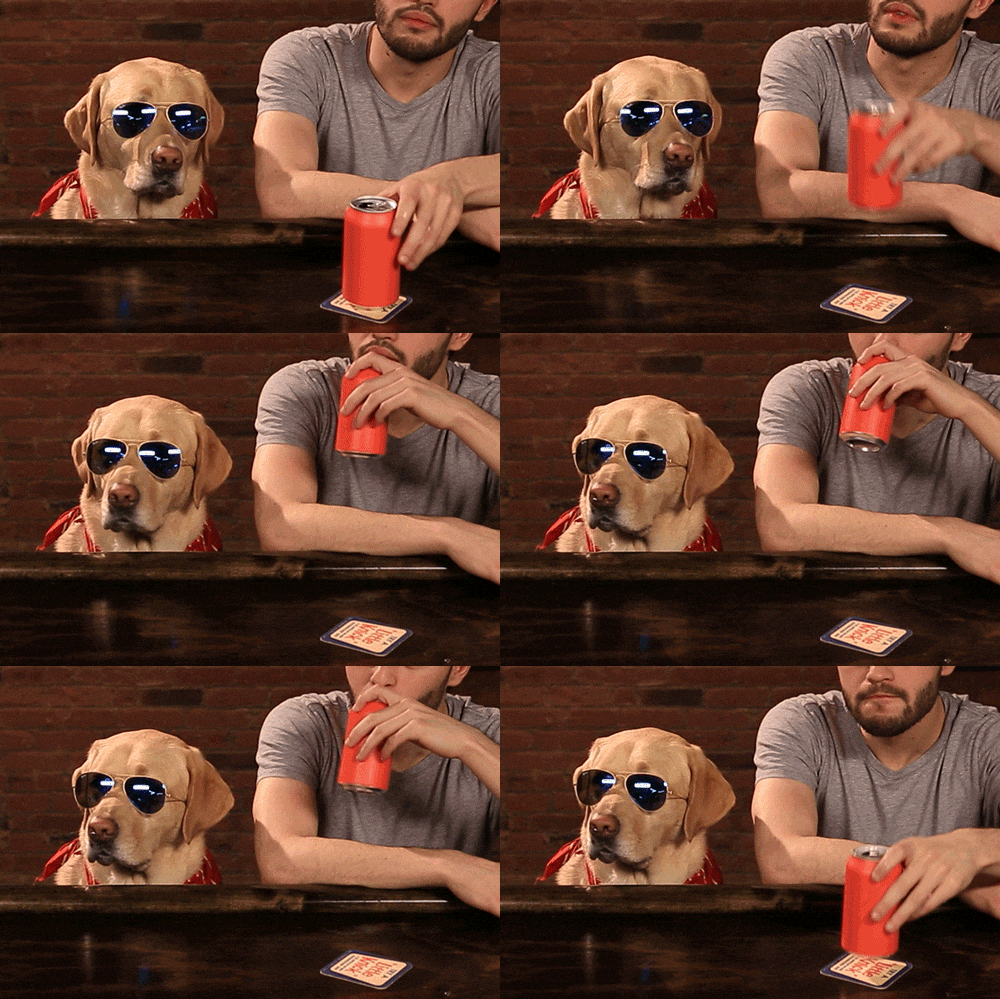
SHOW me there's a dog with sunglasses at the bar, don't TELL me...
I've heard that Steinbeck's work is to blame for this 'rule'. I can't hate the guy because he's a fan of quick, cool moral quoting like I am. I don't avoid showing and certainly, sometimes it's more effective to create a mood when you describe being swallowed in a man-shaped shadow rather than saying a tall man stepped in front of you. Still, more often than not, those that take the advice start to stack up a bunch of these: biting lips, balled fists, clenched teeth. These details can be fun to roll out for a scene where someone is pretending to be unbothered, but they keep telegraphing physical signs of tension. Other times, there's no build and these repetitions are doing quite the opposite. Unless it's truly effective, sometimes 'she was nervous he wouldn't come' is a-okay. Unless holding out that she is 'waiting on someone' or 'who it is' happens to be a good build, I'd push it through.

To be honest, there are just some genres where it works nearly every time, like mysteries or crime. When you want the reader to have to figure out the details before they are 'revealed' then it's perfect for this. I've heard some fantasy readers say they like it, but I find fantasy a place where dragging through every scene this way is tedious, both as a writer and a reader. Fantasy is more fun as a roller coaster, one where you change pace, structure, intent-- all at the drop of a hat for the sake of the story. You want those blockbuster twists. I'm definitely a fan of slow builds, but it has to stay relevant and hopefully interesting. There are many fantasies I just couldn't stomach unless they come out with an abridged version, because it became just as tedious with exposition as it did the very, very showy shit. Which is terrific if you're writing a proposal as a project manager. As a novelist, that shit needs polished up.

Here's another thing: like any writer I can talk a big game, but there's a big chance I'm breaking my own so-called preferences and rules. I'm probably leaning on a bias due to taste and experience. This is why it's okay to call my bluff. In fact, I appreciate being told where I've slipped up. It gives me a chance to reanalyze it and either defend why I did it or mentally seal in what to avoid in the future.

I wandered off of talking about back stories, but it came up because I was looking at my notes today. I haven't looked at them since I started drafting and realize I deviated a bit and still like the original ideas more. So I'll need to tweak the draft on that account, but at least it didn't deviate much. I certainly had the intent in line, so it's minor. 

There are some back stories that just don't fit into this series the way I intend it, but they also fit into the prequel area, a time long before any of the characters were alive in this story, back to where the trouble originated. I had originally gone with the name UnQuadrilogy with the intent to do more than four books anyway (because who doesn't like an intentional Douglas Adams-style gaffe, oxymoron intended?). So I think once I write the last of the main series, I want to go back and play with that prequel! I warmed up to some flashbacks in UnSung and I'll continue to throw those in where they fit, but I think there's a depth I want to reach that would just throw the main series too far off track to try to squeeze it all in.

So I'm thinking of a name for it already. UnFinished? UnEnding? UnTold? Perhaps I'll poll these later, but it's still quite the task to get these all tied up.

Chime in on this one, if you like. After UnNamed, UnSung, UnHeard and UnVeiled, which name do you think might make for a great prequel name?

Friday, November 9, 2018

Mad-Libbing It Up and Skipping Ahead

While I can't really talk about my stories while writing them, there are certainly some techniques for fast drafting that I can share with you. This is assuming you're up to the challenge or it's already a method you enjoy but are curious to see if there's some angle you haven't looked at.

Most fast work is sloppy work. Even people quick to whip out books and articles run the risk of putting out work chock full of errors. If your plots are simple enough or if you have a decent handle on grammar, you might be the exception. However, when drafting something trickier, it's entirely possible you can do a rather impressive job of getting it down and making it comprehensible for editing to iron it out.

Hell, I'll even add a bonus section at the end, showing how to throw out quick notes using Scrivener.

Mad Lib!

In a carefully treaded story, you probably stop, research, play with names, formulate those plots carefully... Do none of that; try this instead.

In place of the name or place or other unknown, plug in a word you absolutely won't use anywhere else. Persimmon, whorebag, igloo-- just grab at something off the wall and let it fill the place of something you might hang up on. Not only is it a quick creative nibble, it's a tried and true trick that makes replacing it later super easy. I usually advise to put it in caps too. If you accidentally misspell it then you'll catch it easier on a manual sweep. Keep a notepad or a plain text window open to record the word and a description of who or what it's filling in for. It might be a mini break in the flow but I've never had an issue with it taking me away as long as other options.

Skippy Dippy!

Sometimes, you want to form a subplot, some fun little opportunity for a bond, a development or a murder. You know the transition needs something but the inspiration isn't hitting, even boring you just thinking about it. In Scrivener, I sometimes create a whole new scene tab and leave it blank for later and move to the next solid scene, but if you're using a simple one document WP like Word, just double space, center text in CAPS along the lines of FIGHT SCENE #1, double space again, return to body format and move on.

If you have a solid lead on a subplot then give it your full effort, but if you're not quite into it, either give yourself time to warm to it or ditch it. Trying to force it out is mental constipation. Don't be afraid to rush on parts you're unsure of. You're going to edit later and you won't easily miss a spot you rushed through. You can always use a word processor feature like highlighting if you're sure you want to find it faster to fix up.

Bonus: Quick Scene

One thing I do with Scrivener is take my bare notes and throw them down right away. In a folder I start a bunch of new unnamed scenes, then take that document notes section and jot down any notes relevant to that scene. If you didn't plan, just jot down the quick version of what you hope will unfold. Name each scene something fun and relevant. By default, those names aren't going to pop up in your main document so you can give them spoiler names. Fall of the King, Poison Ivy is Terrible TP, All the Butts are Itchy, whatever. The idea is to set up scenes like you would for a play or movie. I usually stick to staying on one scene block until they change settings, but you can use them to isolate specific plots and perspectives as well.

Use each scene block's note section to type up a rough synopsis. You might be surprised by how fast you graduate into each transition when you've got the general idea peeking on the side. Mostly, I just type up a rough synopsis, but it's a good place to jot down new appearances or places and possible subplots. The Novel template contains subfolders for Characters, Places, and Research but you can make more of these 'hidden' folders to jump to while writing and refer to those as well. I usually find it to be more work than needed, filling all of that out and keeping it updated, but it can work as a style sheet or database just as well.

------

No matter how you write, I'd always suggest doing a rough outline of what you think you want from the beginning, middle and end. All stories benefit from structure and you might get stuck a lot if you don't give yourself something to shoot for. In the past, my unfinished stories were often due to running way off course. They would become boring or muddy and it would be difficult to find where I jumped off course because I didn't have any idea what course I was trying to take.

At the very least, do some basic linear plotting. Think of it like a pitch. It's okay if you end up diverting as long as you still have a destination plot. If you originally planned for the hero to die at the end, but eventually formulate a much better idea that you need them alive for, then adhere to the new plot, even if it's as rough as 'hero lives'. You don't have to write everything down. Even if you're pretty forgetful, once you light a fire, you can keep rough notes and still be on a clear path. Even if you're blazing full speed, you may hit lulls. I do this from time to time, where I think the path is clear, but the transition starts to feel like it could be weak or dull no matter how you swing it. You might need to work in a subplot or jump to another character. A chapter jump (switching to another character or even a memory/flashback/dream) can be a natural transition when you need to move a character to another scene. If one path seems stale, go ahead and cut it short and move ahead. Don't come back to it until the idea of writing it is appealing. You may need to rework something before it or find some clever transition. Remember, you can use other characters, scenes, timelines, etc. to blend subplots relevant to the main plot. Sometimes you get caught up in detail you can do without. It sometimes needs help by moving ahead without it. That's the beauty of drafting though. You can write it in any order you need to, so there's never a need to force what isn't working.

Wednesday, November 7, 2018

NaNoWriMo Doesn't Have a Difficulty Level

I'd like to sincerely apologize if, at any time, I made what I do seem easy. In the spirit of sharing Kryptonite, here's the reality. Other than being a queen of symptoms and few working treatments (the physical and mental concerns will always be playing a role), there are a lot of factors that come in between me and superhuman awesomeness. So many factors can make one story harder than another, no matter where you are as a writer. Maybe you changed genres or you're aiming for a novel when you usually write short stories. Maybe you're finally ready to work on something you hope to publish.

People will perceive that you're more experienced or successful based on preconceived notions of what you've done so far, but writing is one place where we're all not that much different. We want to shout it from the rooftops when we're doing well, but any momentum is something we may exaggerate because we know we could hit a block of some sort or life will just make it impossible to get to those ideas we're itching to nail down.

Like most people, I battle with tons of ideas with no sure-fire way of communicating them and struggle to find my strengths and weaknesses. I also believe in setting clear boundaries, which means I don't trust total strangers with my unpublished work, always building cautious friendships and talking about personal issues with a measure of earnesty and reservation. For every milestone, there's another unknown looming and at no point did what it behind us make it that much easier to take the next step or repeat something we've done before.

As much as my blog is about introspection at times, I'm terrible at keeping in the first person tense when writing because my mental headspace keeps panning outside of the character and ends up in third. No one wins baseball going from first to third. I have some odd preferences in writing as well. I try not to start paragraphs using the same first word of the one before it. I have a tendency to use the British 'grey' and 'glamour' while every other word follows American English. It's not something I do to stand out, but one of those things I've done as long as I could remember. My English teachers always wanted the double space after every sentence. That took a lot of work to kill that habit (and I still use Find to locate any, just to be sure). Given, these are small things and nothing that would shatter the story. However, you may have noticed, I'm an impulsive thinker. I do often have to put my story back on track when I start chasing shiny objects that don't need to be there. I spend a lot of time editing because there can be a lot to clean up.

Showing a few of my obstacles shouldn't give you grounds to compare. Oh fuck, if it's hard for her and she's done this much, then what hope do the rest of us have? (I've heard this a few times directly and it's mortifying to be regarded too loftily.) If you want to know the truth...

Exactly as much as everyone else. Call it being unable to take a compliment but you can call me amazing and I'll find some way to make myself seem ordinary. Even though I might know I'm amazing, it's a hollow victory if I give the impression it's au-naturale and you either have it or you don't. I had a lot of things working for me, but just as much working against me. Just like you. There are insecurities and egos-- the perceived good and bad can flip around, but you know what? Taking note of the way things slip away from you are nothing to be paralyzed about. Those are the key to your unique insight, where people will start to find you relatable.

I struggled a lot the first time I did NaNo but not because of the word count. I tried to write a book that an agent might look at. I looked at it the wrong way and even though I was satisfied enough to release it, I wish I had stretched it out more, let those characters shine more. Its sequel UnSung was where I resolved to ditch word count concerns and just write the story as broad as I needed the characters to be. It took eight months to draft because I needed to plot, plan and unify the details. Since I originally planned UnNamed as a standalone, I didn't bother styling it to continue. UnSung was born of what I wanted UnNamed to be. UnHeard will continue on the same way. If I thought for  one moment that the next book in a series would be worse than the one before because of forcing it, I wouldn't write it until I felt it could be better. Yet UnSung will wait to be completed because I wanted to see if leaving it open might benefit it as I continue. My first series was one I wouldn't release until they were done. It gave me so much room to go back and change things. While I didn't want to do the UnQuadrilogy the same way, I think that between UnSung and UnHeard, mutual contemplation might benefit them both. So I set UnSung aside to throw in a new approach for NaNo.

The first time I neglected the free-writing part. Don't edit as you go, don't stop to plan, just wing it and learn to clean up the mess later. I was curious if I could not only wing it on a complex fantasy but do it on a third book when the second was still in edit. Not only is it freeing, I don't feel tethered to notes or plans that I can always work in later if I like the original plan better.

I'm going to cut into the fat here-- I used attitude and mentality to create the hurdles of difficulty. If headbutting the challenge was working against me, I could change tact. It's not the same as quitting or admitting defeat. Writing isn't factory work. It requires very volatile things that demand only flexibility. The only failure is killing your drive by slaughtering your talent. You do not enjoy your favorite things because you think you should. It doesn't matter if writing falls under work or play, you are ultimately in control. Even if your characters run amuck, you get to grab the reins of the story and the edit and the vision. It's not censoring them or watering them down; it's bringing them to harmony with the elements.

(This is especially true when I've written something too quickly because of a great mood and momentum. You think it's untouchable but it's actually where you really want to dig in.)

Every character doesn't need to be wise or quirky or fucked-up or deep. Loving them too much will squeeze them flat. It's probably hard to face your own mortality, especially when you superimpose yourself on to a character. But...

Read the 3 Faces of Eve. Do yourself a favor and read an account of a woman who had to kill aspects of herself to assimilate them. Killing your poster child can be a sign of metamorphosis, not self-loathing. If your writing suffers from overloved characters, understand that killing them, either literally or figuratively, is about growth. I didn't die when my mom did. When I die, I won't be around to care that I did. Even the Death card in a tarot deck is about change, the end of something and the birth of another. It doesn't matter if you tend to be hypersensitive and empathetic (guilty of both, believe it or not), if your characters are really independent entities meant to show off their humanity, making them superhuman does both you and them a disservice. No one expects you to extol the virtue of your beliefs through every character.

Whether life or change or NaNoWriMo is difficult is up to how you learn to adjust it. Even in the throes of a panic attack, I once stopped it by thinking "you gonna cry, Barbie?". Hyperventilation turned to laughter and I like to believe I forced a chemical I lacked to release and counter it. No, depression doesn't disappear with happy thoughts. While I know how to trick a lot of moods now, some are still dangerous and stubborn. I have a mental medicine cabinet that must be tried every time, but until I do try everything I can think of, I can't give up. Don't say you can't until you've tried all of the things you can.

You don't get to always decide when to be happy, when to write, how much to work. Americans have been groomed to think we should do things anyway, even if that path is a long walk off a short pier. No. Just no. There are choices and consequences. Don't let people shame you into being who aren't you. You know you'll be the one to deal with it so weigh it as only you can. Tell the Captain Obviouses to fuck off.

I'm gonna be a tireless cheerleader this month. As much as possible. I know what it's like to be low. Doesn't matter if anyone reciprocates it on my low days. I always find a way to crawl out and fight. What matters to me is people finding the joy of writing. People often get lost in that when demanding something from it that isn't guaranteed no matter how much you suffer. It's never a more important time in history for people to learn to reconnect with purpose and one another.

It's easy. It's hard. It's up to you. Whatever you do, do it with an open mind.

Underwriting: Don't Skimp on Learning Grammar

You don't have to be a spelling bee champion or an English major to be a decent self-editor. While I encourage all writers to find their own paths to fulfillment, I see far too many who are really poor with words who simply think that passing it through Grammarly or paying an editor will clean it all up.

However, first and foremost, it's your job to convey meaning in those words you choose. Just like it's a pet peeves when someone asks a writing group to come up with ideas for their plots, the expectation that an editor with even survive a couple of mediocre paragraphs is delusional. If you find you're severely lacking a basic essential skill in a career path, there's only so far you can rely on co-workers to cover you before they start to resent you, avoid you or warn others to do the same.

If you're a hobby writer, it's good to announce that prior to asking for a critique or edit. The occasional misspelling is forgivable in most cases but I've seen sentence structure with nearly incoherent wording do nothing but confuse. If a writer defends it as a style choice, I'm wary of their ability to take criticism. I won't point out awkward wording if it's consistent to the conversation, but calling it style in narration that otherwise never supports it is a red flag.

I may have said before that this is why editors offer 'free' introductory readings. This is the place where they can decide if your work is something worthwhile for them to continue. Finding an editor is about building an honest relationship so if you can't seem to get one based on the mess your draft is in, consider it free advice that your writing needs more self-improvement.

Certainly, it's disconcerting how many people get frustrated that they can't find readers when their message to ask for them is a grammatical nightmare. How many people think ideas alone are strong enough. If you have ever checked out comments sections alone, you'd be aware that grammar ninjas are in no short supply. Sadly, that's about the extent of free advice though.

You don't have to labor through excruciating grammar courses to improve. Grammar Girl's Quick & Dirty Tips is a fun site to pick up rules. When you use programs like Grammarly, assess what it is telling you and further research wording arrangement and structure. You will learn over time that passive voice and ending in conjunctions do have their place. Find what exceptions work. 

It almost sounds like some writers are bragging or making light of being poor at grammar. I'll never understand the culture of dumbing down as something to be proud of. As a hobby writer, feel free to never improve. I don't get it but it's your party. However, if you claim to be a serious writer, get a decent fucking toolbox. Otherwise, don't be surprised no one is interested in it.

Tuesday, November 6, 2018

Passed the 21K mark!

NaNoWriMo is one of those occasions where you're missing out if you don't try something new. Sure, it's great if you have your tried-and-true processes on lock, but it may be a great opportunity to leave a comfort zone if the confidence is there.

This time around, I'm doing the free-writing thing. In the past, I've always sworn by planning carefully and getting it all mostly right as I go. Less to do, more confidence, right? Well, no, not really. I didn't actually save myself from any work. I would still have to go through the steps of editing and redrafting several times to refine it, no matter how carefully I approached the first draft.

I've found a new sort of confidence. While I definitely planned since my NaNo draft is continuing a series, I decided to abandon things like getting the names of side characters right or fully sticking to a plot if I was uncertain. Rather than dwell on feeling great about it, I wrote a rough idea for what might take place and moved ahead. I thought this might mean that I'd constantly think about it, but instead I'd find where my brain wanted to be and it was quickly forgotten. I found that conversation was coming more organically (something I struggle with) and that plots were more exciting to me, even letting me take quick notes to go back and add later, but flying ahead almost seamlessly.

What I thought would be messy is actually pretty damn efficient in a story and world I've now gotten to know from the 300K+ words in the two previous books.

If your book doesn't need planning (a simple quick standalone or short stories, for instance), then this is the place you're probably writing from to begin with. You'd probably think it gets harder to keep track of a world that is filling up with rules and logic, but I've found that I can rely on my creative memory more than I thought. I'll definitely check for consistency later, but right now, I've got my fingers on the pulse of an erratic unfinished series. Just like checking a heartbeat, you have to keep your fingers on the pulse diligently lest you miss the delicate signs of a problem.

Editing might mean a lot more red pen, but it's no more intimidating than getting a funny story stuck in your head and finding the right words before you run into someone to tell it to.

In fact, I overheard a really stupid end to a phone conversation yesterday and I thought about how to tell it as I was walking home. The more I played with the words, the more I knew where to add emphasis and by the time I delivered it (to my sister that morning) it was way more successfully told than it might have been if I'd stumbled through the recollection.

Walking for inspiration is a tried and true buddy of mine. Combined with the spur of the moment and planning, it can be a long-lasting marriage.

I'd love to tell you the very short story, but wow, my alarm went off. Time to get the boys from school already? I totally got lost in my writing goals today! Excellent!

Monday, November 5, 2018

Our NaNo Mail from Andy Weir

It's impossible not to glean every bit of insight into the craft of writing as I can and our inbox tidbit for today was one definitely worth sharing, especially to the writers who aren't in the NaNo loop this year. (If you do have an account, I'd still check it once a week just to see if you get something that speaks to you, whether you're in it to win it or not.)

Today's juicy takeaway for me lay at the end in particular:

And, finally, I have this advice: Resist the urge to tell friends and family your story. I know it’s hard because you want to talk about it and they’re (sometimes) interested in hearing about it. But writers have a dirty little secret: We are mainly motivated by our desire for people to experience our stories. We want an audience. We need it.

Telling your story to friends verbally satisfies that need for an audience, and it diminishes your motivation to actually write it. So make a rule: The only way for anyone to ever hear about your stories is to read them. You can still give it to them chapter by chapter—so you get the sweet, sweet external validation that you crave during the process. But no telling the story outside the pages.

If you do that, you’ll at least finish the book.

-------

I can't express enough how hard I nodded at this. I can't tell you how many times I've heard the excited gush of would-be writers as they hash out every juicy detail, getting that gratification then letting it fade once sated (I have a post about thankfulness scheduled around Thanksgiving that touches on this a bit).

It's, unknowingly before, why I've always hesitated to say too much about stories I've written, am writing or want to write. There's a desperate need to gain that gratification that essentially makes it tough to follow that high into the task itself. Failing to feel that again can be discouraging to the process of a current or future project.

Like he also pointed out, there's also the desire to have someone experience your work unguided. You don't want to plant ideas or impressions that may affect their honest assessment, wondering if you simply gave them a thought to parrot rather than their original impression. 

The other points touch on the reality of writing not always being an inspired blaze, the inevitability that a story may change drastically as you actually write it, and that you might fight a lot harder for a solid 300 words than you did for a rushed 1000 (and that difference between flow isn't unusual). All around, it was obviously a message very worthwhile.

What are you waiting for? Even if you're not NaNo ready this year, go ahead and nab a free account and maybe find your motivation from your buddies and your mailbox. Remember to add me, AbsentGoddess, and feel free to hit up my inbox concerning writing! 

Saturday, November 3, 2018

Digital Painting

Over the years, I've told countless people about my journey through drawing. I've made PDFs, web tutorials, talked about it, but most went bye-bye with GeoCities and MySpace and Angelfire and Apple's iWeb.

While this is largely a writer's blog, there's only so much I can talk about writing since it's clearly not the only way I communicate my ideas. For a good deal of writers, drawing came first. We can scribble form before those forms become letters that communicate the ideas. 

The very first drawing my mom saved in my baby book was one I did when I was two and I told my mom it was called "The Sun and Her Babies". It was a bunch of smiling potatoes with sticks coming out of them, which incidentally looks like every drawing done by two year olds, my own nephews notwithstanding.

My transition to digital began in the mid 90s. Home internet was incredibly rustic then and drawing tablets weren't a thing. My first drawing was of Piccolo from Dragon Ball Z done with a mouse in MS Paint. Again, like most people my age. My siblings and I fought over that computer and my dad got rid of it. My school finally got a computer lab with internet and I would sneak onto Paint after rushing to get my work done and keep practicing. My family didn't get another computer until I was 19. The first thing I did was download PhotoShop 7. (8 and 2000 were next on the list-- because every company was obsessed with the turn of the century 2000 suffix.)

Again, with a mouse. To be honest, it was probably mid-2k before I even learned that drawing tablets were a thing. I saved up about $50 to get the cheapest one I could find. It was still clunkier than traditional drawing but much better than a mouse.

I used PhotoShop for a long time without really doing more than playing with filters on a single layer. Traditional was still preferred so it was casual use. I never touched vector drawing until college (around 2011) and I didn't learn why layers were so awesome until then either. However, college did awaken an insatiable curiosity for digital drawing and painting and I began to soar in terms of experience and expertise.

-------

TL;DR: I was in this digital drawing progression from the onset to its rapid rise and beyond.

What do I use? I've advised a lot of people on this and they've confirmed it's great for beginners as well. For affordability, Clip Studio Paint and a Wacom Bamboo tablet are going to be your icebreakers. CSP has a huge catalog of free brushes and textures and canvas options as well as a simple interface that makes it simple to branch into pricier programs like PhotoShop.

For people with money to blow, Wacom also has Cintiq and Mobile Studio Pro but you're looking to drop 1.8-3K for the top of the line, drawing right on a screen ones. I covet an MSP but I own the mid-range Intuos4 which cost me $400 back in 2000. Yes, you can get off brand tablets for cheaper but I love Wacom so I can't verify how well those work. A PhotoShop suite is worth every penny. I never bothered to upgrade to the Adobe CC. Quite frankly, fuck the subscription business models. I'll gladly upgrade but I'll never pay for something that becomes obsolete unless you keep paying monthly. I stopped at Adobe CS6. One of the best master collections is Adobe CS4 if you can get a hold of it. I juggle between CSP, PS, Illustrator and InDesign. Absolutely shell out for the latest Adobe Acrobat Pro. Formatting lifesaver, that one.

As for how to learn, know what you want to do and take advantage of YouTube. You can learn how to use filters to create nearly any effect. Lynda.com offers subscriptions that come with certification, learning as much as you want. Cheaper than college too.

I may do tutorials again someday. I truly enjoy talking about the nitty-gritty of how-to's. For now, I just wanted to demonstrate that it's not always an express process and you can ease into it in small steps. You don't need to start when you're super young to get good at it. In fact, up until the past five years, I was pretty inexperienced with the finer points of digital.

For those that follow, expect to see some of my latest digital paintings for the UnQuadrilogy in the year ahead. I'll do cover reveals prior to publishing to look out for those. As I've said before, I'm juggling it with writing so I wasn't able to start Inktober this year but I look forward to trying it next year.

If you have any questions about digital painting, feel free to ask. Yes, I love answering questions (as long as they're not the moronic sort that plague Quora-- I subscribed to the graphic design category and I've come to regret it...). As far as technique or process go, I can help you decide a workflow from a source photo or arrange a composition or offer a critique. I won't come down on anyone just for asking, even a dumb question. I also do basic HTML and Flash coding on occasion (epubs sometimes needs HTML formatting as well). I try to answer all questions or direct you to better resources. I did have a general design education but I've focused on specific interests after schooling so I know some things better than others.