Showing posts with label editing. Show all posts

Sunday, March 15, 2020

Dolly Days

So I wrote a bit on the Coronavirus, but I also wanted to post a little update on some of my projects.

UnHeard editing is at a go again. The word count is at about 100K and I'm sweeping through to look for factual and grammatical errors before I continue writing. There is still much original writing and plotting to be done, but I wanted to get my ducks in order before I went ahead with it. There are a few parts nagging me to rearrange and rewrite before proceeding.

Dolls! Dolls, dolls, dolls. I rearranged myself because not one, but two dolls are going to be getting here in the next month. The Hyperon sculpt that will become Maxim from UnHeard, for one, but I also found the perfect sculpt (which I sadly don't know the name for) for his stubborn counterpart, Princess Endramena ir Hyaren. Although I had been debating getting the Iplehouse Aria sculpt for her, I stumbled on her in a wider search and she more resembled my drawings. Although I do think Aria needs to be in my collection someday, I haven't yet found a project for her, so that will wait. It's most important for me to work on the projects that align with the materials I already have. My craft bins are quite full to near overflowing, so I'm working on making rooms and completion rather than collection of more materials!

My dolls do all have faceups now. The Hyperon sculpt will come with one, but I ordered Mena's sculpt without one, really wanting to do a resin face-up for a change and the different challenges that come with it. I'll get to break out my airbrush and sealant I bought for that purpose as well as play with gouache and acrylics for her eyes and lips. I've done most of my previous faceups with watercolor pencils and chalk pastels (which will still be used for blushing and lashes), so paints are both bane and curiosity.

Now, I don't expect mine to look exactly like the wonderful pictures, but I'll share Maxim and Mena's sculpts here:
Maxim
Endramena


So Maxim will actually have dark hair and lighter eyes and I've gotten the tan skin option for both of them, since they come from an island nation (doesn't make much sense to be pale there). His look will feature a lot of black and gold, leather and embroidery and armor. The sculpt here is a bit softer a look than I'm going for. Maxim is a bit of a hardened character.


As for Mena/Endramena, her very turquoise eyes will be the change since the tan skin option is shown here. I may do her lips in more of a red color, but I do like the coral/peach look here too. Again, she'll have dark hair like Maxim and she's getting an impressively long black wig that will be a blast to style. I see a lot of turquoise and golds for her, though I'm trying to steer clear of the whole Princess Jasmine look... It's probably still going to resemble her anyway.


So, I have plans, but things might turn out vastly different, depending on where my whims take me.

Although Rienna is mostly finished, I removed the teardrop from her belt and replaced it with a shell button that looks more like the source material. I put her wild hair back to try to train the curls not to take over her face. Eventually I'll style the wig or make a new one, but I'm moving on.

Talia, my fire dancer, also mostly done, still needs scarves and a headdress, but I've since bought some large beads and jump-rings that I need to complete those. Ordered by mail so when they get here is integral to when they'll be finished. I have specific plans for how those will be finished.

So, without further ado, I'm hopping back over to editing. Again, be safe with all the crazy going on out there, and I hope you're inspired to do some projects of your own!

Wednesday, May 15, 2019

Help Them to Help You

Creative sorts often blog about the many ways to rescue yourself from a creative block, but a great deal of them are hyper-focused on self-care and even a bit too much faking your way through it.

Don't get me wrong--those things do help, but sometimes you exhaust the list, constantly overlooking a really precious experience.

Be a mentor.

I'm not talking about going on group forums and giving sometimes insincere pep talks to everyone brave enough to post their work. Crowd boosting feeds you only the general energy of a crowd, which in turn, actually isolates you from the benefits of real problem solving and learning through a genuine meeting of minds. Pick a passion project. This means to find one person's work who screams at you, no matter how rough, and pursue working with them. No strings attached, no swaps, no fees, no using them to boost or talk about your own work.

It takes serious discipline, to reach out and offer your own expertise without seeking a possible client or fan. You don't have to give it anymore than you're willing to, but make good on whatever you tell them you'd like to help with. Give a brief intro of your experience if you like, but focus on giving them real feedback. Personalized feedback is going to endear them to the idea of sharing, but giving them a piece of your intentions and integrity is a responsibility you can't give lightly. If you agree to take on work outside of what drew you in, don't get squeamish there. Bluntly tell them that that work doesn't interest you, but still commit to telling them why. Even if it's just as simple as not liking the genre or not connecting with the characters, offer something specific, but encourage them to keep offering samples because of that initial connection still keeps you interested.

Remember to set boundaries if they push huge tasks on you that you don't have time for. It often helps to commit to reading only short stories or first chapters. Ask questions that show you've made the effort to pay attention. The more honest you are about how interested you really are, the less you'll corner yourself into reading more work that doesn't grab you, to the point you'll regret and even resent the work and possibly ruin a valuable relationship.

Remember, if you run into the opportunity to genuinely like someone's work when you're hitting blocks with your own, be sure to tell them that their work may inspire you in your own and you may become unavailable. All the same, be prepared to wrap up your obligation to them. They may even happily tell you to postpone it, simply flattered they've given you that spark and send you off to patiently await your availability again.

I've very gladly taken on many beta reading projects without an expected return and I've spoken about this before, but when you take out money or deadlines or expectation, you truly open yourself and your work to amazing new opportunities for personal growth. When asked why I don't charge for it, it's a no-brainer for me: as a professional, I would be paid for work someone wants me to do, but it is not entirely selfless when it's the other way around. I am asking for the privilege to pursue work I enjoy, work that I believe can help me become better at what I do. Through selected experience, I am able to later charge others more.

This isn't the same as working for exposure. As I've said, my offer is extended in the honesty that I am offering only the time I am willing in such a way that doesn't disrupt my own work. I am not looking for a résumé entry, although you can bet your ass that if one of my selected projects gains notable success, I'm attaching my own contribution to it. 

Leading from there, this also why I contribute my expertise to sites like Quora. Even though the platform is crowded with absurdly vague questions, I like to select the ones where I can establish some real solutions. Livelihood is about contribution, not just for myself, but for the benefit of others... And then feeding it back to myself again. I do expect my efforts to come back for my benefit, just not in the exact way some might expect them to.

As always, my choices are about growth and change and when something isn't working, the problem is often with the way I'm approaching it. Am I holding myself back by not proving to be more mentally flexible to the problem? If so, it's time to use my skills to broaden my horizons, acquire new skills or start a new professional relationship.

Since marketing is a weakness, I knew one of those relationships would need to involve that. In return, I offered my own skill set and found a beneficial trade there. 

These things don't exactly fall into your lap just because you want them. Often, months or years have gone by before that opportunity comes along. You can't spend the time in-between anxious, wistful and desperate. Just like it's near impossible to attract a romantic relationship by wallowing in self-pity rather than bettering yourself, you can't expect people to want to work with you when you haven't shown what you are actually doing. My books have been out for a couple of years now and the sales are low and I have no reviews. Rather than letting that get me down, I acknowledged early on that the work had to keep building. More books, more stories, more drawings, more planning. I've had to start investing in new technology and what I'll need to successfully run a convention or trade show booth.

Ahem. So. Essentially, what you sometimes need is a passion project that isn't your own work. Some writers really get mired in their own ego, afraid that liking someone's work more than their own will cripple them. So stop being afraid and lose some ego. Get lost in a new story and remind yourself why you turned to writing. You still get to use some of your expertise and even some degree of empathy, knowing that you're actively working with the author who cares about the work. It's passive yet interactive and a truly wonderful experience in most cases.

This may not be the same for you, but the benefit of using a group to find these projects is that I look at how they are responding to criticism of their work. If they are getting too defensive, wounded or hostile, I back away whether I like it or not. It's important to find some compatibility when it comes to exchanging honesty. If I spot someone who writes well, is interesting AND handles themselves diplomatically, I'm in. I can handle young and inexperienced writers, but diplomacy is very important to inspiring the process that can help both of us.

So don't overlook an often untapped fount for inspiration. The prospect of working with people who I truly believe have a shot at success is thrilling. I'm not looking to hitch my success to that, just to improve the quality and passion of my own.

But I'm gonna brag on them every chance I get, with every milestone they achieve. Isn't it always a bit more gratifying when your favorite garage band becomes an international sensation? Being that day one believer is always a bragging right!

Wednesday, March 6, 2019

Excuses to Edit

One of the benefits (and disadvantages) to putting a draft aside is that, unless you've kept effective enough notes as you go (which is akin to writing the same thing twice over, so I don't often do), time away from it makes a preemptive edit a necessity.

I suppose some might have the willpower not to poke at the draft as they go (aside from glaring spelling and grammar mistakes, which must always be nipped when caught), but I am not such a person.

Today, I started to reread UnHeard's NaNo draft and I've barely cleared the first few scenes after a couple hours of reading because I've already begun to add and fidget with what I'm coming across. Nothing too lofty, a sentence here and there with any uncertainty being shoved onto the Notes section to be refined later. All the same, while the idea of editing was not thrilling, as usual I find that it is a very rewarding experience to have to refresh my memory once more.

Even though rereading any of my books evokes the same feeling, I can't help but feel what I am working on more truly reflects my aspirations for the story. Whether or not that's true, it's very much a feeling that drives me to keep writing, to keep looking for my truest voice, to keep believing my potential is never met, always growing, but not unattainable either.

I also feel as if I'm being more honest about my themes. Although the beginning of this current story starts with what seems to be a budding romance, I'm not handing this one to the reader so easily. Or myself, for that matter. Have you heard a long-married couple arguing in public and been intrigued to know what they were like as children or early in their marriage? Do you hear the odd mix of resentment mixed with adoration and wonder what combination of absence and being attached at the hip kept them from abandoning ship? Did everyone around them think they were destined to be together or was there no way in hell they seemed compatible, either in personality or station in life?

Even though romantic themes tend to be a 'sure thing' from the perspective of planning (not always the case since I sometimes find the story to take some pretty hard lefts), I spend a lot of time picturing them as both perfect for each other and absolutely hating each other's guts, building organically from a place where it truly seems it could go either way. Do I dive into dysfunction and being together for the 'wrong reasons' (being afraid to be alone, for one) or is theirs a 'healthy' relationship? How does outside perception interfere with those interpersonal feelings, if at all? 

Despite the depth I go to to tie in all themes, no matter how swallowed they are in their own conflicting or adoring feelings, how do I assure that it is secondary or even a distant third to a much bigger plot? Well, the same way we stumble through life, able to care about more than one thing at a time. Writing in scenes and short stories before I had the confidence to call them novels was a great stepping stone. Learning how to sew stories together, to create those transitions and plant those seeds of foreshadowing, was no small task. It often involves hiding things in plain sight, to draw some readers so far into an emotional subplot that they likely shove a detail aside, but... not so much that it can't be pulled up like an epiphany later.

The trick is to also distance myself as if the emotion is not effective. For some people, that will be the case. What makes one reader shocked or warm and tingly won't be the same for everyone, so this also means that emotion can not be relied on to carry the story indefinitely. It doesn't damage the raw heart of a story to invite other tactics into the mix. In fact, as a writer, I look forward to the very different perspectives evoked from my words. Having once been an avid user of social media, I've learned to take the aggravation of purposely twisted words as a useful strategy for purposely hiding meaning in my own stories.

What's more karmic justice than turning bitterness into something useful? Let your haters be the fertilizer for your growth, rather than salt the earth.

In any case, back to the enjoyment of refamiliarizing myself with the draft before proceeding. This story is somewhere between planning and free-writing, but with this series, I find that the best parts often arise from just playing around in its build before buckling down on the details.

Ooo, but I do have a couple of things to add before I get back to it.

It's not at all obvious, but I originally planned the relationship between UnNamed's mercenary and brat to be lovers. While they bantered early in the story, I realized that there was something to the way the child was bonding to him like a father since they never had one and he, the furthest thing from what you'd consider a good parent, had a soft spot for the kid. After a while, I definitely couldn't see the original plan of a romantic relationship, but instead found the strongest bond in a familial type bond instead. lol I wish I could be more exact about it, but I'm still new and unknown enough that I'd really hate to spoil it so easily in a blog. Nevertheless, it does align perfectly with the idea that even an original plan can evolve into a different concept altogether. In fact, it was this epiphany that gave me a great idea for one of the plots that spans all four books.

Until the book is published, it's more accurate to say that nothing is actually a 'sure thing'. Some plans just latch on more stubbornly, others are wrested free by the larger needs of the story.

Wednesday, February 6, 2019

Novel vs. Screenplay, As Observed by a Novice

One of the side hobbies (that may turn into a freelance gig at some point) is editing screenplays. Although I've mentioned before that I once loved to write stories in the form of radio plays, I have to admit that until I started editing screenplays and noting the differences between editing those and editing my own novels, I didn't much consider which techniques were stronger between the two.

The obvious difference is in the output. A novel is not expressly used to manipulate the visual medium. While books often become visual media (games, movies, etc.), one of the many reasons 'the book is (mostly) better than the movie' (and I can note quite a few exceptions, and have) is because novels often employ more perspectives that the camera is not able to capture. Of course, there are ways that directors can employ novel elements, but when you encumber a visual medium with two many nuanced elements, it can destroy pace and become tedious.

Internal thought processes, direct narration, and multiple perspectives are often not employed in visual medium, yet they can use the benefits of elements like montages and vignette-edged flashbacks to delve into a character's mindset or history. I wouldn't say there are exactly limitations to what is possible as much as there are just more effective ways to do each one.

It's possible to end up being too 'novel' as a screenplay writer or too focused on the visual to take advantage of writing a novel. A novel isn't necessarily richer. A screenplay has to be considerate enough of the 3D space and staging, yet still give a director room to play in. Both novels and screenplays don't need to be completely detail-obsessed and, whether in the hands of a reader or director, whoever consumes it is likely to have a preference for either filling in the blanks for themselves or frustrated that the work is just too vague and needed a lot more detail.

A screenplay doesn't have to fuck with the big reveal. In fact, it's often necessary to cue the direction where recurring themes will later connect. You're not playing coy when it comes to weaving intent, yet at the same time, you are creating an air of mystery for the first read-through. Even with the markers of intent there, you're still not blatantly throwing in an 'oh, this is where you first suspect this character is the killer.' Instead, you're noting that there is a flicker of menace that makes another character swallow with apprehension, eager to chalk it up to imagination when the suspicious character pastes on a smile and talks in a comforting tone again. Because this is a missable element, it sometimes creates an element more intriguing on a repeat viewing. It can be tricky to create these elements (and that's a really generic one, to be frank) but the idea that screenplays are somehow less deep is absurd. It's not a popsicle stick puppet show, not when it's done well.

Really, anyone CAN write a screenplay or novel, but whether it's actually done well (taste being moot) is a matter of technique.

Upon inspection, you can find examples of where novels and screenplays successfully use their strengths to borrow from the other. Yet each must uniquely consider the efficacy of their elements. You still shouldn't bog down a visual medium with drawn-out thoughts and feelings (although novels can't really pull it off in excess either) nor should you make your novel a play-by-play of visual fuckery. Can you? Yes. And some readers might even want that. Although you can hardly be surprised that it's a very niche market and you can hardly be surprised that it's largely unpopular.

In fact, despite Tolkien and Martin's commercial success, many writers who attempt to draw out their novels with obsessive detail are often met with frustration that their efforts aren't nearly as successful. However, they are also often missing the hook--Tolkien and Martin have intriguing characters. This is a lot harder to hook than technique can hand you. Detailed fiction is a dime a dozen; characters others give a shit about are much more difficult to create. As a writer, you probably have a blind spot for how charming your characters actually are.

I mean, of course, I love my characters. They're like family. That's part of the problem. We often tolerate or overlook a lot of shit family does that we wouldn't stick around for with anyone else. No matter how clinical I am, how willing I am to sacrifice, humiliate, empower or transform my characters, there's still the likelihood that they just aren't jibing and my story is as fun as a high school history book without a cast a reader can care about.

Eh, I'm straying, but what else is new... I've never been too keen on developing the art of blogging. It really just gives me a place to babble so I'm not unfollowed for it on social media. On that note, I have a few things to wrap up today. Today is more editing for a friend and hopefully a start to designing my new business cards. Except my fish have been territorial pains-in-the-ass lately and keep splashing the hood when chasing each other, so it's been distracting to work in my room these days. Not really comfortable to work much anywhere else in the house though, so there's always something.

Rainy days are just so damned good for the arting though...


Friday, February 1, 2019

Living a Life of Non-Excitement (So My Characters Don't Have To)

Third day of no school for the kids and I could no longer wait to clean when there was no audience to trip over. So I started by throwing laundry at the washer then waiting for my sister to get out of the shower so I could do the fish tank. Somehow, I got roped into playing Cuphead on my nephew's Xbox One X while waiting and realizing I'm quite used to having things thrown at me in different directions so, while I wasn't actually good at dodging things, I took it with the stoicism only parenting could instill. Glutton for punishment, check.

Back to the fish tank, blah blah blah, then I preceded to dump bleach powder on my head and poorly lighten my non-color hair to some other lighter non-color.

I blew out the top floor electricity by turning on the vacuum with too many things on and then proceeded to lie on my unmade bed (laundry still in progress) and only mentally tackle how I'm going to format this finished book I'm saddled with. Because I've never actually done it from Scrivener before and I'm determined to alienate Microsoft Word forever more.

And this is a busy day because most days are spent poking at computers and video games, work, research, on my ass.

So yeah, it's not my life wholly inspiring these books. Yet there are tools like patience, fortitude, adaptability and a whole shitload of psychological knowledge that get to play in here. Conversations come from curiosity, sarcasm, what I would and wouldn't do. Places come from, well, memories. Fantasy scapes I've seen, combining in odd ways in my head. On edge of sleep or just waking up, at the wrong and right times where they fit into my day.

So as I dive into the uninspirational process of formatting, I'll probably be daydreaming of the next draft, or putting on some music to add a little rhythm to the task. It's definitely not exciting, all the writier things, but anything I can do to fake it and make it happen? Worth it. The chances of me becoming wildly successful as a writer are slim, but the chances of housework needing done will at least be certain. 

Those certain things are where you draw those ideas, not necessarily of where you'd rather be, but damn sure where your characters can play.

Even in a not-so-great temp gig, those minutes mean money, that money means a little more pizzazz to that ComicCon booth. Another goal without guarantees, but I can't say I'll regret the effort. Weighing milestones by expectations is a great way to destroy their value, for good or bad.

Tuesday, January 29, 2019

Do Not Disturb Until Spring

So the book editing is done and I even platinumed Dragon Quest XI... in lieu of the arrival of Kingdom Hearts 3 today. Yet another game that I had to have on release... with no plans to actually play it right away.

Even with this game here, I still have to devote time to work. My gaming friends with a 9-5 are always stressing that they spend every possible moment on a game they're excited about, but... that's exactly how it turns up for me too. Only my discipline has to be self-imposed for the weeks leading up to my book release and that may mean spending more than full-time hours putting it together before I get to 'clock out' and play.

Remember when you were a kid and had to stop playing video games to go to school and you thought being an adult meant playing 'whenever you wanted'? Even for a freelancer, it doesn't quite work that naively. I don't work for x amount of hours for x amount of money. Often, I even work xx amounts of hours for 0 amount of money, but it doesn't mean the discipline can be looser or 'whenever I want'. I actually have to take those times where I am most productive and jump into work then. If I tried to predict the hours something would take and cram those all in before the deadline... well, chances are I would under-predict the time about threefold and do most of it sloppy, rushed and stressed. No, working 'whenever I want' is usually not when I want to work. When I'm wide awake and energetic and happy, the last thing I want to do is sit at a computer and yell at how stupid technology is until I get it to work how I want it to.

By the way, I'm that bitch that likes to email companies about how they can improve their interface. Although I'm rather diplomatic since I can sympathize with overworked developers often not having the luxury of sleep or normal working hours.

So, even though I would love to binge on KH3, I have some book covers to tweak, print and ebook formats to arrange, conversions to test, and then I can hit that Publish button and take one of those fake-cations to finish the game.

Very likely I won't have the discipline to just relax and play a game and will pick up the draft for my third book to take over my life again.

Work and play offset each other. I need balanced doses of both contribution and consumption or it drives me fucking mental. I laugh when people pull a 'must be nice' with me. Nice? People don't know the half of it. The trick to survive being the tortured artist is to paste on that retail-smile and keep it up.

I'm a fish in a bucket trying to stand out in a sea with really fucking amazing fish. I'm not doing this for As in class or in a contest handing out participation trophies. If I want to make this work, I also have to keep in mind that it may never work. The main source of misery in this world is people who create guarantees out of a life with no actual guarantees. There is no miraculous safety blanket keeping the big bad world from you. There is no guarantee your rise in a company makes you indispensable, your company will thrive or your dream job won't sometimes be your worst nightmare.

One thing that's almost always worked for me is taking a social media diet. When I notice my feeds getting too negative, I disappear for a few days. Even if you're not an empath, that shit can get to anyone. lol Hell, I see a ton of people who just get bent out of shape just watching the news. I can see that too, since I never watch it but it was on in the dentist's office earlier this month and I was in tears before the tooth torture even started.

Which I feel like I should say they did a spectacular job and I'm over-exaggerating. It was no day in the park, but my dentist and his assistants were great and attentive and were amazing at reading my stoic little twitches when something was hurting. It still sucked and was terrifying to hear my teeth cracking, the temporary facial paralysis... you know, that stuff. But I knew what to expect going in and it wasn't extra or surprising.

Anyways, I'm out. Sleeping tonight, no school for the boys tomorrow with this polar vortex windchill coming through, so I get to sleep in and get to... the whatever. The list. The one I keep randomly throwing out there because I keep blogging when I'm forgetful and tired.

Monday, January 28, 2019

January Closes...

As the month nears the close, I am excited to say my draft is nearing completion with less than 10K words to comb through to finish. I anticipate the next phases with its crackle of electricity better than the tingles of first love.

You could be a condescending prick that tells me I don't know what love is until I've blah-blah-blah, but generally my readers are pretty fucking amazing. PFA people, continue as planned. I can bet even serial killers enjoy bursts of overwhelming passion (and weird fear-boners) so overflowing emotion isn't the privilege of the pure and normal-ish.

My strength is slowly returning but I've a lot of sleep to catch up on. It's a freakish waking nightmare to sleep a good night's sleep, just to wake with your body so weak like you just laid down for sleep. What did we just do, body? I look around my room suspiciously, wondering if this is why nothing in my room is where I thought I put it. I'm betting I'm a sleep reorganizer but I'm not brave enough to see what a mess I am when I'm sleeping.

Rest assured, my friend Joe always reminds me he's got cameras hidden in my room somewhere. If he was great with computers, I'd double check my webcam. Insofar, he hasn't reported any weird nocturnal activities. 

I naturally clean the house at 3AM.

I love rereading my stories, thrilling at the new ideas that pop up as I get to know them better with the same words I've already written before. Another reason I like to stress the multiple edits--every time you revisit, you stage it a little differently and fill in more of the world blooming around it.

So! Back to finishing up this phase and back to building up my health. Now that I can chew on both sides of my mouth (I say with an overly proud tilt of my chin), I can finally gnaw on some crispy raw veggies, tree nuts, popcorn. As much as I love yogurt, I was in real danger of getting sick of it. Sugar free jello is out. But then again, I'm one of those weirdoes that loves lime jello best. You know, the kind you have to make yourself because it doesn't sell enough to be prepackaged.

Haters.

Saturday, January 26, 2019

Winter Wonder What?

I've been scarcer on social media these days. There are certain times of year that I simply know there won't be enough cheer to make it worthwhile. Presidential elections, the first time it snows, that whole fuck-lump from somewhere in the week after Christmas up until it's probably not going to snow again.

Fucking modern age of honesty... Too many people addicted to attention, oversharing their misery, triggered by events they try to piggyback. I miss the ridiculous amount of cat videos and joke posters.

I... know I'm being a hypocrite, setting that tone. Despite the rocky start, winter isn't my least favorite. While this first month wasn't the tone I plan to set for an entire year (less dental work, less peekaboo colds, that damned snain. Pick one. Snow or rain. Not both, you extra ass winter...)-- let's try this again. While this month doesn't count in setting the tone of my year, I find that I'm not drawn into the same shared misery. All said and done, sleep, recovery, and editing isn't giving me some rabid tail-chasing strain of cabin fever.

The isolation is zen. There are people in my home but we're mostly content to explore our own interests. My body is weak, the muscles sometimes refusing to work. It's the cold, the chronic pain and the comfort eating, but you can tell by my pajamas I'm not entering a damned beauty contest. I don't want to be social, don't want to go out to find something to post about, don't want to risk my shiftier moods upsetting the precarious peace.

Somehow, this January was pretty low stress and I'm keeping it that way. Closing up this final draft doesn't add tension. Covering some new ground while I set up my next book doesn't either. I'd like to sleep less but I take what my metabolism will give rather than lament what it won't. So despite some low lows, my attitude and determination to work with what I have has been crucial in that perception. I'm still in good pace with my goals. Knowing how the winter can weigh on me, I'd even planned for these hitches.

Will I take some kind of break after publishing this one? Mmm, probably not. I'll likely still be achy, maybe even juiced up to plow into the next project. Remember, I pounded out around 80+K words for NaNo and I try so hard not to think of it while closing this one up. It's a toughie--if an idea becomes too natural, I'm likely to think I've introduced it already when it's not on the pages at all. So if an idea is particularly juicy, I might scribble it down but smack my hands away from the story.

On another note, how do I have so much scrap yarn? I feel like I need to pound out some adorable and random amigurumi this winter too. Yet another isolated distraction.

Oh! I bought a fancy shmancy nameplate for my desk-slash-future-ComicCon-booth. Still have to go all thematic and design bookmarks, business cards. I want to make my characters out of the insanely tiny Mini Perler beads I collected. Look at gridwall racks for displays. Look at printing costs for custom banners.

Friends, family, country mice... See you again when the season thaws! Stalk my blog or, if I own a piece of your reluctant soul, message me to say hi. Head in the game...

Friday, January 4, 2019

I'm Not My Number One Fan...

And, bear with me, you aren't really your best fan either. Maybe in terms of who gets sleepless with excitement as your work unfolds, who actually puts pen to paper (figuratively since most of us type these days)-- sure, you can be the ultimate first adopter. However, I'm exploring a new way to look at it, a sort of level-up for the long haul.

First off, my number one is an honor I want to let my readers believe they enjoy. They aren't necessarily, but very well could be, the actual first to buy and devour my work, eager for more, but it's my hope they both believe they're worthy of the spot and are just as eager to share that spot. I'm not writing solely to drive my ego so, while I'm driving the vehicle, fan input and even personal ranking is not something I feel is imminent domain.

Leading to my second point, I am the driver of my destiny, so I wear enough hats. How many hats is enough and why not wear them all? It's not a certain number, just a feeling. I wear similar hats to that of the fan, but when I can't be the most enthusiastic fan, I have to be able to choose the right hat for the job. Fans, no matter the lengths they'll go to paint their naked bodies in arctic weather, are still meant to be passive observers. Fans, you are candles in the night, both ritual and beacon in so many ways, but when I suit up to be a writer, the role of fan is too passive (as it should be) to affect the actual act of working? You can wear the same stinky socks for a week in the name of luck and less laundry, but it is still my job to move the words. So too will I look to you for inspiration at times when I struggle to find my stories.

Third, it's just not a good idea to share hats. Actual concerns about head lice not being the factor here, there's too much of an elitist thread in posing myself at the top of a hierarchy I made in the first place. I don't need first chair, first place, first comment, to secure my presence. It would be really fucking weird if I didn't have enthusiasm for my work anyway. Needing to lead my own fan pack is not a vote of confidence so much as a desperate plea. Certainly, I would be honored to be asked to give my blessing to make a fan club for my work official, but that opportunity is lost if I take the reins on that aspect of it as well. So in some ways, being stingy and selective with my hat collection as a budding writer is important to building some opportunities of higher value overall. Again, giving room for fans to build from their own experiences affords them an angle wasted on me.

Semantically, of course a writer still has to be their number one fan. Yet there are days I just don't like myself much where I still need to grab a hat and get to work. Some parts of writing aren't about passion. While fans assign themselves different responsibilities as well, from passion to precision, I still remind myself that I can't take on a passive role.

To embrace a cliche, these books won't write themselves. In that case, my writerly hats take precedence over that sentiment. Hey, number two ain't so bad, right? It's still the shiiiiiit...

Friday, November 30, 2018

Aw, Shucks...

My scheduled posts went a little on the dark and heavy confessionals, but NaNo is my month of isolation and I have to admit, UnHeard is becoming a voice for themes in my life that aren't light and pretty. There are moments of humor, moments of lightness and kindness, but like many of the themes in this series, I wanted to be as honest as I could about what these characters might go through, not just due to disability but how the fantasy version presents issues that I do have to create without any context in realism to go by.

It's exciting, as it always is, but it also builds a sense of urgency. No matter how ambitious my word count is this month, I won't even by halfway done with my draft this month. I engineered each of these books to exceed 200K words. Not with fluff or rambling, but with actual plots, structure and development. How do I know? Well, I couldn't have said so prior to writing UnSung, but once I stopped looking at word count and just developed it, I found that the stories I wanted to tell naturally tended towards large word counts. And this coming from a skeletal writer who used to struggle with working off of a frame at all!

Truly, I'm excited to put this one down where it stops and go back to refining UnSung for its final forms. No small task. A single book three times the size as the average book in my first series and I need to make at least two full editing passes before I'll even consider publishing.

I make it sound like I wasn't careful the first time around.  Eeeeee, so not true. I might even say I was way *too* careful in those days. I can recall fully passing through each one upwards of five times, wondering if the deliberate rush in the beginning would hurt it or not. It originally wasn't intended to be a novel after all, so I struggled with the first one the most. The others came more naturally. I was turning my life around, getting healthier and WHAM BAM ZOINK those drafted up so quick that I was skeptical that they could even be coherent. It wasn't until towards the end of the series that I dialed back the obsessive urge to pass through 'editing' that resulted in zero changes... repeatedly.

Nevertheless, I'm planning to take a short break after NaNo and another around Christmas. I'll crunch some more of the everything in between the New Year and the release of Kingdom Hearts 3, aka Soul Steal Month. After that, I plan to enjoy marathoning again, something I haven't done since the letdown that was Final Fantasy XV. Only so crushing because such an otherwise beautiful game with great mechanics was flattened by a limp story. lol I do have a Selective Gamer blog floating around with my handful of reviews that go into this more, so I'll spare the rant here.

So! As we reach the end of NaNo, congratulations to all of the participants and I encourage everyone to try to fit it into your future! I'll post my final word count (and I only count the novel, not the endless blog posting I do) and my graphics in a later post. Post yours in the comments below! In fact, do your victory laps everywhere you get permission! You've earned it!

Monday, November 26, 2018

An Ode to Editing

Some people dread it. Some embrace it. Initially, I'm on the fence, but fences are places where observations take root, so it's not a bad place to be.

I started editing for UnSung tonight and once more, I looked at the beginning and felt disjointed. I wanted to say too much at once. I was trying to fit all the nouns into one little sentence, one wordy paragraph, one choppy chapter. Yet in this mess, I also centered and found what I really wanted to say. In this case, I took out the character and set about rewording it to paint the scene before the character introduction found a nice natural spot to nestle in. It not only worked, but the dreaded beginning quickly morphed into the story I demanded from it.

If you're the sort of writer that struggles with beginnings, you probably always will. I do and this is far from my first. Either as a reader or a writer, I've seen them all. It doesn't get easier, but I gave up the perfect cram of nouns and started with building on solid ground. Because in the beginning, it's all loose sand sifting through sweaty, anxious hands. What clings is few, what remains isn't enough to make a decent sand castle with. Yet you can make the accumulation interesting, the bits and pieces start to form. You just have to let go of all you think sand is and start working on what you need it to be. I need these words to lead to castles and I need these characters to build them. As the writer and the editor, I am the benevolent pharaoh and these will be pyramids, modern day tombs and underworld palaces.

Sometimes I even forget what my job is. I get drawn in to this false sense of comfort that I am simply the reader. Yet in that tunnel vision, I find those organic flinches that tell me something isn't right, an intuition that goes beyond just the technical edit and helps me polish the pace, the structure, the flow. I also find those sterile places that need my voice, those opportunities for humor or exasperation or introspection.

The hours creep away. I meant to read one chapter and suddenly it's 2 AM and I'm four chapters deep on the edge of my seat. I should know what's happening; I wrote the damn thing, yet there I am-- edge of my seat, wondering when my heart will slam into the ceiling as the roller coaster car plunges down so fast, I'd swear it jumped the track and any moment I'll crash. Yet I soar because I thought I knew what I wrote, but I had no idea I'd hit the right notes quite so well. I am proud, I am amazed, I am spinning even when the ride gasps where it's done.

Or the crash comes and I'm frowning at the tragedy of rushed and messy and sometimes incoherent words. Yup, I wrote that too. Yet rather than throw it aside for another unfortunate session, I'm combing through, sifting out the treasures and reminding myself once more. Too much, too little; don't see the sand, see what you want it to be.

I'm sure you're arriving at where I'm going here-- that however you feel about those dreaded edits, there's some real gold-mining here. I even pity the people who are so confident in their first drafts that they bypass this sadistic (and masochistic) pleasure of the edit. It's partly attitude, partly experience, partly realizing that your writer brain is absolutely not on stand-by but a valuable and liberating part of the process.

So here's my advice: no matter how much you focus on being prolific or rushing to the next idea because you just have so many or whatever excuse you've made for avoiding it, teach yourself the art of editing. When I'm not working on my own projects, hell, I'd be happy to let you pay me to do it even. In the beginning of my journey, I might have tried to get away with doing it as little as possible, but now, I anticipate it. When I'm celebrating a finished draft, I'm rubbing my hands together at the treasure trove ahead of me in the next phase.

In my experience, a great editor, like a great writer, is adaptable to the process. In the case of self-editing, you're holding court with yourself-- often it's the you that initially wrote it and the you that is deciding if that hard work is really the best it can be. You don't trade the passion of drafting for doldrums in editing. I find my new knowledge to be exciting to work with, like an expert that has the power to change canon with a tap of the keyboard. Because I am.

So, if you need the motivation to tackle every perceived weakness, remember you'll be skipping along the highs of your strengths. You'll be the master of a drafted piece and you'll wave a wand over mistakes, be inspired to add (and delete) scenes, really feel the life pulsing through your ideas.

To me, book releases are far more dreadful. It's that stage that always makes it hard to swallow because it's where you're finally letting it go, where the words are stuck exactly where you left them. Yet don't let that stop you either. While some stories will never give you the confidence that they're ready, others will be more insistent. I always give my MSs one final pass where I tie my hands down and ask if this passes as a reader. If so, it's going to be the best damn indication you can get.

Truly, I hope I can win over more writers to the joys of editing. It's certainly not the first dastardly task that has won me over with time. If my stubborn brain can be won, I have hope for the rest of you!

Wednesday, November 7, 2018

Underwriting: Don't Skimp on Learning Grammar

You don't have to be a spelling bee champion or an English major to be a decent self-editor. While I encourage all writers to find their own paths to fulfillment, I see far too many who are really poor with words who simply think that passing it through Grammarly or paying an editor will clean it all up.

However, first and foremost, it's your job to convey meaning in those words you choose. Just like it's a pet peeves when someone asks a writing group to come up with ideas for their plots, the expectation that an editor with even survive a couple of mediocre paragraphs is delusional. If you find you're severely lacking a basic essential skill in a career path, there's only so far you can rely on co-workers to cover you before they start to resent you, avoid you or warn others to do the same.

If you're a hobby writer, it's good to announce that prior to asking for a critique or edit. The occasional misspelling is forgivable in most cases but I've seen sentence structure with nearly incoherent wording do nothing but confuse. If a writer defends it as a style choice, I'm wary of their ability to take criticism. I won't point out awkward wording if it's consistent to the conversation, but calling it style in narration that otherwise never supports it is a red flag.

I may have said before that this is why editors offer 'free' introductory readings. This is the place where they can decide if your work is something worthwhile for them to continue. Finding an editor is about building an honest relationship so if you can't seem to get one based on the mess your draft is in, consider it free advice that your writing needs more self-improvement.

Certainly, it's disconcerting how many people get frustrated that they can't find readers when their message to ask for them is a grammatical nightmare. How many people think ideas alone are strong enough. If you have ever checked out comments sections alone, you'd be aware that grammar ninjas are in no short supply. Sadly, that's about the extent of free advice though.

You don't have to labor through excruciating grammar courses to improve. Grammar Girl's Quick & Dirty Tips is a fun site to pick up rules. When you use programs like Grammarly, assess what it is telling you and further research wording arrangement and structure. You will learn over time that passive voice and ending in conjunctions do have their place. Find what exceptions work. 

It almost sounds like some writers are bragging or making light of being poor at grammar. I'll never understand the culture of dumbing down as something to be proud of. As a hobby writer, feel free to never improve. I don't get it but it's your party. However, if you claim to be a serious writer, get a decent fucking toolbox. Otherwise, don't be surprised no one is interested in it.

Sunday, September 2, 2018

Editor's Paradise

I know the two words together are causing some instinctive flinching but it doesn't have to be a nightmare. I've covered editing methods in parts in the past but realized I haven't really broken down either the types of editing you can do yourself or where you might need to bring in some interaction, professional or not. I'm going to cover the six main kinds, in a basic sort of order and explain their purpose. Some types can actually be done simultaneously but you can decide which ones are needed for yourself and know what to ask for if you're unsure.

Content Editing (aka structural/substantive)

Most first drafts start here and I'd say you want to definitely do at least one pass at this yourself. This is the method that involves basic character and scene building. Beginning, middle, end, how they connect, what builds a necessary element and which parts should be cut, added or developed.  If you're often a pantser, then this is where you start to flesh out things you've established along the way. 

How do you do this? Focusing on each specific character and scene and jotting notes works best to start. When I use a program like Scrivener, I use icons to mark where certain characters appear or where scenes start and end. You can track one character at a time or focus on specific scenes this way. It's much easier to detect and find what you need to strengthen when you can focus on this as seamlessly as possible. (I did discuss this method HERE, largely used for plotting.)

Why? Even if you're not the best editor, this is most important to making sure you have a compelling and interesting story. I list this first because it shouldn't be avoided and should be tackled as early as possible. In fact, I'd hesitate to ever query your MS if you haven't examined it carefully.

Manuscript Evaluation (also 'beta reading')

First off, if you've done nothing to your MS past the draft, you're offering an alpha-read, so this step assumes you've done a basic proofing and content check and are ready to subject someone to work you've shown consideration for. If you just want a general critique or opinion, this is what this step is-- one where you're getting an outside opinion. This one you can do at any time, any draft, any place where you're editing, but I'd recommend getting the best 'bang for your buck' and holding off on this one for professional editing until you're in a good place with your work. If you have a dedicated editor, one that will work with you throughout with assessments (especially with a flat fee and you're not demanding gobs of their time for that generosity), then even better!

How do you do this? The bare minimum for a professional evaluation usually entails a 2-5 page evaluation. Don't expect mark-ups or comments on the actual document unless agreed upon. This is basically just as assessment on what works and doesn't and if your intent is coming across. For beta readers, you can ask specific questions to guide the assessment, but don't expect the world. Free readers may not get back to you at all or just hit you with a 'nope' or 'good job'. Some editors even offer a free evaluation in lieu of other services, but check their services and don't expect this (or ask if they will when they specifically say they don't).

Why? Feedback. You might have big gaping blind spots in your perception of your own work and need to filter it through someone else. Remember, professional editors can use their free evaluations to decide whether they want to continue working with your manuscript or not. If they turn it down, you may need to give it a hard look all around or find someone who enjoys the subject matter more. Or your MS is gibberish and requires a hard-edged proofer to really clean it up. Most people have limits as to how much they're willing to make your work coherent though.

Development Editing

This is another that you can ask from beta readers, pros, or DIY it. This step also follows an evaluation in most cases. This is where you focus on developing the book as a whole or into its specific chapters. Development is where you address the content again, but also look at the structure in both a broad and narrow sense.

How do you do this? For beta style reading, you can offer them specific chapters through a platform like Google Docs or BetaBooks, one where they can mark-up and comment on specific aspects. You can also mark-ups and leave notes for yourself, either in a notepad feature in your program of choice or directly affecting the draft. Development is where you are making sure intent and storytelling align. Is your chapter meant to open or close a specific plot or develop the relationships of characters? Is there anything here that distracts from the story or isn't necessary? Dig deep and be prepared to shred and re-order!

Why? Coherency and intent. A well-developed story doesn't make people keep running for a glossary, discerning your context or having to page back to find something that only vaguely supports (or disproves) another fact.

Line/Style Editing

This one digs even deeper if things just aren't working. You're getting to the nitty-gritty of the sentences and paragraphs. This one will work most intimately with your voice and phrasing. Very often, you might be hitting roadblocks with odd turns of phrase, conflicting character traits, and lackluster development. There's a reason why Yoda is a Muppet of few words. It's fine to have that Ye Olde English character, but people don't write in Shakespearean phrase anymore for a reason-- it just doesn't flow in modern thought and requires a lot of interpretation to the uninitiated.

How do you do this? A lot of writers swear by text-to-speech options where it reads your writing aloud and you can hear those painful missed commas and odd turns of speech. Run-on sentences are busted here too. This is very much a form of grammatical editing but the focus is more on style and placement than spelling. This is editing that fits alongside content and development well, but may need specific attention if you're just slamming into too many trees.

Why? You're probably purple, but with all the delight of a bruise. Some people love purple prose, some despise it, so this is a sensitive place for some. People may very well enjoy your voice, but you may be overconfident in how well it works for your story. This isn't a hack job by any means, but it will require a very critical mind for editing.

Copy-Editing

Continuity errors. His eyes were green, now they're blue and there's no event to justify the change. The three bedroom house now has four. Your character lost a foot but they're dancing like a pro with no prosthetic in sight. Copy-editing is where you check for all of the consistency and cohesion. This is something every genre needs and is where you make sure that body covered 75% in hair isn't 30% or 65% later. Every element worth writing about and writing about again shouldn't contradict without damn good reason. Advertisers use this to avoid false advertisement. If your air-conditioner's output is 5000 BTU, more or less is bad business.

How do you do this? You can actually use the content editing strategy here and quickly refer to certain scenes, chapters and characters thoroughly. In fact, you can technically lump content/development/style in one edit over several passes. I'll always recommend several passes of editing no matter what you focus on. This is a place where a professional is super helpful and often where they charge the most because it's so important. It does involve grammar checking as well, so don't skimp there.

Why? Of all the disciplines, I'd say this one is a biggie. It balances all of the editing styles and done right, should be a confident step towards the final product (and why it's toward the end of the list-- don't escape a thorough edit!).

Proofreading

This is one you can do or you can't. It's not just for grammar or spelling alone, but also important if your first language isn't the one you're writing in. This one does deal with structure, phrasing, spelling, but strictly speaking, doesn't need to focus on content or style at all. If you don't want your MS touched in content, asking specifically for a proofread is just going to focus on making sure what you have is grammatically sound.

How do you do this? A firm background in grammar or the patience to look it up. You may not know what doesn't sound right so if you did poorly on your last writing assignment for school, there's a good chance your own eye won't cut it. You can use services like Grammarly or Hemingway but even those don't just wave a magic wand and you'll need a discerning eye to catch some mistakes. You may not speak an English dialect that grammar loves, so you do need some love of standard English to get by. (No bias here, but I'm assuming someone isn't using Google Translate to read my blog and it is in English.)

----

Hopefully, this sheds light on some of the details that go into editing. I've brought up some methods I've used, but I'd keep in mind that this can be a hit-or-miss skill and I'd only recommend it if you have cultivated a talent for it. I'd still advice other eyes on it, but really weigh that one on personal factors. Plenty of people will insist on shelling out for covers and editing and, while they're not wrong, they're not you. You are able to weigh the consequences and reputation you want to build. You are here to challenge yourself and tell your story the way you think it should be.

Querying may strengthen your need for a solid manuscript. It's true enough that some people get accepted for their mediocre first draft, but just as many wade the entire pool and get no bites. It's true enough that mediocre first drafts past muster in traditional publishing and you can practically see the editor's only marks are the drool stains on their keyboard.

My only addition here is to vet editors carefully. They don't need a degree, but I'd consider if they come off as jaded, just putting in the paces or overcharging and expecting you to pay on good faith before you even see if they're right for your work. I'd advise not handing off entire unpublished manuscripts to just anyone. Throw a few chapters at them to test their interest and skill. No decent editor will balk at your polite hesitation to blindly trust them. Diplomacy is important to all professionals.

And that includes you. Yes, you. If you're working towards publishing your work, YOU are a professional. Develop humility and confidence, understanding that even when you hire someone, you are attempting to establish a relationship, a rapport, and it affects both of your reputations. Don't become blacklisted for treating them like indentured servants and getting the reputation for being hard to work with or having an undeserved ego problem. Don't smudge their record just because you're hurt that they decide not to work with you. I say time and again that I like to steer away from 'don't's but not being a dick is a good policy for success. Total dicks CAN be successful, but it's really an exception, not the rule.

For a new writer/editor, it can be disastrous. Rich people can usually afford it. However, famous YouTubers do usually disappear after one stupid comment, so don't assume success is always a blanket for a bad attitude or a careless action. (I still think James Gunn got tanked for no good reason. Like Jim Jefferies said, he's a bad comedian, not a bad guy.)

Saturday, September 1, 2018

Is It That Time Already?

Yesterday marked the deadline for submissions concerning the fantasy anthology I will be a part of. Wow. In a couple of months (on Halloween), it becomes a thing. Because I've really only been working on my long game, it will be the first officially published short story I've done. I've free-published a lot of things over the years, but there's always something special about doing more than just poking at a keyboard and hitting the Publish button (coughbloggingcough). That's not to say blogs can't be researched and well-edited, but it's not the same beast.

If you flip through my many posts on self-publishing-- formatting, covers, etc. it still only covers the tip of the iceberg. I had to go through a lot of processes to make sure the quality was to my standards.

Namely from the time I finally finished my first series (I had decided early on that I wouldn't publish them until I'd written and edited them all meticulously), it took at least a month per book to get them all publishing ready. While a lot of that was learning, correcting, and trial and error, getting better at it really only shaved minute amounts of time off of the process. 

The first big hitch in my process came in formatting, the very first place I started. I've talked about it in detail before so the short version is that Word HATES imported text and styles and makes a mess of it. I did a lot of transferring the file to different versions of Word or mobile word processors without realizing that I confused the hell out of them. The first three books suffer from this problem since they were in various stages of completion over the ten years I started them and poked at them half-heartedly. Even when I've had to go back and reformat them for Smashwords Premium or do some minute edits, they've consistently been uncooperative. The best solution had been to import them into a generic text program to strip the formatting before pasting them into a clean file and NOT messing with the Normal style to create new body and header texts. (I'll paste the links for my tutorials at the end here since I'm bringing them up more than once.)

Editing is where a lot of people lose confidence or just get frustrated, but it can be enjoyable once you develop some effectiveness for the process. I know this goes against most "rules" writers are fed, but the first edit is usually more creative than my first draft. I'm taking everything I was wobbly with at first and refining it, developing the characters and story, and so on. If I ever ask anyone to read my work, I've already done two or three basic content edits by that time. My first draft is more like 1/8 of a treasure map and not one with the location on it. I usually develop the most confidence in my story well into the second draft, if not the third. Editing about 80K words take approximately 2-3 full days or a week with more of a part-time dedication. This includes content, grammar and corrective edits. If I end up having to add entire scenes, it can take another week. (Sometimes I consider this more drafting than editing since it's new content that I'll have to pass through editing.)

Design. It is what I went to school for, but graphic design also took me through formatting (I had to do catalogues, pamphlets, package design, copyediting-- so it's not just making collages and doodling). Book design carries a number of factors. Marketing or vision or both, it's creative control and also substantial time spent in the designing itself. The font and placement factors aren't such a huge deal with time, but remembering that the image will need to leave room for them is important (something I didn't much consider in the beginning-- oops).

Eh, for the hell of it, I'll share one of the first book designs I did for school.

Not bad for a beginner, but it's a tad bit cheesy and I'd use less glow and more textured backgrounds these days.
This tends to be where a lot of writers decide to outsource, but when you're an artist first, it just seems like a missed opportunity to improve that skill. If you do decide to go for it, I'd say it can take anywhere from a few days to a couple weeks to make a decent cover. Sometimes I do a cover design while writing the book and decide to tweak it or redo it, which throws the time off from any window of certainty, but I tend to be a quick though quality designer. While interning, I heard that a lot so it must be true.

The hamster wheel. Even when you're sure you have everything formatted, edited, and designed, self-pub services aren't perfect. They'll flag you for correction of weird and invisible mistakes, not auto-adjust an image that is 1/32" off-- fun stuff, you know? Every time, you must go through approximately ten minutes of uploading a new file. Smashwords gave me so much shit over my third book, the ebook constantly making odd sections of text bold when this anomaly wasn't showing up in anything but the epub file. I eventually fixed it, but it was an odd one that took a couple of weeks to iron out. Smashwords records all old and new updates so anyone can view the many times it took me to fix that.

To put it into perspective, I was finished writing all nine books by May 2017. The first was published August 7, 2017. The final one was published July 11, 2018. It seems 'fast' (when you consider most authors publish one book a year) but fast writers actually finish books in about 2-6 months on average. This is actually considered the slower part of the process since it entails most of the editing, formatting, wording process. However, you can expect about a solid month of aftercare, if that's also a fulltime+overtime level of dedication. One year is both ambitious and generous for a new writer. If you do take the six month deadline, then it's probably best to spend the next six months marketing.

Marketing... yup, I'm still not there yet. But props to my friends/fans for dropping my name here and there while my head is still in the writing game.

I could add more but the weather is making me lazy about hanging out on my desktop to blog these days, so I want to surround myself with sketchbooks and notebooks on my floor instead. I'll throw my technical links below for easy use. 

Self-Publishing: A Process (This one takes you through some steps and requirements)

I've done tons of blogs dabbling in editing and method so it would be tricky linking those specifically. I've gone over some methods as I 'discovered' their use through trial and error to see what best fit any story I was working on. Most of these weren't described in great detail, but I might condense that into a post later, just some editing methods, what they were useful for and why. Editing is one I haven't specifically focused on, other than the mentality you can use to turn it into something fun rather than the chore some people make it out to be. I have picked up quite a few tricks to content and grammar editing. I'll have to bullet-point this one to hash it out best, but what is editing if not effective organization?

From time to time, I'll repost those links, but I'm going to tag this post with 'book links' for easy access.

Saturday, August 18, 2018

Editing Under the Influence

This probably comes off as a fuck-you-Hemingway or a threat to the virtues of sobriety, but in truth, I'm talking about an uglier influence: negativity. Normally, I'd say that this is is the time I'd rather divert to another task. I've also said that it's good to hate your work sometimes, so that's where I'll poke at this thought.

Some people poke bears. Some people get drunk and sleep with them. I'm looking at you, Hemingway.

It's impossible, for whatever reason, for me to like my work right now. I know it's not a genuine disconnect because these are ideas I was just recently excited about so they don't just magically suck-- all of my open projects at the same time? Something's up that has nothing to do with the quality.

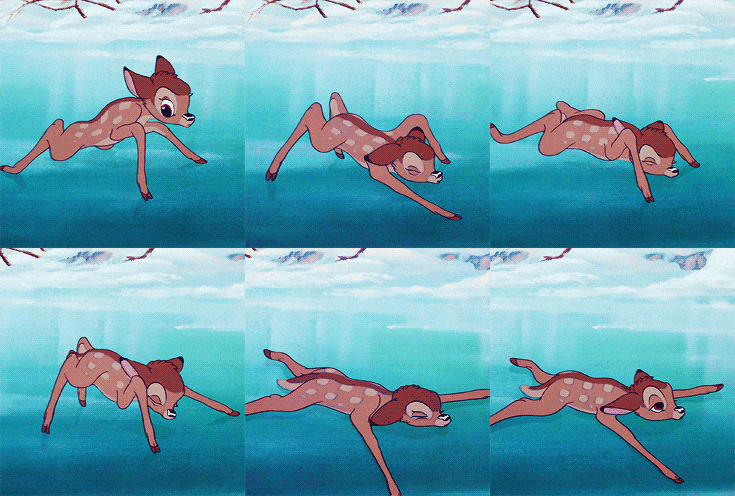
However, these feelings can be paralytic. This is where I read about people going through what I am, always insisting to the blogger-- no, it's worse than everybody else's! I can't physically move, there's a weight on my chest, it's hard to breathe, my heartbeat is sluggish or feels like it's stopped, I'm numb. I used to be one of those insistent assholes so I'm calling your bluff. Despite loving my friends, my social anxiety doesn't just extend to stepping foot outside but to them as well. Despite the heaviness or chronic pain flareups, I can put one foot in front of the other (even if the results are a bit Bambiesque).

I'm pretty sure Hemingway wrestled Bambi too.

In these long slumps, unmedicated and encapsulated eternities, it can all feel pointless and hopeless, but it's not. I'm not irreparable, I'm not worthless, and I have to fight the damn goblins with those platitudes to the point of exhaustion, but guys, they're only as 'real' as we encourage them to be. For many of us, the price of immersion and imagination, the mania of it, just has an undesirable downside. I've even said I would trade the ridiculous highs for a serene middle ground, but that's also not a choice. How dare I simplify a complex problem? Well, would you rather give it validation to continue or kick its ass and belittle it? I'm a nurturer, but when it comes to negativity, I'll be a sadist any day.

Get out your gimp mask, depression; you're MY bitch now.

I know that it's not about choosing your attitude. I'm not belittling it that way. But I am saying you have to stop treating yourself like you're so precious too. What? You hate yourself and all you do? How is that precious? How is contemplating ending it all precious?  Even with your survival instincts going full retard, it's there and it's not valuable like hope. It's dismissive and catastrophic. It's telling you to nurse your pain and wallow in it because it makes you deep and strong. Like a vagina. You're a pussy. No matter how you feel about those words or their connotations, the fact is you're reducing your own potential to heal, becoming one piece of yourself when you're better than that.


Also, don't be a dick! Unfortunately, there are zero pictures of people giving a thumbs-up that don't look like total tools.

It took years to admit that those stupid exercises the therapist had given-- take a walk, don't eat garbage comfort foods, focus on breathing-- all of them were legit parts of ending sabotage loops, treating myself like I matter so I'm not encouraging more self-destruction and health issues to feel sorry for myself with. If you're still thinking about editing in this state, it may actually be valuable, but don't neglect self-care, don't use it as an excuse, don't make big permanent changes, and be okay with reducing your workload even if you are used to being a full time writer. Again, these are the sort of don't's integral towards my experience but do try them anyway. Also, probably don't confuse this with burnout for writing. I don't know if this is what people refer to as burnout because I know it's neither about the writing nor the passion or it wouldn't make sense to pine to write again, but no matter what depression or anxiety latches on to, this specific burnout isn't only solved by being able to work.

(*I'm going to add here that my perception of real burnout tends to be a complete revulsion or disillusionment, a lack of finding any value, not just enjoyment or state of mind. Burnout is something that you see in retrospect-- where you walk away and don't come back after an extended period of time. Perhaps this is why we fear it. The distance had to be established to realize it's not just a regular block.)

Writer's block?
 Facts-- while I haven't been able to pen my creative projects with any success, it does make me turn to blogging for introspection. I have been able to edit in short bursts (I do have more advice on this coming up). I'm hiding it from my friends, even though I probably shouldn't. Everything I do requires exhaustive effort but doing nothing is worse. So how do I function?

Not writer's block.
Well, I started by trying to find the emotional connection with my work, but it's pointless (try anyway). If I insist on loving it, I'll fail and get frustrated and it won't happen. Guess what? Don't need it. Instead, I do some joyless line editing. Look for grammar issues. It's a perfect time to outline because you're better able to be concise, grab important story points rather than thinking everything is important. This is where I do continuity checks, look at vocabulary, decide what points I might want to revisit later, creating turning points or Easter eggs.

And yes, because it's loveless, there is no marathon editing. I'm lucky if I can pump in two hours at a time. However, when I'm in a state where getting up to pee or eat is a huge effort, I'm not going to get militant with any other aspect of my life either. 

I might be talking semantics, but I'm not *really* saying force it. One of the reasons I juggle projects is because I often have to juggle basic needs with great effort. 'Nudge things around' is more like it. Shuffle it around. You're not trying to force it or snap out of it or even beat it out of yourself (no, Krista, no more misleadingly hot pictures of sadism). You want to be as firm as you can muster, which requires caution but diligence nonetheless. I know-- it's not easy. It's the hardest thing you will ever do in that moment. But you matter enough to try.

One thing about my issues is that I avoid medication at all costs. I have addiction in my past (present and future, but I'm not abusing/using now) and the side effects are worse than the problem. So yes, holistic means I have to feel the whole damn thing, not just the tip.
I'm trying to be serious, I promise on my pinky. But just the tip.

Medication numbed it but it also made me numb and apathetic and immobile. If you benefit from medicine, make sure you're keeping that a part of your self-care routine. Be an advocate against being a guinea pig if it's just slowly destroying you. This isn't a one-size-fits-all. It actually took my friends and family to point out I was getting much worse. Please make sure you have a support system that can point out how medication is affecting you because you might be too zombified to see it.

Being open to yourself about what you're feeling and what you need is a big part of learning how to walk yourself through a slump/depression. And I know the lows are terrifying and make you feel fragile and they ARE dangerous. We just don't always know what will trigger us into giving up. Celebrity and success clearly doesn't make you immune. It's okay to ignore social media or refuse to look at reviews or critiques, to avoid bad vibes or the risk. However, I do insist you find a way to exercise, mind your diet and kick away your crutches. Limp around, wobble and fall, but you CAN move. I'm not speaking from a pedestal or a safe place. I'm even more certain that you need tell yourself this at ground zero.

Regardless of whether the setback is mild or severe, you can't really actively get rid of it. There's no magic pill, no revolutionary workout, no epiphany from the work you love. Or at least, don't count on it. Because there COULD be is reason enough to work too!

But if you insist on throwing your money at something, I might have a pill to sell you. #shameless
 While there may be exceptions to what works, don't be afraid to try. Be an idea factory, write short prompts or scenes, blog, throw darts at pictures of people you don't like, stay in pajamas but still wander around the neighborhood. Because lying there, leaking and whimpering, only makes it worse. Don't nurse and encourage that fragility. Make yourself cry or get angry. Keep your lows an active forward-moving slump and maybe your work will benefit too.

There are a lot of factors involved though. The discipline may include long term attention to care, to coming to terms with setbacks, forgiving yourself the trickle of productivity. Just keep in mind that whether you're a long suffering depressive or one of them rare normal Pokemon that just isn't aligning to the task, there are methods to try.

For the last time-- not a Pokémon!
Find your strengths in your weaknesses and you'll get there.

Really, I hope I could make you laugh and cry at the same time. When you're all up in your serious feelings, a sense of humor-- I can't emphasize this enough-- is VERY valuable. I know some people like to watch sad movies, to get some good crying in, but I usually prefer a comedy, the stupider the better,  so I can look absolutely insane with the whole bucket of emotion.

Plus, inappropriate laughter is always the most therapeutic.
So yes-- edit when you're down too. Distancing yourself from things for fear of ruining them with your stupid, worthless, unenthusiastic, uninspired garbage is the exact opposite of what your work needs. If you want to be a dimensional writer, then don't tell yourself you need to be anything. You also don't need more layers to be deep. It's possible to write a phenomenal book when you're in total control; it's possible to write one when you're a hot mess. It's not the amount of strife that makes you deep or interesting, it's how you incorporate yourself into it. I get it; you don't want your sob story leaking into your strong themes. Again, when you can't trust the emotional aspect, you're still ridiculously capable of finding focus through surrendering to apathy. Rather than being critical of content or tone, remember to be a boring grammar nerd or a fact-finding vulture.

You're never completely useless, I promise you. Every aspect of humanity is tailored into a creative pursuit. There will be days when you can go above and beyond, days where you can meet expectation. So expect many many days of slumps too-- just... well...

MAKE THEM YOUR BITCH!