Showing posts with label integrity. Show all posts

Wednesday, August 29, 2018

Selfish

Me. I'm selfish. I'm proud of that because I'm not using it in the same vilified sense that it gets injected into an insult.

My work comes first.

Also something you're probably not getting the context of because I haven't established any. I'm not one of those people that lives to work and the 8-hour work day is not the most productive once you look into it. Sitting at a computer all day is also a bad idea. Those 10 minute breaks every hour where I seem like I'm idling or procrastinating (when I'd rather be writing or drawing)-- those are there for the sake of this ideal of actual productivity.

It's true enough that most days I spend about 10-12 hours easy on work but it's all spread out over my waking moments (and sometimes perched around a nap when I'm really failing at real productivity). I don't ever take real vacations, but I play pretend and intentionally use that infuriating little 'stay-cation' word with a shit-eating grin to show you I know exactly how annoying it is.

I raise my nephews. (Like a boss.) I walk two hours a day. (Like a boss.) I have a social life so rare, it's still mooing.
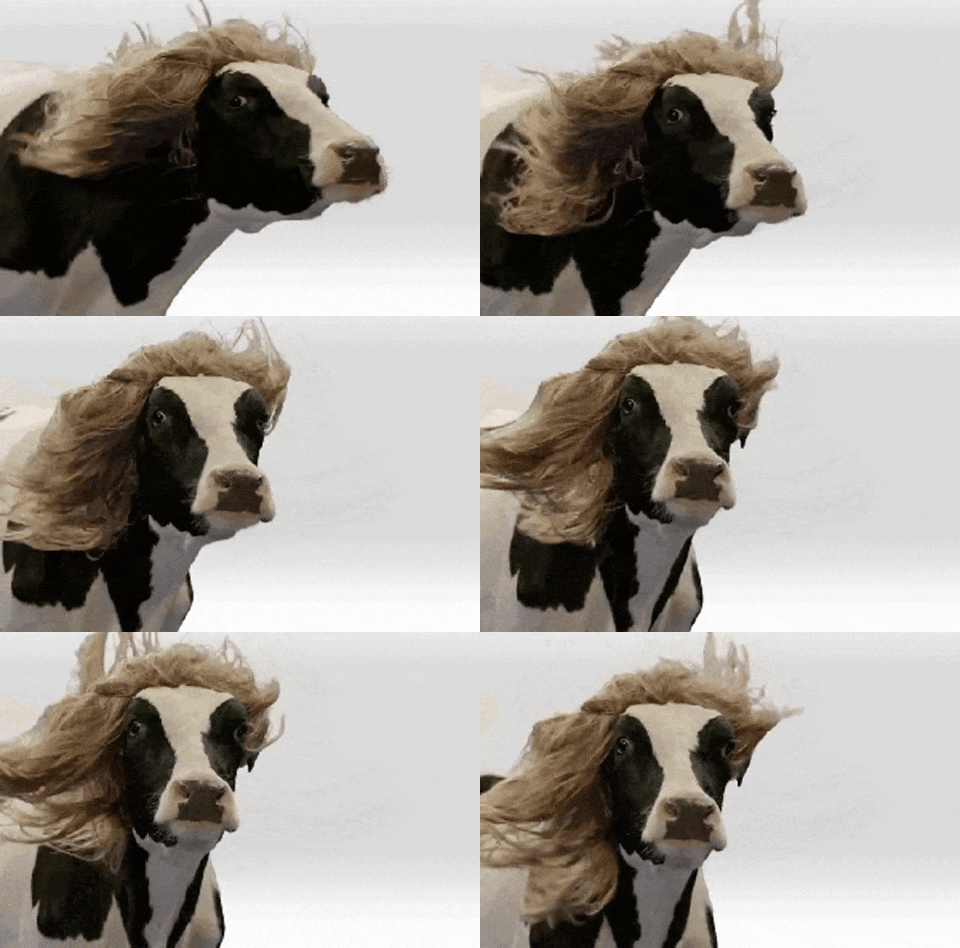
(Like a cow.)
It's cool. I love the little guys, I don't hate walking, and I also have the coolest most understanding friends who get what creativity entails. They've all seen my room and wonder what Narnia vomited its idea of interior design into such a small space. 'Selfish' is what it took to chase the dream, but I've sacrificed. I pray to the tech gods that my shit won't break because I'm pretty broke and nothing is easy to replace. I miss when I could just go ahead and call someone up because I'm bored and I want to hang out with someone. Most days, my head is so into what I need to do that I plan social visits just so I can be sure I'm actually present and NOT thinking about what's waiting at home.

Work comes first, but to be honest, first place isn't a static factor or at the least, a lot of things share it simultaneously. It's possible to feed a hungry nephew while daydreaming what I stopped writing about and it's oddly possible to have a conversation with them sometimes while drawing (although it's also very likely I'll let slip what I'm doing in PhotoShop instead of what I actually meant to say). It's not exactly the most coherent or fully present version of me but it's a compromise. There was a time I'm not particularly proud of where I'd yell at any interruption or use the possibility of being interrupted as an excuse not to work at all. My nephews are at least old enough now that they're polite about interrupting and even supportive of what it takes to do it.

Gone are the days of putting myself last. It's not just society that makes women feel like it's okay to be self-sacrificing in terms of domestic or nurturing instincts-- sometimes it just exists in us and it's something we have to correct if it doesn't align with our ambitions. Women are encouraged plenty to embrace their nature and we can access self-empowerment without permission so I never blamed men or society for retreating into instincts against my primary ambitions. I also don't regret not going to college sooner or being who I've needed to be to balance raising kids and still being a creative powerhouse. I don't pretend my life is harder or easier than it is and I own the ups and downs. I'm okay with not fitting into liberal or conservative boxes. There are more than enough breeders and homemakers and laser-minded career bitches, etc. Human survival is not at risk for lack of any type of person. I'm okay with swatting flies coming at all sides.

Women like Christina Hoff Sommers exist. Level-headed and self-possessed people who operate with integrity, who push ahead with a clear voice and infinite patience. We live in a country that doesn't quite understand that true acceptance is within and too often it's an outcry for more boxes and less actual freedom of choice for anyone. It's less about respect and more about power/control over strangers. Expectations for the world around you are becoming the greatest source of misery in a country that should actually be flourishing. Who we project ourselves to be is just as vital as who we are. I can't tell you how often I see people completely baffled that they aren't seen as good people because they have 'good hearts' when they actually aren't aware that outwardly, they're projecting their worst defensive traits rather than their ideal. You know, like the 'nice guys' that feel entitled to the world's most 'beautiful' women simply by virtue of having a penis. Lack of self-awareness and entitlement is an ugly trap.

I get how hard it is to be yourself and I'm going to deviate from my original topic a bit because this just in: sometimes people suck. Today, I had to be polite to a man I wanted to punch in the face. I was out walking and saw this guy ahead of me, so I didn't think much of it. I turned down a street and no one was behind me-- until I noticed a shadow picking up speed behind me. I was almost immediately afraid because it was the guy who had been walking ahead of me before but I smiled despite the urge to scream 'creep!'. Not only did I thank him (with clear reluctance and no smiling) when he said I was 'cute' but I gave yes or no answers when he was asking personal questions because the details weren't really any of his business, but I wasn't sure if it would be safe to look away. I hated it, but I also didn't know what kind of psycho I could be dealing with who thinks approaching a strange woman like this was okay. I kept trying to put my earbuds back into my ears in a nervous gesture to signal I didn't want to talk but instead he asked me if I wanted to make five dollars. I had no idea if this was about drugs or sex but I doubted he really thought I was 'cute' but just trying to flatter me into doing something I didn't want to do (and I was insulted that I looked like I'm hard-up for five fucking dollars, possibly). I sped up past him and still I could hear him trying to press me to change my mind. In my mind, all I could think was 'go the fuck away' and' please don't stab me'. Or worse. I wasn't entirely convinced broad daylight or even the risk of neighbors coming to my aid was a deterrent at this point.

I was never more relieved when he gave up, but for the rest of the walk, I kept looking behind me and I never really relaxed. I didn't go home though. I was angry and I didn't want this to mean I'd be too afraid to leave my own house. Look, anything can happen out there. I'm always aware of that. Because of that, sometimes we don't survive by being 'real.' We have to forgive ourselves for what we lose sometimes to see another day (or greet another day without the shame of regret for what we didn't do). There's no manual, and we can't 'have it all' but coming up with a strategy for self-acceptance and survival is worth it. Locking yourself up in safe spaces isn't going to keep you safe from it all either, so risks are necessary to properly understand what is worth trying for.

Writing and drawing, they have their ups and downs too. It can be maddening and isolating if you are able to lock yourself away into it. People see working up to full-time writing as some utopia but it can be abused to self-destruction too if you don't exercise boundaries with it too. You can have too much of a good thing. You can lose a good thing if you take it for granted. Such is life.

Enjoying selfishness is a responsibility, but one you don't have to feel guilt for. Regret? Now there's something that can haunt you. Before I learned that missed opportunities aren't always the end of the world, I knew the sting. It's also useless to let them stick around rent-free. Writing does give me a good place to channel them, but writing is also not about me. Once I pass the baton to a character or a story, it's not about telling my story (because some of it is just not that exciting)-- it's about telling their story and detaching from the consequences and triumphs alike. At some point, I'm just their completely useless therapist, cashing in on how well I turn their life into a book.

Benevolent. Selfish. Hard-working. It's whatever. Just do what it takes to like yourself.
I blame the cow with the incredible hair.

Thursday, July 5, 2018

Why You Go Ahead and Publish

You've completed your novel! No mean feat! For first timers, it feels like it's in the bag, so you start looking for the lucky agent/publisher who has the opportunity of a lifetime to cash in on your bestseller.

High as a kite on aspiration, your fingers float over the keyboard. You type something to the effect of 'publishing' into that search bar.

Huh, editing... Well, I guess I did that. I ran spell checker after every chapter for sure! Professional? Yikes, how about self-editing? Ouch, steep curve... No wonder some people pay someone else.

Formatting... (And you thought editing was a curve...)

Beta readers? Can I trust my precious to just anyone? If I like it, someone else will, right? No guaranteed feedback. Should I get an NDA? 

Brain freeze! Wait, I'm drinking hot coffee...

Let's suppose you get past the intimidation of the basics. You formatted, edited, read it to the point where there's nothing left to nitpick. Still, something just never feels right. You find a misspelled word in the first chapter--ugh, it's ruined. You edit again-- ugh, you hate that dialogue, that character, why did you give that a pass? You dismantle, you rearrange, you rewrite.

Guess what? You're probably ready. For what, I can't say. If you don't have the confidence yet to put a value on it, you have to know that most authors,,even best selling ones, never love their work when they took the leap of faith and never looked at it since. They often need fans to even help them revive the memory of it.

Wait, shouldn't they know it like the back of their hand? Funny how accurate that saying is. Try drawing the back of your hand from memory. No peeking. Even when I tell you to draw it while looking, you'll probably look constantly as you do. Let's say you have a photographic memory or you truly memorized the back of your hand because you're kind of an asshole (don't worry; I've done it just to debunk an argument too). The recall of even a pristine memory is often very clinical, devoid of emotion in order to exact perfect recall of the visual. Something gives. Your mood, your confidence, your nerve, your dog ate your hard drive, what novel? The point is, your novel is not sentient. Although I would love to see you write a book to that effect, you're probably looking for an out that isn't really rational.

Name any famous author. Their work is shit. What about--? Yup, them too. Because any famous author is just not someone else's favorite. There is no universally beloved author. None that come close even have an entire don't of work that can do no wrong. They've cashed in on their fame, become hated on Twitter... Well, you would trade in fame for a small, loving fan base anyway. Ooo, you want a hugbox? Do you think trolls are less evil when they find you? Oh ho ho, no no no no...

I'm not here to frighten you away from this. To make fans and friends, the work has to get out there and that means trolls and assholes too. You'll get passive aggressives that insinuate how similar your work is to someone else (coughripoffcough) too. Oh, give you a troll over the crusty grey assholes any day. 

Just ask yourself if you're ever going to burn this manuscript or if you'll pine over the what-ifs. Ask yourself if you're truly a storyteller or just a rabid fanchild. 

Why do you publish? Because you know its value. Because you're ready. Because you have more stories to tell and this one is just the beginning of a pattern of completion you're setting. I can't give you that answer, but in this day and age, with all that's available to you?

Because you fucking can.

You can also pull it, learn from it, grow from it. This is for YOU to decide. Scary, wonderful, terrible, terrific, yours.

Tuesday, June 19, 2018

Manspread All Up In That Story

One thing I've always felt strongly about is this: if it's good for the goose, it's good for the gander. In no particular order. I'm a proponent of equality in that I don't think that any perceived oppression somehow means that one side receives the okay to a privilege at the loss of someone else. If there aren't enough toys for the whole class, no one gets to play. The idea that X amount of resources get rotated in time allotments always means someone is happy at another's expense. A good solution is one that works for everyone. You only need one kickball to get everyone in the game.

Writing groups can fester with us vs. them debates and what men are allowed to write about women's bodies is often nitpicked, completely ignoring the entire domination of the romance and man-meat genre by women. Not even a new genre, making a mark before self-publishing could make it explode with popularity.

I get inside the heads of all my characters, keeping in mind both the prevalence of gendered psychology and individual variety. Men can be poetic and reserved, even in their heads, where women can be aggressive and fixated on looks-- there's no dominion here but there's also a reason why those aren't the norm. Men are more prevalently visual in their affections, with a woman's curves, a thing the average man lacks, a point of attraction and mystique. This doesn't put women at a disadvantage in their norm; ladies, our bodies are built with more emotional and physical receptors, making us creatures of touch. While on average, it's easier for a man to have visual priorities satisfied, women who warm up to their desires are introduced to a lengthier and more lasting fulfillment.

Women and men can both experience physical attractions and casual satisfaction. They can both be sexual predators, taking what they feel like they deserve. Physically a man can easily overpower a woman, but women can use manipulation of a man's virility and expectation to perform to coerce their wants. It's a deeper subject than I will be able to give justice to here, but the possibilities do require some thought before assumptions are thrown around.

Where does man-spreading come in? Often, in the heads of men I write, they are engaging in the dreaded male gaze, the pure physical enjoyment of a woman, whether they entertain courtship or something more temporary. I realize the reader on first impression may jump to fast assumptions: he's a pig, he's shallow, he's typical. However, if all it ever amounted to was a first impression, I'm a poor writer. With first impressions, it is often about core traits, something either formed by society's expectations of them or even something that embarrasses them and are glad it's safely in their heads-- at least unless it tumbles out, then it's another issue for the telling.

Well, women are not exempt, as I've said before. Their thought processes and experience are sometimes different beasts as well and on the other side of the coin, they may blurt out their empowered come-on proudly as well. And there's something that bothers me about the modern attitudes that frame that wording too. Is it really an empowered come-on or is she just a pig too? My fantasy worlds may not carry any of our standards, so what remains is to give you the weight of it in the cues of reactions and internal dialogue. You could launch into a preachy monologue about 'society's weight means this and that to men and women.' Wait, maybe not. Boring, boring, boring and you just abandoned your fantasy into the realm of non-fiction. 

What remains is finding the lead without dragging the reader by their nostrils. It's possible that their aggression is still frowned upon, but it's also possible they don't care and are prepared to brush off anything that stands to shame them. Without any more details, you don't know the weight their gender places nor can you clearly say they are looking for consent or predatory. They might not even know the lines, a conflict of self-perception or a lack of a measure to compare their actions. However, give it a gender and the reader is more prepared to impose their own experiences first, at least until the writer can shed some light on the way the character works.

This is why I encourage writers to focus on the character, not about the sensitivity of potential readers. When you are focusing your craft at the mastery of your story, I trust that most writers are addressing how to present the conditions with deeper thought than I've grazed over here. Most of us are not fond of the things our protags/antags do to maneuver through, but if everything is fade to black, it looks lazy, generic and scared of itself without letting the reader in on why. Sometimes your fear is preempting the point before it even gets made. It happens too often that a writer asks if an idea is okay before it's even written. The thing is, your description shows nothing of the effort it takes to accurately decide if it works or not. What if I rewrote Harry Potter with a female lead? I don't know-- are you writing it as Hermione, Harriet Potter or Voldemorticia? Without the actual act of using your voice and storytelling ability, it's a two cent idea.

Whatever you do to tell your story, it must be written first. Don't be afraid to write women as a male. You will have opportunities to find out what is working for people as you go. As a woman, I don't try to make a man 'me plus a penis.' I don't know what men face, I don't assume they can operate with my advantages or disadvantages. I don't discount that they can be sensitive but I'm not going to force it either.

When I say I manspread over a story, it's tongue in cheek. Just like I can enjoy a nice female ass, they can too. I've got big old writing balls that I can't bear to crush between crossed legs.

As always, I may not have covered all of the bases, but UnSung is getting damned good and the bulk of my brainpower goes there first and foremost. Argue it or take it in stride, but as always, I strive to let people know that trends bloom and die-- give your story a limited forum at your own risk. Own it, grow it, release it.

Wednesday, March 7, 2018

Are You Word Shy?

Two posts in one day, but this one is directly inspired from a post about using little known words in your story.

Do you ever catch yourself wondering whether you should dumb down a word so that you don't lose an audience? I'm not going to tell you one way or the other whether your supposed audience should be considered or not, but I have a thing or two to saying about dumbing down.

#1, don't.

You probably have a special knowledge on a subject that means you sound like you're speaking a foreign language to most of us, but don't give up a big money word just because it isn't well-known. In this case, the poster wondered how knowledgeable her audience might be about a horse term. In this case, it was a perfect fit and omitting it would mean having to explain it. When you do this, you run the risk of infantilizing your audience. You may need to boost the context around it or just let your audience look it up and see why the word fits so well. I encourage you to throw in your special vocabulary and educate your audience... in small doses. Use the big word, then use a better known word to lead them. Don't omit them all out of fear. Let your audience grow into the knowledge that excites you and it can pay off.

On the flipside, I will agree that the reverse, using big words that you don't usually use, is usually a bad idea. The temptation to sound smarter or more diverse often drowns out your voice, the natural flow of your story, and looks very much like you've just discovered the wonders of a thesaurus. By all means, tap into your Word of the Day on occasion, but don't risk looking pretentious by filtering in words that don't fit your voice. When that day comes to address the fanbase you've worked so hard for, don't walk in making them expect a scholar and ending up with a grade school primer with a few pages torn out. Represent the talented storyteller that wrote the books. In fact, wow them a bit if you can. Don't build a house of cards and then show up with gum wrappers.

There's my two cents on that. I believe that novices always go in with shaky knees and a lot of questions. Take all tips with a grain of salt, knowing that your experience will be unique. Simply be aware of the consequences you could face. It takes gobs of confidence to win every small step forward, so make your steps with a solid base of consideration.

Thanks for reading and keep writing! I always try to help my fellow writers and authors build so don't be a stranger.

Monday, November 20, 2017

Word Counts and Motivation

Sometimes, like with weight loss, people get a little too obsessed with the numbers in writing. Can't say I haven't been there, but it's an old habit from my college days and one I don't feel inhibits the process.

The guideline for most fiction novels is widely stated to be 80K, which I always hold to be the minimum especially on the first book in a series.  Fantasy is usually given the green light for 120K or more. Intermediate children's books and pulp romance often ends up as low as 35K. If you're self-publishing, psh, the max page count of whatever service you use is really the only limit. I think CreateSpace's limit is in the 700-something page range, which even at a big font with adequate spacing can still put you past 300K to accomplish so it's hardly a limit unless you're trying to squish up a big compilation into one volume.

Math, sorry... but it's important math for any aspiring author. The limits I mention outside of self-publishing are where you're looking to land for traditional publishers and agents. You'll notice a big series like Harry Potter started off modest, but once Rowling got the green light, those books got much bigger. Nevertheless, if you're looking to take advantage of traditional publishing to market you, knowing the standards is important in the beginning.  Your first book is your business card so they want to see you can both write a decent novel-length story and not take up gobs of their time while they are actively seeing if you're worth taking out of the slush pile.

Word counts, though; what else are they good for? I like to use them to get a good feel for how I want to divide up scenes. In UnNamed, I introduced a lot of side characters that needed a face. I wrote the bulk of the book, made it to about 76.5K words and decided to go back and humanize some of those characters. So I set a word count on the five characters that needed a little boost, giving each of them an approximate scene addition of 2K each. I did the same for the epilogue at the end-- get it up to about 5K.

It seems to be a common writer issue where some writers just get too beefy.  I believe King has a personal rule of 'first draft - 10%', meaning if his draft is at 100K, he makes it a point to chop about 10K. However, all of my works aren't built the same and I often find my first counts underwhelming while I'm pounding through central ideas.  Some scenes get colorful and detailed, others read like 'there's this guy and he's gonna be important but we'll come back to that'. 

While I was poring through my first draft, I found it much more productive to mark spots where I could elaborate without too much side-tracking, once I'd gotten to know their roles better over the course of that first sweep. I didn't take time dissecting chapter counts or parts.  Part I is substantial.  Part II is definitely the biggest, and Part III?  Pretty little actually; more like a chapter than anything. However, the division I chose holds importance in the flow.  The epilogue was reserved for leading the end of this book into the next, so it's pretty much a separate story with a few familiar faces popping up.

I do like to break convention, but I certainly don't go out of my way to do it. Generally, I can agree that you shouldn't be a slave to word count. However, you do have to consider what you want for your work. If you're free or self-publishing, obviously you have more freedom to toss around. There are plenty of authors who use free publishing but make a killing on donations. I wouldn't expect this to be the norm unless you do have a day-job that pays the bills. The popularity of your work is never guaranteed, so how you brand your work can be a part of whether it succeeds or fails.  Some works are successful giving your audience the ability to choose your worth. It's not typical and it can look like a lack of confidence, but that sort of perception can clearly be countered. Put a price on something and you have different concerns, such as the piracy of your work, whether people think it's fairly priced, etc. Back to word count here, but popularity can also depend on length.  You may want to consider whether your target audience likes short bits or epic tomes. This may not exactly be a matter of word count, but if you're finding it slow-moving, this may come up in reviews or comments.

Let's switch over to a little motivation...  A lot of people seem to wonder where I get it from. I've been a squishy can of worms, hesitating on getting anything done for years.  I called it a block but the ideas were always there; the confidence, not so much. Did I have the right words?  The right skills in art?  Even after achieving two degrees in graphic design with honors, I had those days where I questioned my abilities. I couldn't improve when I wasn't finishing anything and I wasn't improving or sharing. Even lacking confidence, I just wanted to share SOMETHING, anything. Starting small can help you warm up into a workflow and confidence.

Plenty of writers get jealous over 'lazy successes' (like poorly written novels like Twilight and 50 Shades or short poorly-drawn comics about everyday life). I've been there, but in some ways it's been motivational.  You do want to keep your integrity and your visions, of course, but frequency can play a role.  For some of us, those short stories and short comics STILL take up gobs of time, but not so much as the big projects and they offer exposure. You may want to take advantage of some of those exposure sites for your smaller works: DeviantArt, Soundcloud, Line WebToon, Wattpad, all great places for artists to protect and post projects of any size to drum up interest. Yes, it can be extremely unnerving when you start comparing successes or telling yourself you might deserve it more, but these people are often lucky or just diverse enough that something strikes gold on the many, many social outlets they use to find their audience. Until you create a demand, those months and years of working on bigger projects aren't going to guarantee your successes, but they will have valuable lessons. You can keep striking until the iron is hot, but if you lose motivation, you may need to make some mini-breaks to refresh your course. Shorter competitions, awards, there are plenty of other things to work for while trying to find that coveted fanbase.

That doesn't mean you have to work for that eye-rolling 'exposure'. You'll always get people that think they can define the value of that for you and those people are usually looking to benefit from your work while subtly devaluing you and exploiting it for their own purposes.  YOU decide what exposure will be valuable. Your best bet is to use protected public social sites, some with the incentive of income opportunities if you achieve a certain number of subscribers.  Don't do 'exposure' work if you can't afford it, either in time or money. Don't be so eager to slap your name on everything if you don't feel it will benefit your goals.  You'll find that motivation is much harder to come by when you're slave to what someone else thinks you should be doing.  Do those things if you're curious or stand to gain something from the experience.  

One thing I always found discouraging was leaping into a project that someone else was way more excited about. It's not that I don't have interest in collaborating with some people; if they are patient, often I will find the inspiration after my own priorities are taken care of. Currently I have a handful of solo projects that may keep me very busy for a couple of years. If someone has put an idea by me that I really like, it can take years for me to get back to them. If your one big passion project relies on someone else to collaborate with you, you may want to take on some smaller projects rather than badgering them. Hell, it might influence them to get on board sooner if they see you are actively working on improving too.  Some of us just get worried we'll get suckered into work where we're doing most of the actual labor involved.  That can be anti-motivational. 

If you have a proposal, write it out, plan the project with division of labor considering the amount of time everyone might be putting in, even the division of pay in accordance with the effort. You might be screwing yourself out of a working partner if you want 50/50 but your output is 80/20. It's always helpful to an artist if you have a solid grasp of these things before wanting to dive in. For one person, it may just be an idea they've been playing with, but the other person may need some solid motivation to rely on someone else.

You can find motivation everywhere, some things very simple like a soundtrack while you're working but other things might include security and contracts. Everything about creation is not flighty and fun, but you don't want it to be just work either.  Motivation can often be about adjusting expectations. If you've been working too hard, you may need to make it lighter so you don't burn out or you may need a break altogether.  If you feel things have been moving too slow or you're not doing enough, you may need to restructure and reprioritize to achieve some of the things that aren't progressing. Motivation to do one thing is sometimes about stepping away until those ideas you want so badly come back to you. Even the most well-planned projects can peter out. Even with deadlines, try to plan for those. I usually give deadlines twice the actual project time it will take. If there are any setbacks, blocks or breaks needed, that is what I make the time allowance for.  Sometimes I can be a machine and get something done in the shorter time, but stress to finish can be a motivational killer.

In personal news and to finish up, UnNamed is pretty much wrapped up during NaNoWriMo, putting my final WC at nearly 90K with nearly 55K done for NNWM itself. I'm hoping my readers/fans/ family will support the campaign to get publishers interested in my work. Production values will get bumped up from my current self-publishing projects and I hope I can start getting some bonus swag going for early adopters. What I can offer my readers will increase with my ability to financially invest in my projects, so as always, if you want to see what an artist is capable of, be sure to donate or preorder!  I'm excited to get things moving.  

Thanks for reading and keep writing.

Tuesday, November 7, 2017

LGBT+ and Its Presence in Fiction

An author friend of mine, Amelia Faulkner, posted a very insightful article by Han Hirschi titled "Why Writing LGBT Stories Doesn't Make You a Part of the LGBT Community." I'm not going to rehash it, but if it's a topic of curiosity, do check out this opinion piece and feel free to talk about it...

What did interest me aside from that were the comments and discussion, which these articles/posts are meant to do.

I haven't ever really discussed my impression of stories like 50 Shades that got similar flack for what communities often address: inaccuracy and inclusion.  It seems to be a common offense in the LGBT community-- if you're not one of us don't write about us.

Keep in mind that you could BE one of those letters and some people will still find offense. There is the general jab to NOT write outside your letter or you're basically writing as an "ally" which some people feel are outside of the community.

This is precisely why, as a writer and author, I don't feel particularly fond of writing 'as a representative' and make it clear that I have no interest in a hive mind mentality.  Everyone needs allies, even if they tend to step on toes by not having 'the same struggle.'  Who does? I certainly don't adopt the struggles of all white women of questionable preference and eclectic fandoms.

Whether you like it or not, fantasy is just that.  It is not meant to be inclusive or factual, nor particularly accurate, even when some attempt is made to give it a basis in logic. It is sometimes written with a broad audience in mind, sometimes just appealing to a handful.  Fiction is meant to be daring and offer a writer's unique take and perspective.  Nevertheless, it is entertainment, first and foremost, and was never meant to be held to the standards of nonfiction where facts and accuracy carry far more weight.

So when I see someone is offended, I do consider where they are coming from, but if they are in attack mode, they are far less sympathetic. Being offended is their choice and chances are it is coming from a sincere place.  Yet, as Dave Chappelle said, how far can total strangers be expected to adopt the quirks of someone's identity? Is it not far better that there is an attempt to be empathetic or interested than it is to avoid addressing anything so people can feel 'safe'?

I have seen many 'safe' works and they end up being far more offensive or bland due to the lack of anyone challenging anything.  What makes up one person's interest and take on fantasy is not going to be good for everyone.  Even in genres, you'll get people who balk at being challenged as to what 'belongs' there.

Yes, books like 50 Shades can be controversial in their poor examples of actual BDSM (and let's not forget-- it is definitely a literary nightmare, being poorly written).  BDSM communities were quick to jump its shit, domestic abuse and mental health advocates were quick to explain that the Ana chick was a victim, but I think over the course of controversy, we forget one thing.

It is fiction, whether you like it or not.  It is good to facilitate those discussions, but I wouldn't lose sleep over it. Whatever personal or professional reasons you have, don't deny writers their voice or try to intimidate them away from that outlet.

On a side note, if anyone feels I am abrasive, understand that you missed my intent. I can be brash and honest, but I never give any advice or opinion as if the mike is dropped and no more needs to be said.  By all means, challenge me, but keep in mind, I lose enough sleep on creative endeavors. I won't be drawn into useless feels over opinions, but I will gladly lose sleep over intelligent discussion.

Wish I could cite some more LGBT examples.  The mentioned friend does write queer male stories as a bisexual woman, so if that's your thing, do check it out!  Gotta pick up my nephews, so if I have more to add specifically on LGBT+, I'll update it after some coffee.

-----

Just a little more to add. I did want to go back to at least weighing in on the article. There was a lot of emphasis in one section where the poster is adamant that heterosexuals (and a side note including whether asexuals or aromantics 'belong.') Maybe it is true that it is 'problematic' when they consider themselves part of that community when they can be seen as 'the enemy' or an 'abnormality.' Still, you have to consider that their sympathies mean that they often don't fit where you think they should go, especially among homophobes or the very questionable grey areas of the ever-debated asexual spectrum. There are plenty of people whose comfort zone doesn't get a nice little label. Hell, maybe they can't identify or have an underlying mental illness they aren't completely aware of. In trying to force them into a box, it doesn't do them any favors. I get it if you don't want those people to speak for you, but even in the comfort of a community, 'your' people will try to do just that.  It is better to weigh in on their actual intent rather inject your own general bias, is it not? No one likes assumptions.  Opinions are fine, but always speak for yourself.  Even when you are asked to speak for someone less courageous, be prepared for them to disagree.

Be good to each other whenever possible and keep writing!

Monday, November 6, 2017

"I Cry With My Characters" and Other Shit Writers Say

First off, I don't want people to think I'm out to bash other writers and I intend to keep these examples anonymous. I'm in a number of writing groups across social media, so I get to hear some real gems, most of them starting with 'is it just me or--'?  Stop that right now.  It's never just you, snowflake, grasshopper, natural woman.

Let's start with the post heading!  Whee!  I get this one a lot-- "I'm just bawling over here, playing this song over and over on loop...  I'm crying with my character...  My poor readers and character, what have I done?' which is verbatim of no one, no worries, but the collective idea in a nutshell.  It's not uncommon that I get a little teary-eyed or come up on some nail-biting action, etc. but there are undertones of this being essential to the process.  It's isn't.  In fact, it often feels sloppy and I know for a fact I'm going to have my hands full editing that blubbering mess.  Emotions are always essential in creative work, but I'm not willing to buy into it being the only way to write.  I am often without general empathy, only capable of showing concern for people I am personally close to.  However, I firmly believe that ALL writers, with limited empathy or not, DO create a bond with their characters, even going so far as to living in that body when they do.  When my mother passed, I often had no tears to cry and uncontrollable weeping was less a release than quiet contemplative pain.  I'm not saying that my way is the correct way, but it did make me ridiculously curious.

Writers out there, do you feel like you have to emote to write an emotional scene? Do you find that it's a bigger mess to clean up when you do?  Can you write the rawness better in retrospect?

"I'm writing this scene for my story-- even though it's crazily exact on Google, tell me the procedure you would take without having an opinion."  Is it just me or does this end up with a lot of 'you're so detailed' and parroting the exact same Wiki entries with no actual creative elaboration or collaboration. I'll admit, we writers can be an egotistical lot, but the humble brags and roundabouts are really transparent. I like the outright honesty of "I'm really excited I'm writing out this scene like this and I hope you enjoy it as much as I did."  Otherwise, it feels like clickbait. She put WHAT in her throat and you'll never guess what came back out!? Naaaaahhhhh...

I l-l-l-love encouraging writers, but if you humble yourself or at least be honest, I will be the first to put you on a pedestal for your courage. I once told a co-worker to ease up on patting himself on the back. He asked me who would do it if he didn't. Someone with better reach. And they don't need a mirror to see it at that. Yes, it can take every ounce of your drive to exude confidence, but false confidence is often seen as bravado rather than a sincere faith in oneself. 

These are often flaws I see in younger, less-experienced writers, the ones that still think success is all about numbers.  In the beginning that was my terror too.  I read a lot of articles about the ups and downs of creative careers and at the end of the day, isolation can either lead to desperation or the more difficult search for meaningful connections.  I like to find the mouse, the one that barely speaks up and admits to beating a personal best.  That's the person I want to motivate, the person I want to motivate me. Sometimes I feel like the lion, sometimes the mouse, but when I see someone who is in it for the long haul, they often squeak but never give up. 

Believe it or not, my big fish author friends are often mice.  They have their proud lion moments, but they bury themselves in their craft and speak directly.  They are curious about the things you can't find on a search engine, curious about who you are and what you gained from what they share.  There are meaningful ways to engage other writers that don't involve pandering or self-congratulations.  Have faith, have patience, and prepare to do it without guarantees.

DOUBLE POST TIME!
UNOFFICIAL POST HEADER NOW COMMENCING
"But You Do It For Love, Right?"

Yeah, I could have started a new post, but I'm way too tired tonight to be linking two posts on different topics, so I'll spare my friends the share spamming.  This is my way of getting blog-tired. If you don't get my bad puns, I can't help you...

You're going to see 50 bazillion posts about this because people still don't get it. Artists hear the dumbest things about one of the most challenging fields to get into-- 'creative'.

There are a handful of people who get into steady jobs in this field-- people who freelance graphic design when they would rather illustrate, actors working as baristas in between those rare auditions-- you probably know the trope from entertainment.

What people don't often do is take the struggle of the passionate risk-takers seriously.  There isn't a single creative job that isn't highly competitive.  Even those steady jobs are sheer luck to get into because you're at the whim of someone not just looking at your technical prowess, but their finicky tastes that you will never have any prior knowledge of.  Even they can often like something that doesn't fit their usual repertoire.  They'll 'know it when they see it' is the frightening, fascinating truth of creative jobs.

They are not guaranteed.  On the off-chance that you do find 'permanent' work, art companies are often always one shitty client away from bankruptcy, one marketing mistake away from debt. And if you're the passionate risk-taker? The term 'starving artist' can very likely define your entire career someday when you never landed a break.

People do not have to pay you just because you put in your time. This is the really big one that people tend to gloss over.  Artists often have to either risk paying a premium for only enough to do a job or risk paying a pretty penny wholesale for materials they may not get a return on.  The 9-5'ers get a pass on this one, but it's only slightly more secure for freelancers.  Freelancers make contracts and often you only interest clients by compromising, half now, half on finished product, more pay if it exceeds x hours or x materials.  Most clients will not protect your interests.  You will sometimes have people back out, some leaving behind a mess you won't even want in your portfolio. What 'half' you are left with often covers less than minimum wage and you're out material costs if you didn't negotiate a termination clause that covers your ass.  Well, what about writers?  You may not immediately think of it, but even cheap electronics aren't that cheap.  Clients in all creative fields often expect you to have the latest software at least and you might be able to squeeze by on a $200 laptop, but you'll still need to run that $400 software that better be compatible.  If your livelihood is based on maintaining costly electronics, you can run into huge pitfalls when your unreliable clientele.  For the passionate risk-takers, if your work doesn't take off, you're racing the clock on either having a full-time back up plan or finding that shitty service job to stay afloat.

They work more hours than most of you. Yes, there are dedicated service people who pull those double and triple shifts and many people are pretty much slaves to jobs that are far more important than what you give creative fields credit for, but remember-- mental illness and stress are killers too. We aim to help you escape. Personally, I sleep, at best, 5 hours in most 24 hour periods, but I can get a full 8 when exhausted. My work days are typically 14 hours long.  When it's not typical, it can exceed that. Days off? Not usually.  I've attempted to go 24 hours without working and it drives me absolutely insane.  There is an insatiable need to stay sharp and always perfect my craft.  You will find this in any job in the world where people actually find some enjoyment despite the frustration.  You will often weigh yourself down with the passion and drive.

It's not all fun and games. And here we are: but you love what you do, right?  Most people have that for a goal, but it's not the be-all, end-all.  Our passions bite into time we could spend with friends, family and kids. Or we have to take longer releasing something that helps us provide for our loved ones.  Like any career, we can't work on love alone.  Even people with hobbies do more than just dump money into them.  That's just it-- when we do take on full-time status, it is well outside of hobby hours.  Hell, even hobbyists often afford growth through selling their work. Volunteers who don't work for money, they spend a few free hours a week on something they are passionate about, but they would never accept that as their primary job.  A writer can either spend ten years on one novel that never sees feedback until it's done or a writer can take a year off and make it perfect, growing into a prolific hit with time to grow. No, we don't just do it for the money, but no one lasts in a job where it's only for the money. In the same way, is it not ridiculous to dismiss someone who is doing it for love, to have it dismissed as not worth paying for?

There is no other business where you can consume the product and decide not to pay for it. You don't go to a fast food place, order and eat a cheeseburger (all of it) then return to the counter and say you don't want to pay for it because it doesn't taste as good as the one you had last time (you know, that time you were at a completely different restaurant).

People will often do that to creatives.  Yeah. And not just the big commercially successful ones, but the little guys.

Shame on you, whoever you are.  I hope they knock the cheeseburger out of your hand.

Saturday, October 21, 2017

What are Your Future Goals?

I don't know about you, but the further away my goals are the less I know how to even imagine how to answer that.  I'm sure you've heard the question "where do you see yourself in five/ten years?" In retrospect, did you ever really imagine five or ten years ago that you would be where you are NOW?  In my case, a big hell no. 

Ten years ago, I was diagnosed with fibromyalgia and similarly misdiagnosed bipolar.  I've struggled with neuropathic issues since I was in my mid teens and autism wasn't 'a thing' back then.  I knew back then that it wasn't bipolar because I wasn't hypersexual and my shifty moods were largely about confusion in normal situations and social inadaptability.  Gawd love my friends for taking the quirks and seeing the better parts of my challenges.  I tried to blend in, but I was always the non-conformist, the eccentric, the weirdo. I embraced those assessments because I had no plans on bottling it.  I burst through containers so I stop trying to fit into them.

For this reason, plans are something that are hard to come by, even on a much smaller scale.  I often get asked how I 'focus' to get so much done.  The answer is 'I don't' and if you're frustrated because you can't get those big projects done then maybe you can benefit from this.  Not all of us can focus entirely on one thing and you don't have to.  What you do have to do is keep consciously making all the things a priority.

1. Break it up. Despite what you may read on social media, those two things I 'spent all day on' weren't it.  It would be horribly boring to list my ritual of the same breakfast I make every morning, working out, blah blah blah.  Those timed things are the only thing that have to be considered-- basic needs to fuel what I want to be done.  The rest?  I choose between these: edit something, draw something, tweak something, write something.  And that's it.  I generally choose two of them and I may edit three currently running stories or do two sketches and a few scans.  It's not important that I'm focused on the one big goal.  It's important that I don't paralyze myself when I'm getting myopic.  So what if you have X impossible deadlines?  Don't take on work that doesn't give reasonable deadlines.  You can or you can't and there is zero point destroying your credibility by taking on too much. Break. It. Up.

2. Chapters-schmapters.   I did my nine books series in chapters because it worked.  I recently read an article that said 'chapters are important' for reasons, only to have the last paragraph debunk it and say 'go with your gut.' so basically, just that part.  Sometimes, we set the goal that 'today, I'm doing exactly this much.' pffft, no.  You're introducing chapters in your life that may be too short or dragging past the point of usefulness.  First, we don't all read the same or appreciate where the chunks stop or start.  Bookmarks are a thing both digitally and physically.  Decide where your work should take you as you go.  Sometimes it's even best to make yourself stop right when it's getting good so you're psyched to pick it up again. I don't have to tell you that the writing analogy carries over into the first bit of advice.  This just emphasizes that even short term goals need wiggle room.

3. Allow generous deadlines, but push when the getting is good. I am arranging my next self-publishing release for early 2018.  I rarely ever set a date any sooner than two weeks prior to when I'm sure.  This usually means I have illustrations almost done, formatting ready for any additions, and even if life gets in the way, I'm not frantic last minute to pull magic.  I know now that for this current series, illustrations don't take longer than three months and that is even generous.  It also gives me time to squeeze in writing, either for publications or leisure like blogs and fanfic.  I'm not illustrating my working series so it is purely a writing project.  Hell, I can even sleep and squeeze in gaming.  It's responsible to the integrity of any job to not be a slave to any one task.  Could I do my illustrations in six weeks?  Yes, but they would be sloppy and I might burn out to where I might not be able to motivate myself to jump to the next. This isn't just a creative strategy.  When I was working service jobs, I'd work my ass off to the point of misery and spend that 'extra' money trying to find enjoyment.  If you plan for what makes you function the best in everything you do, your moods will benefit and no matter what you do for a living, taking your frustrations out on people WILL hold you back.  You will find you have those days where you are pumped to hit those grudge tasks.  Do that too.  Just accept that pushing may necessitate the same effort to rest.

4. Dream big anyway.  Your goals, moods, lifestyle are working because you've found your balance.  Go ahead and make some head-in-the-clouds fantasies.  See that big fanbase, think of those witty retorts for your haters, lay out the red carpet.  A lot in life relies on the luck of catching the right eyes.  By all means, practice humility, charm people by staying practical and down to earth, but ramble on with your imagination and be enthusiastic about your ideas.  In any job I ever had where I found good fortune, I was teetering on the edge of what should be done and how I could do it better.  I not only won regular customers, but I had the stars in my eyes that inspired them to dream bigger too.


Most things in life are not just about how hard you work.  Anyone can plug in a formula and do what needs to be done.  No shame in that.  I admire my father greatly for that.  His co-workers also rely on him and know he's damn good at what he does because he applies himself and makes damn sure they know it.  That's the thing-- humility doesn't mean you can't be your own advocate.  No matter what you are capable of, always aim to do your best, always aim to improve.  If you're going to go by the lazy adage 'work smart, not hard' then utilize your talents based on how capable you feel.  

Don't let capability hinder your ability to at least try something you haven't done.  Don't confuse your current skills as the limit.  My hands tremble sometimes, which can make drawing an absolute bitch, but I work around it.  If I kept telling myself that I couldn't do it anymore, I'd pine for it and never push for it.  Don't know if you've seen my drawings lately, but they aren't the drawings of someone who 'can't draw.'. 

If you had asked me five years ago if I'd ever draw again, I would've said 'outlook not good.' I'm glad we're not beholden to our terrible foresight.  Now, when I get asked that question I laugh and say 'Great things are ahead and I'll be better than I could even imagine.'. Believe it and you may surprise yourself.  And it sounds pretty impressive besides.

Thursday, October 19, 2017

Cult of Personality

I know I am absolutely not the first to ever think of this, but I continually find it to be the strangest phenomenon that people are so closely wrapped up in the lives of celebrities that it affects their ability to enjoy the creative output.

Some people love the spotlight, good or bad.  Getting into the psychology of a personality is not where I'm going with this ultimately.  This is more concerning the direct confusion I often experience with the zeitgeist (a word referring to the collective likes or dislikes that form trends or attitudes).

I don't even attempt to put my finger on trends and a lot of the things social media claims are "trends" are clickbait sites and absolutely no one is actually doing them and it is therefore satire...

Let me start with an example.  Kanye West is a douchebag.  I don't mean this disrespectfully because I absolutely adore his music. No, I don't care if that's uncool and, yes, I think it's hilarious that he slammed that Swifty chick who has zero talent, no personality, and is getting no actual mention of her name from me.  See, the thing is, I liked his music from the first time I heard it.  Bought his College Dropout album the week it came out and noted two things about him right away: he had a clever rhythm and flow (a brilliant lyricist) and the music itself was always infectious.  Through the Wire was one of the most looped songs for me back then.  

News about him was pretty unavoidable, but here's the other thing-- I've never thought that artists should be rewarded simply for being likable or get morality sales for good behavior or lose fans for bad behavior.  I find it abhorrent when political parties manipulate people this way or think that moral stances should be laws.  You police thought and action and you make outlaws out of otherwise good people.  Given, I do understand liking someone as a person and being curious enough about how that might translate into how they work creatively, but doing it the OTHER way, well, it's rarely ever a good experience.

Anne Rice and Laurell K. Hamilton were two such authors that were a bit of a cringe when I got curious.  I'm sure they are quite possibly very lovely people in certain settings, but when one thing I never enjoy finding out is just how much they write their powerful, infallible females to be the carbon copies of how they see themselves.  I unfollowed Hamilton on FaceBook because it was way too much cheese.  Nora Roberts is another one that does this, down to the damn outfit they wear.  Anne Rice is just guilty of the cringy period blood vampirism scene in Memnoch.  If you know me, you know experimental smut is good game for me, but it can absolutely fall flat.  We've all got our own kinks and such-- some just translate into 'no, thanks' according to taste.  I don't hate you ladies for it, by any means, but it just made me absolutely determined not to write myself into any story.  There will always be characters I can relate to, but I don't have the sort of ego to care about whether I am being represented in any way, shape, or form.

Stephen King is a one-man word mill and pretty 50/50 on the hits and miss for damn near everyone.  Can't fault him for both the passion to do it himself (no ghostwriting like a lot of famous authors pawn off) and the ability to take risks.  Because of this, I am also really cautious about seeing any of his movies or getting books without scouring reviews.  Personality wise, I feel his presence is part likable/part unlikable.  He doesn't mind bagging and throwing away the movie renditions of his books.  I think we can all admit that there's always room for improvement, but I find I lack respect for authors that participate in the shredding of their work.  I suppose you can afford to throw away fans by trashing their favorite books, but it's because of what he does with his artistic integrity that makes me not line up for his work, not because of any personal thing he's done.

So lots of examples here, but here's the question.  Why do people so thoughtlessly let the personality attach to the work?  Think of all the little ways people do this.  The excuses are always "I can get the same thing/something better elsewhere" or "I'll never give my money to someone who doesn't fall in line."  Okay, no one says that but that is the sentiment, no?  And no, they CAN'T always get something elsewhere.  For better or worse, there is only one Kanye West.  There might be 50 better places to buy fried chicken, but turning off the spigot to find a 'similar' artist just seems... pointless.  There are plenty of people that absolutely DO become attracted to an unpopular artist and sometimes just as stupidly to SPITE the people that snivel at their personal decisions.

Clearly, it's NOT everyone, but like the song Cult of Personality drives home, the zeitgeist is swayed by the gravitation of fans and rebels around some of the most nonsensical reasons. Sometimes people are successful for being loved, sometimes it becomes mainstream to reward someone for being largely unpopular.  

Stephen King once said (and I partially quote here): "Talent is as cheap as table salt." He said that what separates the successful from the unsuccessful is hard work. Although if you know me, I do think the second part of that sentiment always sounds really lazy and not well thought out.  There's that other ingredient that frustrates people because you can't do a damn thing to sway it and it's just plain luck.  Even 'work smart, not hard' is lazy.  Do you think if there was any way that an artist could predict the popularity of their work they wouldn't at least START with any old bestseller and then maybe coast on integrity, writing whatever they wanted or, fuck it all, living in the lap of luxury?  There are plenty of people with gobs of talent and hard, smart work that can't be a career artist because they just can't tap into that crazy zeitgeist.

Most writers want to encourage each other.  My foolproof advice is always 'do it because you just can't imagine doing anything else.'  I want to see people succeed, not just in their careers, but in finding their happiness.  

I'm not going to lie and say I don't get a little jealous when luck is on their side, but I will absolutely tell you I don't believe in better or worse.  I'm one of those people that hates being asked if I have a favorite anything because I normally don't.  I can't even list my top 10 favorite songs if I tried.  I don't think it's important to rank art to show how important your tastes are.  I have one of the most maddeningly eclectic music libraries.  I mean, really. Bluegrass, Korean pop, kid songs, pop hits, rap, R&B, punk, metal, classic, game soundtracks.  I even have a couple of country songs even though most country is garbage to my ears.  If I like something, I like it.  I don't like it because I should or because it's acceptable, any more than I would simply like it because I shouldn't or it's unpopular.  I generally do not trust the mainstream at all, but I don't swim downstream to run far, far away either.  

Believe it or not, I actually tried Twilight and 50 Shades before they gained popularity and when they did, I couldn't believe it.  I couldn't finish them they were so bad.  Nevertheless, I've never felt other people couldn't like it.  Another thing that is completely pointless, thinking you can judge how you'll like someone by how much of a carbon copy of YOU they are.  I have plenty of friends I share very different passions with and I would never require a significant other to be my clone.  I have found that the marriages and partnerships that are most successful are people that do have very separate tastes and lives.  They have this magnetism and respect for each other's differences and like each other more for the times they break off to explore those other aspects.  They aren't even more likely to cheat, believe it or not, because they aren't driving each other up the wall when they have been tolerant from the onset.

I hope this random scattering of thought (I do not frame ideas prior to blogging, as you have to be able to tell) sheds a little more awareness of how you choose things.  

Side Note: You ever notice how your sweet grandma gets a little fouler and freer with her thoughts over time?  I know this may sound crazy, but this is a display of wisdom.  They probably held their tongue on a lot of things, thinking acceptance was the most important thing to have.  Acceptance is a really hollow victory, people.  It's fragile, it's fleeting.  The backlash is often the mid-life crisis, the departure from the person you thought they were until they exploded in the opposite direction of who they actually wanted to be.  Live a life where you understand it's okay to be uncomfortable with how people will react to you.  Don't swallow all you want to be because you're afraid that being unpopular will ostracize you.  Even if it does, you'll weed out the bigots and find your people, similarly ostracized and WAY cooler than those assholes.

Saturday, September 30, 2017

Men and Women Writers: Where's the Bias?

This is a topic that tends to come up with frustration on how to explain it, but let's attempt to dissect this a little more.

As you should know by now, I am a female writer and author.  I know there are some fundamental and biological differences between men and women as well as the tendency to be more masculine and feminine.  Being a woman with more masculine traits or vice versa can conflict with society's perception of your identity, but many people who fall into that category are perfectly capable of making the distinction and embracing both their biology and their tendencies.

Some well-meaning people will say that 'there's no problem with how men/women do this' but then admit to what they think are harmless biases that affect their taste.  When writers see this, it can cast odd doubts about whether they wrote 'like a man/woman' and if they should announce it in an attempt to 'warn' their audience.  It's an odd bit of entitlement that some people want assurances on the content of the books before even reading it, especially when a feminine/masculine viewpoint or tone could very well be the whole basis of a surprise premise that could be ruined by assumption.

I caught myself debating.  Sure, I write like a woman, if that means I develop my characters emotionally and they aren't perfect tropes.  Yet, it's silly that such a broad sweep of the brush like that is an acceptable way to lump women together when male writers also use this description without uncomfortable discussions.  

I've seen the argument of inclusion, which is not a gendered desire and also on an individual basis.  Some people want to roleplay a character of their gender.  They call it escapism to retreat into a single character.  Popular books in fantasy are often focused on a main character or two, one male, one female.  When a man does this, I often see it described as his motivation to achieve his goals, that one has value as being a plot device.  In the same turn, if a known woman uses a male and female group, there is the dismissive assumption that it's a romance.  It's not that the male writer did not develop the romance as well, but when a woman writes it, it's a distraction that interrupts the story.

Female writers in fantasy often use initials and the famous example is JK Rowling.  Women going through traditional publishing are often told they can remove any unconscious bias of quality or content by not disclosing they are women.  After all, it's only a female voice if you know it is.  Sure, publishers want to maximize the potential for profit, but they are only perpetuating the bias that there is a gendered difference.

However, when the market at aims at women, they aim low.  I read that a male writer in a female-dominated genre, crime thrillers, said that when he wrote in a woman's voice it was 'simpler, whereas when he wrote as himself it was more subtle and metaphorical.'  Readers in fantasy, however, tend to argue the exact opposite, that men get to the point whereas women work on prose and mood more elaborately.  If you take this to have truth, then it would stand to reason that women writers gravitate towards writing fantasy rather than other popular genres for women because they AREN'T simple writers.  They like to create rich lore and explore characters and motivations in depth. 

This is why I can't stress enough that whether or not you are uncomfortable, diversify your reading.  On purpose.  Choose by taste AND perspective, especially if you've made the blanket assumption that men/women write a certain way. Writers that gravitate towards a certain genre aren't coming with the sinister agenda to tear it down and rebuild it.  You ADD to the existing library, maybe out of a sense that where you've been placed isn't where you go.  So yes, when people assume that you don't go there because their comfort level is challenged, it can be insulting.

I get it, I do.  The YA fantasy genre tends towards women writers that write transparent romance as the entire vehicle.  Ultimately despite that JK Rowling wrote a book that perfectly fit that genre description but it is above par with any expectation you might have had because of the trends that clog it.  It seems like only when an author attains notoriety for being different do we realize that not all books in a genre are the same.

I myself didn't write an 'adult epic fantasy for women.'  I set out to write an epic fantasy.  Because my characters are adults, my premise required them to operate as such.  They use foul language, they have sex without always fading to black...  In a fantasy world with different rules and norms, they also conform or rebel to THEIR society as it pertains to their character and motives. Yes, I think their personal and public lives are relevant and that's why it's an adult story.  Now add 'women' to that and you're attaching a label that places a spotlight onto all other books marketed towards women as 'simple, angsty, emotional.'  I am happy to be a woman.  I am all for not hiding that.  Perceptions do need to change and they won't as long as women are afraid of their voice and their ability to succeed.  However, don't MARKET me as a female author, market me as someone who speaks for the genre, not all women.

I know you might wonder how that affects self-published women like myself who do all of our own marketing.  Well, it works the same way only we keep control rather than worry when our publishers will stop championing us.  The buyer's market is still trying to assume something.  I found it difficult to write a blurb without giving anything away because it's a many-layered beast so I started simply with the first character to make it more personal.  However, because the character is a woman and one that the other characters look up to, I'm sure it set off warning bells.  My alternative that I'm using for the full trilogy release will be vague.  Basically, a group of survivors after a series of attacks, goes on a quest for revenge, only to learn there are much bigger forces at work.  No matter how I try there is simply no way to elaborate that without giving away plot points and I know it sounds trite and common.  I work with it regularly, but to be honest, I never much gave a shit about the blurb myself.  When I didn't have a clear idea of what I wanted to buy already, I'd head over to a genre section and roll the dice.  Didn't care about the cover or the blurb because I've always known not to judge a book by its cover.

However, simpler times...  If these biases existed today, I wasn't hearing them.  Yeah, the internet wasn't a storm of information like it is now.  There's more of everything now, especially opinions.  Because of that there is more potential to flourish, but also more potential to destroy.  What you say and how you say it DOES plant earworms (or the visual/mental equivalent) and harmless statements of 'the way things are' IS harmful to a market that thrives on popular opinion.  The writer's dilemma is often the disparity between the intent of their work and the bias of the market.

And as I've heard said before, most writers are not representative of all of their unconditional parts.  Writers of color are not required to speak for everyone else of color.  Female writers are not representative of all women.  In this way, men do have an advantage because they CAN write without the general assumption that they are making a blanket statement applying to all men.  Yes, I think we can safely say some things are more feminine or masculine and not mean anything harmful.  However, intent and effect are causal and you have to remember that the less descriptive you are, the more room there is to twist it into something harmful.

In this way, I can't blame people for wanting to stay silent sometimes.  Words are things to be carefully considered.  In fact, writers painstakingly attempt to do just that.  It's perfectly fine to stay silent until your words have the power and logic you want them too.  We all have to sort through how we feel and think and not invalidate it in others because it's not how we feel or think.  Being less offended doesn't make you right.  Be unaffected doesn't mean you have the upper hand in logic.  Then again, no extreme gives you clout where assumptions are concerned.  Maybe you did assume something, thinking it harmless.  It's not bad to catch ignorance.  You might even need someone to elaborate so that you are changing your mind based on logic rather than how it benefits them.  

When someone is really about equality and fairness, they aren't trying to kick someone else under the rug.  The aim isn't to have it as good as someone else had it because that just means turning the tables and letting someone else have a turn at being the oppressor.  New generations aren't going to understand taking turns, only which side of a bad decision they were on.  In that respect, you may notice that while I talk about the market bias affecting women, I am also conscious of how it reflects badly on EVERYONE.  

Women don't want to be lumped in as fluffy writers (although if you are and it works for you, no shame in that either) and men don't want to be lumped in as the problem.  When you see me talking about these issues in forums, I am very clear that the bias also exists in women!  The debate here isn't woman vs. man at all so much as market bias vs. women.  In the example I gave, even though men do the same in crime thrillers, the discovery that they are men does not hurt them in the market.  Even women I have spoken with admit that a female voice sometimes makes them uncomfortable because the visibility of female authors has been so low, that a woman's voice isn't something they are used to. They also often believe that any romance written by women somehow clouds the story or that the writing will be colorful but flighty and shallow.  And yes, people will parrot popular books even when it was a lukewarm read for them.  People like the idea of having a lot of people to talk with about a book.  In that way, the success of a book IS about visibility.  If certain books are being dismissed by 'harmless' biases, they fade into obscurity.  Women are not trying to faze men out-- they want to be a part of the discussion because they are just as passionate.

You don't cook delicious food by adding the same ingredient over and over.  It would be boring if a recipe were paprika and more paprika.  We also don't have to add EVERYTHING into a pot.  Strawberries and paint shavings aren't a match.  The problem with trying to debate any topic is that someone tends to love their straw men.  You know what I'm talking about before I even say it.  You express your concern with Puerto Rico and someone pipes up 'but there are starving kids in Africa.'  Yes, and we don't like that either, but start another thread and go to town.  More than one problem can exist at a time and we are capable of caring about more than one, but please-- help people gain some insight.  The world is full of half-baked knowledge. As long as we duck in and out of conversations without any resolution we aren't learning anything but hearsay.  I promise I'm probably already on several different threads already and each one of them has at least one person wondering if they should feel guilty for not focusing on something else...

Phew, I know this was a long one, guys, and the longer they are, the more my focus wanders, but I feel fairly confident it all fits with the post heading.  I'd love to keep some posts short and sweet but it can be quite difficult with layered topics like this.  As a rule, I try to see the good in people.  Experience has made me cynical, but in all honesty, when I can connect with people socially and individually, my perceptions do expand more than attempting to engage a group discussion.  I tend to single people out and ask them questions as diplomatically as possible.  I'm never trying to put people on the spot and make them look bad and while I am direct, I also like to assure them that I am not making my problems override theirs.  It can be hard to do-- the internet is largely full of people who like to put people on the defensive.  My intent is to disabuse people of that.  

That's a good tip I can leave you with today: operate on curiosity.  Try not to join a discussion with the intent of being heard.  Look for answers, look for views, look to unruffle feathers and find someone's rational argument.  People are often afraid to play what they might think of as a passive role, but when you take someone out of their comfort zone, they are more likely to explain why if you don't taunt or belittle a sore spot.  One guy I talked to had mentioned that he was someone that read male-dominated roles so he could include himself in that role.  I was curious to know why he didn't branch out so I started with the assurance that wanting inclusion can be cool, but what made him uncomfortable about a more omnipotent view or a woman's role?  He admitted that he would probably have a field day with a psychologist, but his own trials in life made his need for escapism to eliminate his presence as a reader.  While literally escaping into a book is also a kick-ass premise for fantasy, he was doing the next best thing for him.  I'm never one to judge someone for being weird, so I appreciated the candor.  I wasn't trying to force him to diversify or confront things he would need to see a therapist for-- it was important that he knew that.  What he was doing for himself isn't wrong, but he was having difficulty explaining why he avoided a woman's voice and, since he did attempt to choose his words well, I think he deserved for his words to be heard right and also not perpetuate a bias.  To summarize, ask your hard-hitting questions, but give someone the security to answer honestly.  If you think you're going to dig the truth out of everyone by being tactless, you will barely brush the surface.  When you want to know, humble yourself to the task.

See, this is why I write novels...  I can't really leave on any note without kicking and screaming... with diplomacy, of course. 

Saturday, September 23, 2017

A Weeeeee Bit of Vanity

I don't want to spoil my books or tell people anything to influence the experience, but sometimes I labor intensely to describe them without giving anything away.  The blurb is often said to be the hardest part-- trying to hook interested readers without giving away the juicy bits.  It seems the richer a story, the harder that gets!  We end up reducing it down to "It's about a person that meets these other people, who have this in common, and they face adversity trying to solve this problem..."

I have to admit, I read my blurbs and I'm never satisfied.

My series is set in a made-up world.  It has cultural influences loosely based on places I know about, either naturally or through research.  At first, I had written the first chapter after playing Final Fantasy XII over a decade ago.  If you played the game and thought it oddly familiar you know why.  Princess Ashelia's kingdom is invaded on her wedding day, her betrothed is killed in the attack.  It was a scene that had a lot of impact on me at the time and it's still powerful.  From there, I broke away from inspiration.

You may be able to see inspirations from Dragon Age as well although I had never played the game until I was partway into the fifth book of my series.  I was blown away by how similar my concept was and was a bit chagrined, thinking the comparison would definitely be noticed.  Only I was still using a more adult-oriented Final Fantasy direction.

My fascination while writing these books was the discrepancies between history and legend.  How often those lines are vastly blurred due to a bias or someone attempting to fill in the missing pieces.  When writing lore, I used a very basic concept of gods and their creations, a concept found in a lot of mythology.  In the second trilogy, I borrow very obviously from a semi-familiar mythology but place a very different spin on it...

I've warned people that these books are not for children because I don't fade to black on sex scenes (if I find relevance in their details) and they are all over the map in terms of what people are comfortable with.  I don't hold your hand and tell you what to enjoy or what not to enjoy.  There is no wrong answer.  It's your experience throughout, not just regarding this.

The problem with the blurb is, well, you could attempt to reduce each of my points into one sentence and you end up with something like this: A story that questions the validity of history and legend, inspired by Final Fantasy and Dragon Age, in yet another made-up world.  Oh, and there's sex in it.

I don't have to tell you what is wrong with that.  

Dress it up however you want, it just doesn't cover the richness that ten years of work and doing everything myself might entail.  Instead, I have to pick a theme that runs the gamut of the book and it's the woman you meet at the beginning attempting to lead others against questionable foes and the relationships that develop between them influencing whether they succeed or fail.  She isn't the main character.  The chapters are set up like short stories from an omnipotent and sometimes intimate viewpoint where each character plays the role in both assuming a hero's role (when they don't particularly feel like one) and the fact that luck and forces out of their control set them there with no guarantees they are needed or wanted for the role.  

One thing you learn about heroes is they rarely ever know it and they usually get embarrassed or shocked the first time they are called one.  I hinted at this in the title even: The Truth about Heroes.

I hesitate to tell you more because I'm not here to influence how you think.  I want to invoke your curiosity on how I do this, what relevance this fantasy has, all on your own.  I was hoping only that you wouldn't see it as fantasy and assume it was skin deep.  When you scratch the surface, you start to see the layers.  I did not write with an intense knowledge of the genre or what sells or what to emulate.  I wrote a story based on a passion for storytelling and the confidence in its value.

Please give it a try! From October 1st-5th, the e-book for the first book is available for free and I encourage people to read it and even visit me at Virtual FantasyCon October 15th-22nd where I can answer your questions or hear your thoughts.

I blog, I write fanfic, but I don't have awards or competitions under my belt, something I am seriously considering if not for any other reason than curiosity.   There are many authors that stayed under the radar before they gathered the courage to put themselves out there.  Wow, did I fly in blind, but I have no less confidence that I have a lot to offer readers.  Barring tastes, it is sound work that will only get better.  I plan to dabble in other genres and ideas, but I do hope to keep a steady center in fantasy.  

Friday, September 22, 2017

But muh diversity...

It's been whispered about in fantasy groups about the fiascos concerning the Hugo and Nebula awards and it's taken me some time to catch up on the politics of the situation.  I haven't yet reached the point where I feel some desperate need to collect these coveted writing awards, but the way I'm seeing grown adults bicker about it, I'm also in no hurry.

That sinister diversity agenda...  And I say this sarcastically because I don't see it as sinister, nor do I see it as an opportunity to vilify white men who are constantly being blamed for why diversity isn't being awarded.  I have to admit, I'm far too out of the loop in popular entertainment to weigh in on whether or not there is a conspiracy for or against diversity.  I can tell you that under no circumstances would I be okay with accepting an award just to be some politically correct token female.  I'd like to belive that I've earned it.

I've had the pleasure of reading some of NK Jemisin's blog (I even used her feminization post as a discussion point of my own) but not her Fifth Season book.  In the process of making my own books, I tried to limit my exposure to other work to write my own work.  Everything I've seen from her indicates someone dedicated to the craft and someone who has put in her paces.  She is not a "diversity or feminist" agenda writer.  She does not purposely use those facets of herself to sell books.  All that I have seen of hers even shows that she has even on occasion written for the market.  She doesn't appear to be setting out to wipe out and redefine the genre.  She is a true fan of the genre, she just has her own voice.

I'm not sure where to even weigh in on this.  Sure, the internet is full of racist, sexist, chose your -ist bigots, but I think there is also a lot of bigotry coming out of the social justice set.  There are absolutely people who champion diversity to the point of ignoring quality because there need to be x amount of this oppressed group for it to be objective. In an age of self-publishing, no one is being silenced here and anyone has the opportunity to use their keyboards to attempt masterpieces.

I get it-- the problem is no one is doing it and when anyone attempts it, they are more likely to become a poster child than to have their work looked at objectively.  It absolutely sucks that the quality of entertainment is going down because half-assed directors are trying to cash in on lukewarm ideas.  However, try as you might, you can't fault Jemisin.

I've seen her passion and she's diplomatic and professional.  She defines herself and she's not quick to see the worst in people. She is a part of a society that does not ban her from having a platform, even if there are plenty of ankle-biters accusing of her of something sinister.  Meanwhile, you get these obvious groups trying to game an awards system and telling everyone how to vote.  I can't say for certain without interjecting a bias that I can't conclusively say exists, but they assume that sales or so-called fan feedback somehow shows she falls short of deserving a nomination let alone an award.

Maybe you haven't heard but Amazon is currently being plagued with fake books, people using click farms to cash in on the pages-read system, and false accounts made to plant reviews.  Insofar, the only thing they've been able to police is author-swaps where authors agree to read each other's work and write reviews.  Which I think is a terrible thing to forbid.  Not only can authors establish a rapport and trust with others who understand artistic integrity, but it assumes that all of them will only post favorable or false reviews in exchange for their beta reads.  So things like sales and exposure aren't reliable numbers to determine either quality or who deserves it more.  It's just more gaming the system.

Diversity is always a hot button issue but the truth is, we don't need more agendas.  We need more artists to write what ignites their passion.  We need to consider all things based on their own merits.  Don't read my books just because I'm a woman; read them because I told a damn good story.  

I don't need a hugbox or a safe space.  I've come to the point I am in life because of what I've overcome.  I am who I am because life isn't fair.  I'm never going to accept any societal norm that says someone is better than someone else or demean someone's struggle because 'there are more important things.' that's the way I have always been.  I don't care who you are-- if I can help you, I will, provided you don't feel entitled to it. I don't tolerate disrespect.  I am not going to come on the internet and champion everyone who is perceived to have some disadvantage.  Assuming others need you to speak for them is assuming they are too inferior to do so.  I will stand with someone while they defend themselves but they have a voice.  Also, tell me to shut up and you'll probably be next on my shit list.  Even if you're right, silencing me just lost my vote.

I truly don't know what to think of all the generalizations these days.  When I use a general statement, I like to try to reiterate that I'm painting with a broad strokes and it does not speak for anything but a specific majority that does fit it.  It's like clothes off the rack though.  Some of us don't have off the rack bodies and you're even less likely to find an off the rack mind.

By all means, encourage your friend that thinks their ideas aren't marketable to publish anyway.  Just don't belittle their work by reducing it to propaganda.  Propoganda is so much toilet paper and everyone deserves better.