Showing posts with label romance. Show all posts

Wednesday, March 6, 2019

Excuses to Edit

One of the benefits (and disadvantages) to putting a draft aside is that, unless you've kept effective enough notes as you go (which is akin to writing the same thing twice over, so I don't often do), time away from it makes a preemptive edit a necessity.

I suppose some might have the willpower not to poke at the draft as they go (aside from glaring spelling and grammar mistakes, which must always be nipped when caught), but I am not such a person.

Today, I started to reread UnHeard's NaNo draft and I've barely cleared the first few scenes after a couple hours of reading because I've already begun to add and fidget with what I'm coming across. Nothing too lofty, a sentence here and there with any uncertainty being shoved onto the Notes section to be refined later. All the same, while the idea of editing was not thrilling, as usual I find that it is a very rewarding experience to have to refresh my memory once more.

Even though rereading any of my books evokes the same feeling, I can't help but feel what I am working on more truly reflects my aspirations for the story. Whether or not that's true, it's very much a feeling that drives me to keep writing, to keep looking for my truest voice, to keep believing my potential is never met, always growing, but not unattainable either.

I also feel as if I'm being more honest about my themes. Although the beginning of this current story starts with what seems to be a budding romance, I'm not handing this one to the reader so easily. Or myself, for that matter. Have you heard a long-married couple arguing in public and been intrigued to know what they were like as children or early in their marriage? Do you hear the odd mix of resentment mixed with adoration and wonder what combination of absence and being attached at the hip kept them from abandoning ship? Did everyone around them think they were destined to be together or was there no way in hell they seemed compatible, either in personality or station in life?

Even though romantic themes tend to be a 'sure thing' from the perspective of planning (not always the case since I sometimes find the story to take some pretty hard lefts), I spend a lot of time picturing them as both perfect for each other and absolutely hating each other's guts, building organically from a place where it truly seems it could go either way. Do I dive into dysfunction and being together for the 'wrong reasons' (being afraid to be alone, for one) or is theirs a 'healthy' relationship? How does outside perception interfere with those interpersonal feelings, if at all? 

Despite the depth I go to to tie in all themes, no matter how swallowed they are in their own conflicting or adoring feelings, how do I assure that it is secondary or even a distant third to a much bigger plot? Well, the same way we stumble through life, able to care about more than one thing at a time. Writing in scenes and short stories before I had the confidence to call them novels was a great stepping stone. Learning how to sew stories together, to create those transitions and plant those seeds of foreshadowing, was no small task. It often involves hiding things in plain sight, to draw some readers so far into an emotional subplot that they likely shove a detail aside, but... not so much that it can't be pulled up like an epiphany later.

The trick is to also distance myself as if the emotion is not effective. For some people, that will be the case. What makes one reader shocked or warm and tingly won't be the same for everyone, so this also means that emotion can not be relied on to carry the story indefinitely. It doesn't damage the raw heart of a story to invite other tactics into the mix. In fact, as a writer, I look forward to the very different perspectives evoked from my words. Having once been an avid user of social media, I've learned to take the aggravation of purposely twisted words as a useful strategy for purposely hiding meaning in my own stories.

What's more karmic justice than turning bitterness into something useful? Let your haters be the fertilizer for your growth, rather than salt the earth.

In any case, back to the enjoyment of refamiliarizing myself with the draft before proceeding. This story is somewhere between planning and free-writing, but with this series, I find that the best parts often arise from just playing around in its build before buckling down on the details.

Ooo, but I do have a couple of things to add before I get back to it.

It's not at all obvious, but I originally planned the relationship between UnNamed's mercenary and brat to be lovers. While they bantered early in the story, I realized that there was something to the way the child was bonding to him like a father since they never had one and he, the furthest thing from what you'd consider a good parent, had a soft spot for the kid. After a while, I definitely couldn't see the original plan of a romantic relationship, but instead found the strongest bond in a familial type bond instead. lol I wish I could be more exact about it, but I'm still new and unknown enough that I'd really hate to spoil it so easily in a blog. Nevertheless, it does align perfectly with the idea that even an original plan can evolve into a different concept altogether. In fact, it was this epiphany that gave me a great idea for one of the plots that spans all four books.

Until the book is published, it's more accurate to say that nothing is actually a 'sure thing'. Some plans just latch on more stubbornly, others are wrested free by the larger needs of the story.

Sunday, February 17, 2019

Smart Women Need (Dumb) Love Too

Why not talk romantic and sexual love today rather than wax on the semantics of different kinds of love?

I can't say for certain why women so often want to write about love and romance. Historically, it's what we've been superficially told we care most about but never for the actual reasons. more often than not, it's because what we want out of it is still a kind of social taboo. We're talking about it more now, but our bodies and needs are still dismissed as crass. It's still weirdly acceptable for sex to be one-sided and shallow, but really icks people out if it's emotional and intense. We're allowed to get raunchy in all-girl spaces or with our partner, but we're still shamed if we dare to step outside of those places.

Sex and love are topics we should be able to discuss in classrooms, break rooms, not giggling awkwardly behind hand-covered mouths. Why is it treated so solemnly or so primitively? Is the mystery and intrigue in romance, courting and sex ever truly dulled when we know how to talk dirty, what hole does what, and why consent is pretty straightforward when the chemistry is actually there? 

Why are so many women championing the inclusion of sex in literature without it being reduced to rags? Certainly because men have been allowed to write it any way they please and not have it thrown into the romance pile. Because men can write sex clean, dirty, shallow, deep and end up being called classic, profound, insightful.

Why do women object to being thrown in the romance pile? Because our suspense, nerd fantasy, genre specific work is not light and fluffy. As a smart women who likes light and fluffy, I know that while it's a genre that does inspire me, my shit doesn't fit there. Just because I'm a woman that isn't afraid to write sex doesn't mean every plot is cemented around it.

All love and sex is dumb. It doesn't operate on logic, but it's part of the human experience. It doesn't 'cheapen plots' or 'destroy intent' and, when you're already neck deep in the psychology and plotting, it's not an invasion of privacy to 'go there'. What is awkward, clumsy, confident, aggressive, passive about sex is part of what people sometimes wonder about and making all aspects of it taboo are precisely why cultures try to dance over consent, rape, fetishism and the stigma that surrounds it. Why give these offenders any room to claim they 'didn't know any better'?

So we are allowed to enjoy and implement what is dumb, but don't look down your nose at what is only a persistent and willful ignorance of its place in entertainment. There's a place for all sexy plots in all mediums. Intelligent subjects and dumb ones alike are put in place to offset the other--like light and dark, oil and water, fire and ice. Even if required education starts teaching us about each other's bodies and drives and responses, there are degrees of that understanding that don't fit into textbooks or the dusty, shameful sections of a smut pile. To balance that dialogue, we can't just encourage men and women to join the discussion, but we also have to consider the fluidity of sexuality that exists in all identities and genders.

Encourage writers to incorporate these subjects in more meaningful ways as well. If your knee-jerk reaction is to belittle all sex in literature, especially when the writer is a woman, you are certainly part of the problem.

I love dumb love and I love an intelligent plot. If you're in the same boat, you might enjoy my work.

Tuesday, February 12, 2019

Eagerly Awaiting

So, my proof copy of UnSung is on its way. It's that copy I can look at and see if this is a copy worthy of that price tag I'm putting on it. $20, for those who are curious, but it costs $10-something to print, then the minimum charge of $16-something means charging $20 will net me a not-even-$2 profit. My profit per ebook is close to $4-something so I'd actually encourage ebook sales this time around.

So no, more book does not mean more money for me. Just putting that out there for the prospective authors. You probably shouldn't be doing this for the money...

So what can you expect from this one? I don't think it gets easier to explain a new book, no matter how many times I've done it. My novels all tend to feature simple subplots that weave into a bigger picture and this one is no exception. If you did read the epilogue of UnNamed, then you were introduced to Talia, a fire dancer who is nervous about school and boys and her faltering self-confidence. After meeting Aiden, a bard who can't speak, she is thrust into a series of events that remove her from her once-carefully selected plans.

UnSung starts from the bard's perspective (not first person, mind you; third-person limited). Even with a sea between Aiden and his old life, he feels the paranoia of it catching up to him. Neither Talia nor Aiden are able to easily assimilate into a life where their own decisions matter. However, who they are and what they want to be are a distant third to what the world has in store for them. A dangerous mage that almost shattered the world is at large, murders of a very calculated and macabre nature crop up, and an abandoned city begins to seem as good a refuge as any in this world.

This is a slow-burner series with enthralling subplots uncovering the secrets of the four Gods, the rebirth of magic, the fall and rise of new civilizations. There is capricious romance, fickle magic, mystery, and dark suspense involved, but it's largely a playground for exploring the big picture through the little details.

Don't worry about needing a glossary; I don't dump exposition on you and new vocabulary and names are not heavy in this series. The complexity is woven into the psychology and themes rather than the terminology.

UnHeard... is another story. Literally and figuratively. This one takes on a more political (but fictitious--I'm not making a current statement through fiction) angle so I may be providing a list in the back matter of all of the Houses. For some people, the details will be interesting, but I don't want it to be a requirement (and an info dump) that weighs down the story. However, it takes place in a nation of islands that still cling to a very strict monarchy tethered to its geography. Again, while these details do maneuver into the plot, I still find my writing is more driven by the movements of the characters. They are the ripples that create the tidal waves.

I'm heartened to see that the struggle for women writers who write romance/erotica themes into epic fantasy aren't being tamped down by literary prudes. It is certainly their preference to make wrongful assumptions concerning our depth. Much like how detractors of blue language make blanket assumptions about the intelligence of people who use it, there are still self-proclaimed literary experts who reduce women writing any 'soft' themes into complex stories as crude, crass, undisciplined, shallow, basic, awwww, just pick your old-timey derogatory synonym for 'female'. Even if women do tend to be the majority of our audience, the idea that men should be the majority of a readership for it to be valid or worthy is perplexing. Are we still assuming that gender really has that kind of power these days? Or that women should just scamper into the romance section and quit striving for literary diversity? Bitch, please.

As a writer, I'm not going to work too hard to avoid or adopt ANY trends just to rebel or assimilate to what is expected of me. I'm going to write what my story needs to be. If I am simply writing things to make sure I include a market, then I am actually excluding the depths of my potential, which means dipping those toes in waters that I know may be infested with sharks.

Of course, publish independently and people will invent even more hoops for you to jump through. They'll question what you've invested in it, WHO you've invested in it... Is it any wonder that a great deal of writers just ditch social media and get to the writing? The more you succeed in any aspect, the more you'll find those detractors.

It's because of the changing climate of publishing that indie writers are asking for one simple contribution: if you like what we write, post a short review. Yes, there is plenty of crap passing through the gates, but if you want a more diverse market that doesn't suffer for quality, then direct people to the work you've taken a risk on. Say what you like or don't like, let the market know when indie is doing it right. While stomping and pouting won't make shitty book farmers go away, reviewers can restore some integrity to the market. I'm not just talking Amazon either. GoodReads, Books2Read--there are many outlets to post your thoughts on that can direct other book lovers to work they might jibe with.

Speaking of which, I need to upgrade some sites to reflect my upcoming release so I'll catch ya later! No small task...

Friday, September 28, 2018

Love Is In the Air

Let's talk about love.

No, not my love life (or absence of one). If I could lead in with a personal anecdote, then what comes to mind is one of my favorite 'love' songs "Fairytale of New York". And no, not the famous one by the Pogues but the cover my friend Joe introduced me to by the punk band No Use for a Name (with Cinder Block from Tilt doing the female vocals). It's one of those songs where my young dysfunctional experience with relationships really took notice. No matter the version, the song runs the gauntlet of a young starry-eyed couple with less than ideal life choices to their disgruntled older versions sore at each other over their regrets. Even then, the last choral block shows that the blame blankets the underlying reasons that a good life would have meant jack shit without the other after all.

It's a raunchy modern day tale with a timeless theme and that's the beauty of it. You've heard the saying that someone is 'in love with the idea of love'. Or that once it passes, what foundation keeps people together or sets them drifting apart as strangers? When I was younger, I have to admit, the cat and mouse of people resisting their feelings was a huge draw (and still is). I've seen modern angles try to dismantle it as enabling men to keep pursuing a woman who has no interest, that he might win her eventually, but are readily skipping over the subtle signs that the woman DOES show an initial interest but for a myriad of reasons (being hurt before, not wanting to take the risk, overwhelmed by those feelings), she makes a show of being cold and disinterested to test if her initial attraction is both reciprocated and lasting. The person she loves is not being tested so much as she is testing herself. What's even more interesting is when it's not just the man or the woman (or the man/man, woman/woman-- gender is only an example here) putting the brakes on it, but both. Either they sabotage each other's resistance without trying or situations make it unavoidable to trust each other or remove those barriers.

I like a dysfunctional love. Many tales can easily support a natural and healthy love, but there's something clever and stimulating in those antagonistic developments that I've always found irresistible. Probably why, even though it's a horrible situation when taken literally, I find I Love the Way You Lie with Eminem and Rhianna somewhat satisfying. No, not because of the gut-wrenching violence, but because of the destructive qualities of the 'heart wants what it wants' frustration. The terrifying way that love and hate dance just as hot in the same fire.

Writing a love story at all used to be a source of frustration for me. Not because of 'inexperience' but because it's hard to keep a fire burning. I've always hated how at the climax, there was always a 'happily ever after'. In fairy tales, it was quaint, but in books, it was a cop-out. Unfortunately, the aftermath I dreamt for that couple was usually pretty mundane and boring. My mom's parents were best friends and it was beautiful, but it was still... boring. I don't begrudge anyone their happily-ever-after, but what I looked for in a tale of love was the promise that they'd have more heated fights and explosive make-ups.

And how do you do that? You don't want them to be abusers or aggravatingly resistant even after they've become lovers, or purposely contradictory, or prudish, etc. but you get the point. Too often angst is the name of the game, but no matter how much I wrote it, it always fell apart. In fact, even in the most successful examples of it, I got bored just reading it. 

Lasting love in stories seems to thrive on its smart-asses. I don't know what it is, but you need at least one smart-ass in the picture at all times to really keep things going. It doesn't even have to be within the couple itself (although they're going to end up flat if they're always harmonizing).

Again, I know it's a taste thing, but I've just never really been able to jibe with anything short of dysfunction. No matter how straight-laced my friends seem, there's always some underlying dysfunction that seals our foundations. People who are too bright and shiny scare the absolute shit out of me. Namely because we all have cracks and the ones sealed up too tight often burst at the seams in the worst possible ways. Love too perfect is the same way. I'd rather know someone's kinks straight up than be 'surprised' by the sheer horror of an incompatible fetish.

I wouldn't say I've ever considered love to be central to my stories. In edits, I pass over those parts because they come naturally to me, whereas I obsess over the lore and world building and plots everywhere else far more. By comparison to other books, it's probably more than most, but I'm not ashamed to say that if the plot supports a bit of romance, I don't shy away. Too many female writers are shamed or scared away from it, threatened with having their work relegated to the 'trashy' realm of romance. Although 'trashy' was never a catch-all for romance and I've read many with rather brilliant plots. Of course, nowadays all generalizations are offensive. Also, all distinctions are still attempting to be generalizations so it's a fuck-all. Do your thing.

I've written a lot of love sub-plots. Of all of them, there was one particular storyline that visited me quite a bit-- the story of an arrogant young woman and a big dumb blacksmith. Ha, I know it already sounds like a trope that's been done to death, but it's the details that kept tying me into their story deeper along the way. When the reader is first introduced to them, the girl nearly runs into him while he's blocking the entrance. She's talking a mile a minute and he's just nodding his head in awe. She thinks he's incredibly stupid to take her abuse, but he remains grateful when her father hires him since their town has no resident blacksmith. He turns out to be the nephew of her mentor, a librarian there. The young woman has a twin brother who actually befriends him and her dad also likes him. She doesn't really have a reason to hate him so much, but her mother sides with her, which takes some of the edge off of her unreasonable dislike.

As it turns out, the blacksmith had a hard life where he came from. Orphaned as a boy, his aunt was married to an abusive man that refuses to let her take him in. The only thing that saved him from homelessness was the local blacksmith noticing he was rather large for his age and took the boy in as apprentice. The blacksmith was not a kind man, but the boy learned quickly that playing dumb afforded him a sort of advantage with people. When his aunt's husband died, she could no longer stay and she asked her nephew to leave with her, but he refused, insisting that smithing was the only life he knew. She tells him where she is going. Years later, the blacksmith dies and that is what sparks him to look for his aunt again.

As for the girl, life had never been particularly hard for her. Her father and mother were considered heroes after their exploits and they founded the town she was born and grew up in. She and her brother were born both gifted and disabled and their uncle was on a mission to figure out why. She would have been happy to spend every day with her brother, but as a teenager, his interest ran towards other females. The blacksmith coming along was just one place to direct her loneliness and rejection. It doesn't escape her notice that other women seem to be obsessed with him in the same way her brother was interested in other women.

Begrudgingly, she realizes she can't put off getting her bow fixed when the grip breaks. She kind of hopes he'll tell her he's not a fletcher, but apparently he is. He agrees to fix it, but says nothing of payment, which only makes her call him stupid again.

Events transpire in the story which result in the twins' uncle dying and them left with newfound powers that 'fix' their disability, but make it obvious they can't stay where they've lived their whole lives either. Her brother can no longer speak and she's scared of leaving. Her father makes sure they're well-packed but surprises them by telling them the blacksmith will be going with them. She tries to put up a fight, but her usually malleable father is immovable in this. Before they leave, the blacksmith returns her bow to her. Not only is the grip replaced, but it is silver and expertly carved with the image of a bird that has special meaning to her.

It's not a magic moment that forms their bond either. In fact, the more she knows about him, the more reasons she would have to like him, the more she fights it. She begins to hate herself because this man shows he is very willing to die for her, but she can't manage to soften her heart towards him. It's almost karmic how much her own powers penalize her disloyalty, how much they demand from her and how unbreakable his devotion is towards her regardless.

Their relationship is one that followed me more than any others and is one I still visit fondly. I saw them similarly imprisoned in lives that couldn't be more different and ultimately, it was their attitudes that made all the difference. She who had everything starts to see the downside to everything while he had nothing to look forward to and always sees the bright side. 

Now here's the question that sometimes get posed that seems to make all the difference-- did the romance revolve around the plot or did the plot revolve around the romance? In this synopsis, you wouldn't be wrong to assume it's a love story. However, ultimately, the three books in this particular trilogy actually spin around the revival of an old wild magic. The mythology is loosely based on Celtic folklore, namely the strife between the Fomoire and the Danae. Despite the former generation being so keen on finding the truth, they are also bound to conceal a very dangerous secret. The wild magic has elemental qualities but they are broken-- each one carries a very specific penalty for the user, demanding everything from life to death, to free will and memory. While they fight to survive what they never wanted, they fight to find some semblance of a normal life.

The simplest answer is that I never use romance as the plot device. Ultimately, love doesn't conquer all and life just sucks sometimes. I also don't pretend like it's taboo. Giving my characters privacy is absurd (yes, I've heard this as an actual argument). While I enjoy the romantic subplots, it's still more thrilling to build the worlds moving in, around and through them.

I love the chaos of a grand scale. I love diving in and out of detail and the big picture at dizzying speeds. I love love. I write violence that makes me cringe too. What I really want from a book is one that makes you think, so often it's a labor to pull back from explaining too much, to give the reader some room to guess and dream. I read things that piss me off, if only to decide what about it is something I want to actively avoid.

I'm just going to wander a bit from here since love has run its course. 😂

Too often, we see low blows in writing. We see advertising and stories written solely to evoke negative responses because it works, but it's also why it's NOT the kind of writer I want to be. I would take obscurity over infamy. If I am to trigger an emotional response, I don't want it to be because I threw my work in the fire and pissed on it. These days, there is just too much being 'loved' for being mediocre. Yes, I know-- that's a statement that calls to taste. Yet often these artists are willingly admitting that it's crap and it worked. Because of this, advertisers and media have taken to feeding us all that sucks to get our attention rather than the less effective positivity in our work.

But there are still deserving ones that rose through their own appeal. Harry Potter and Game of Thrones, however you feel about them personally, did not rise through calculated negativity but through sheer interest. They reflected the stories that the authors truly wanted to write, not just a marketing strategy on what they think everyone wanted to see. Yeah, we all hope it goes there, but seeing as how there's no guarantee you can successfully just write for a market, I'm still convinced that writing the story you want to read is going to give you the better chance.

Where I'm at in my current book is devoid of any actual romance. Flirting and such, always, but not every plot really has room for it. Probably why I keep coming back to it. In any case, absolutely embrace your love stories. Continue to redefine genres and put your foot down to defend it, if need be. I know I'm always going to deal with assumptions on my abilities based on some pretty lumpy generalizations of my gender, race, lack of religion, etc. 

I do get that stereotypes even exist for a reason, but I've also believed that rather than assuming them to be the rule, they're just something you can laugh at when they prove to be true. I don't hate pumpkin spice, but they're not my white girl crack either. I don't avoid something I love just because it's become a way people can pretend they've figured me out. That's actually a terrific way to lure them in to trap them.
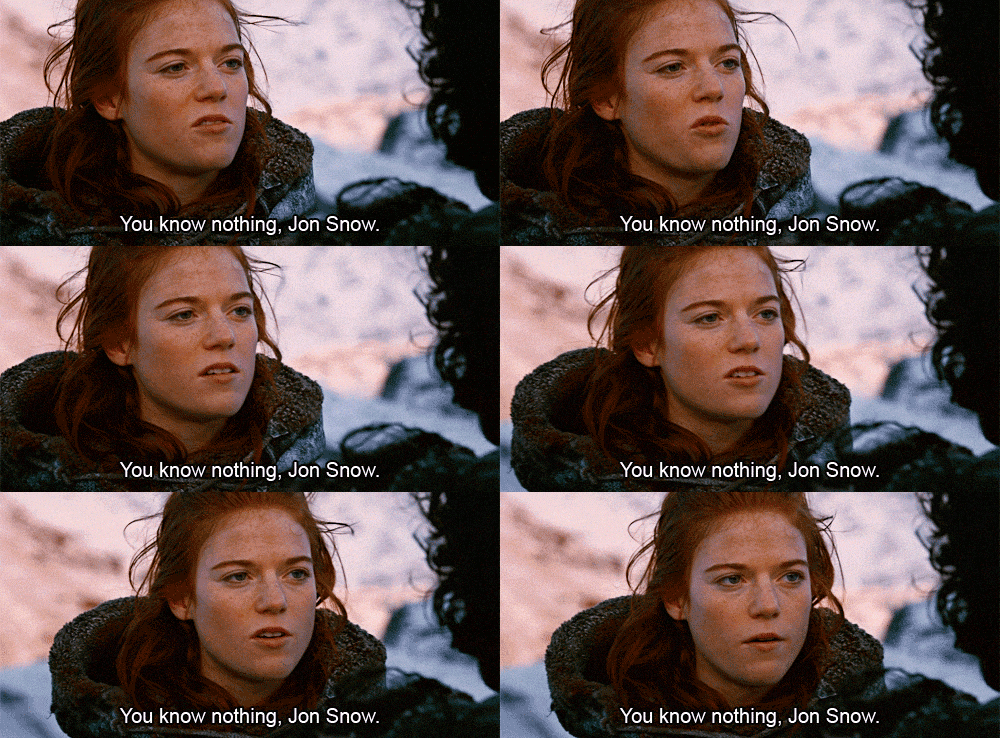
I don't see this ever growing old, but you never know...

Saturday, September 15, 2018

Planning Extravagance

Da Vinci is credited to have said that art is never finished, only abandoned. In truth, who said it doesn't matter so much as the sentiment. Because there is ALWAYS something more to be done, it's just as true that there is a time to move to another phase, let it go, share it. 

Control is another point of dispute. There's no cushy line between the claim that 'the author is too controlling and I wanted to imagine it for myself' and ''his might as well be Mad Libs for all the holes in this story!'. 

What if you're using the wrong medium? I covered an answer on Quora that took on video game dreamers for misguidedly translating that idea into a novel.

It could drive you mad, scraping through a story too much. I suppose. I've read my own work more times than I've read any favorite author, so I court madness with open arms. Not just to edit but I've gotten sucked into my words and worlds time and again when I was supposed to be editing. Planning itself can be a siren call into restructuring what might have been nearing completion.

It happens. Embrace it. I'm still on the task of typing out perfectly legible notes. And not word for word. I'm catching inconsistencies in the plans and is it EVER easier to correct a typed document than the battlefield my handwritten copies would become.

It's a beautiful thing, really. To visit a world, even knowing what comes next and feeling differently about it. Sometimes you cringe at a little mistake or you think of something better or you want to change it. That's where publishing seems scary to some of the never-ending creatives out there. If you really feel ten years is what your series needs, ten years it is. If you're ready to set it loose after a few months, do it.

I'm really enjoying this planning though. It's all for UnHeard when UnSung is still in progress. Yet UnHeard is my NaNo baby, so I'm setting it up to fly. Planning can benefit from extra sometimes. As a teen, it was all about different color pens. Even now, switching to a designated tool for a designated task can be motivational to the process. 

Visit your worlds as many times as it takes. It is never finished and it never needs to be.  The art is about flexibility and the need to return. For writers and readers alike. No matter how airtight and done to death it is, a fan can tirelessly both spot flaws and create reimaginings. Even 'ship' characters, which is a term I won't use often because, while the origin story is cute, the concept itself is applied so thick that it's about as unoriginal as another overused word 'love'.

Heyyyy, let's shoot the shit with that one since I'm here... I almost obsessively avoid using 'love' directly when lovers are confessing their feelings. One of my favorites comes from two characters in the third trilogy of my first series. It tickles me because it's an obvious avoidance and a simple truth, but you know it means 'I love you.' In fact, it becomes an endearment, an emotional running joke between them. Lol if it were anyone else's work, I'd tell you their names and what they said, but at this point, I'm a newly published author and I hesitate to run the risk of my blog being the equivalent of a movie trailer that spoils the best parts.

I love writing romances where there is light teasing and quick jabs of tension. Some fantasies keep romance on the side of solemn and intense. The Arwen-Aragorn romance was a big one there. I've never liked seeing love from the 'til-death-do-us-part angle. I won't just brush it off as being done to death, but there are so many books I've read where confessing love or marrying was the height of the story. Or having a child. I won't deny that those are exciting moments for many people, but ultimately it came off as depressing that these very isolated events were given more weight than than the ACT of falling in love through a rich plot, what it takes to make a marriage work or even the beauty of raising a human being into a good person (or the horror of them becoming an inherently bad one). I have never seen love as a quick prize.

Even some romance novels that attempt to make a rich plot, the MAIN plot often still makes the confession the central point of the story. Maybe this is what most romance readers DO want, but when I started reading books where romance was a subplot, it was noticeably richer to me than poetic descriptions of eyelashes and dimpled smirks in books solely focused on it. I might be an odd one here, but romance isn't my favorite genre for romance. I like a lot of cat and mouse, but the juicy kind where the cat catches the mouse but toys with it to give chase again. Some erotica is annoyingly framed as romance so when I realize the plot is lame, it becomes a hunt for the sexy parts, where all the effort was placed. Yes, erotica can have a great plot, but that makes erotica the SUBplot. If you frame a book as romance primarily, I don't even have high expectations for plot. Still, it can't be boring. Even when I want light and trashy, I want to care about it. More often, I say I want romance to be a subgenre, even fifth on the subgenre list because I don't want solid expectations of it being there. I like when it's present. I enjoy the building intimacy and the private insights. At the same time,  I want to see its fragility, know that it can be cut short, know that it might not be returned, or even be passing or not strong enough with other temptation. I plan my own story's romances as carefully as my world building. If it's going to be there, I need to care.

And hey, some people want romance to be insinuated or absent. That doesn't make me hesitate to tackle it if I'm feeling the vibe as part of the story. I can't really help you. Despite or maybe because of its absence in my life, romance will always have a place in the story. Because I'm not fading to black when there's a veritable gold mine of character development (or fun) to be had.

One of the oddest kinds of comments I see in reading groups is along the lines of how much of a thing is generally accepted as okay. Can you poll that? Lol it doesn't stop people from trying. How much _____ do you like in a story? If you like all or nothing, every time, then you're an easy one. When I see these, I input 84% just to throw a wrench in the logic. There isn't a magic number when something is liked. In fact, someone's claim that they've NEVER seen _____ written in a way they like so they avoid it... Often makes me want to try. Not FOR them, but because I embrace the challenge of truly enjoying reading and writing on prompt. I wouldn't say that I aim to be the one who does it right. Most people who think in black and white will never ever try that disliked topic again. I don't doubt they'll still find plenty to read so that they can easily avoid every attempt to expand their thinking on it. They can have that. However, it's still backwards thinking to have not read anything in that category in decades and still make the claim there can't possibly be anything worthwhile. When they can't even frame an opinion as such, that opinion is usually as shallow as their ability to communicate it.

A guarded opinion is often external (this work is awful) as opposed to a more honest opinion actually focusing on their impression (this wasn't to my taste). I've always found that technical critiques can be external, focusing on grammar, punctuation, style, whereas using that same tact on opinion is always where it comes off as dishonest. I believe that some reviewers probably think it sounds stronger or more professional to leave out personal pronouns and impressions. To change 'I think' or 'I believe' into more definite points (this IS or ISN'T). In fact, it's often used in advertising because it's supposed to sound more confident. ('this product changed my life' as opposed to 'I really feel like this product improved this specific task'.) I'm going to disagree though. To me, bold assertions always sparked my skepticism, had me running to research it myself. Does it work? In advertising, the numbers would say yes. However, most people have neither the actual skill to reframe an opinion (to use actors as a scapegoat for something they never directly said) nor the ability to defend it fully. It is often parroted the same way every time, with no new additions, or extremely cherry picked examples (even to the point of purposely omitting knowledge of an exception).

I think I've found a few things to babble on about well enough so I'll return to planning. Got my notes typed out and printed today. Condensed and refined to nine pages. I have the series-arching plot arching over the subs, the book main plot (each one has a pivotal main character or two and a focus on one God and region), character planning, regional development (some idea of the map), and several of the micro systems planned. I also have a sort of running bestiary, but I need to play with a map. The scope is somewhat 3D like one of my locations in UnSung so it will need a top-down plan. These are just aids for me, nothing I'd ever publish (unless by some weird turn of fate there's ever a demand). Mostly done though. I'm excited to start it, even while finishing UnSung.

For some people who fancy themselves novelists, I wouldn't be surprised if some are actually most in love with planning. Those are the sorts of jobs that are harder to land and do start with a solid display of completed writing. I sit in the middle, the pantser that digs big holes and then plans. I'm not afraid of the holes though. I find a lot of comfort in them. They're puzzles I'm happy to solve. Even in a dark story, I find it cheering to get down to the critical fixes.

UnSung can be pretty dark. I wouldn't say grimdark or dystopian but still goes place light doesn't. Grimdark is really about the focus of narration. In fact, I'd love to try a cheerful narration of a dystopia. It's even been done! Twilight Zone had the infamous episode where a guy with a nagging wife and a joyless job finds joy in hiding in the vault of the bank where he works to read. Cut to nuclear destruction and he's the last man alive. It breaks cheerfully into him carefully gathering and sorting every book he can find, his face distorting with a happiness he'd never known before as he plans what to read next. Of course, he's severely nearsighted so it's a cruel turn of fate when his glasses fall off his face and break. For a loner, a solitary world seems ideal until you meet the grim realization that at some point, you depend on society to support the simplest of luxuries. What is a world without the passions most dear to you?

Of course, I'm not even going for the grim reality with my view though. What if survival isn't quite as bad as you think? What if you are actually good at it and the survivors aren't all morally bankrupt or zombies? I wanted to like you, Walking Dead... I really did. Can someone let me know if they ever actually decide to go to Washington DC to see if the virus center is even a thing? Because really, that was what kept me sticking around a few seasons longer than I should have. I assumed they'd wouldn't just keep escalating with a group sicker than the last and actually have an aim again. At some point, I didn't even care who died anymore because they all sucked.