Let's talk about love.
No, not my love life (or absence of one). If I could lead in with a personal anecdote, then what comes to mind is one of my favorite 'love' songs "Fairytale of New York". And no, not the famous one by the Pogues but the cover my friend Joe introduced me to by the punk band No Use for a Name (with Cinder Block from Tilt doing the female vocals). It's one of those songs where my young dysfunctional experience with relationships really took notice. No matter the version, the song runs the gauntlet of a young starry-eyed couple with less than ideal life choices to their disgruntled older versions sore at each other over their regrets. Even then, the last choral block shows that the blame blankets the underlying reasons that a good life would have meant jack shit without the other after all.
It's a raunchy modern day tale with a timeless theme and that's the beauty of it. You've heard the saying that someone is 'in love with the idea of love'. Or that once it passes, what foundation keeps people together or sets them drifting apart as strangers? When I was younger, I have to admit, the cat and mouse of people resisting their feelings was a huge draw (and still is). I've seen modern angles try to dismantle it as enabling men to keep pursuing a woman who has no interest, that he might win her eventually, but are readily skipping over the subtle signs that the woman DOES show an initial interest but for a myriad of reasons (being hurt before, not wanting to take the risk, overwhelmed by those feelings), she makes a show of being cold and disinterested to test if her initial attraction is both reciprocated and lasting. The person she loves is not being tested so much as she is testing herself. What's even more interesting is when it's not just the man or the woman (or the man/man, woman/woman-- gender is only an example here) putting the brakes on it, but both. Either they sabotage each other's resistance without trying or situations make it unavoidable to trust each other or remove those barriers.
I like a dysfunctional love. Many tales can easily support a natural and healthy love, but there's something clever and stimulating in those antagonistic developments that I've always found irresistible. Probably why, even though it's a horrible situation when taken literally, I find I Love the Way You Lie with Eminem and Rhianna somewhat satisfying. No, not because of the gut-wrenching violence, but because of the destructive qualities of the 'heart wants what it wants' frustration. The terrifying way that love and hate dance just as hot in the same fire.
Writing a love story at all used to be a source of frustration for me. Not because of 'inexperience' but because it's hard to keep a fire burning. I've always hated how at the climax, there was always a 'happily ever after'. In fairy tales, it was quaint, but in books, it was a cop-out. Unfortunately, the aftermath I dreamt for that couple was usually pretty mundane and boring. My mom's parents were best friends and it was beautiful, but it was still... boring. I don't begrudge anyone their happily-ever-after, but what I looked for in a tale of love was the promise that they'd have more heated fights and explosive make-ups.
And how do you do that? You don't want them to be abusers or aggravatingly resistant even after they've become lovers, or purposely contradictory, or prudish, etc. but you get the point. Too often angst is the name of the game, but no matter how much I wrote it, it always fell apart. In fact, even in the most successful examples of it, I got bored just reading it.
Lasting love in stories seems to thrive on its smart-asses. I don't know what it is, but you need at least one smart-ass in the picture at all times to really keep things going. It doesn't even have to be within the couple itself (although they're going to end up flat if they're always harmonizing).
Again, I know it's a taste thing, but I've just never really been able to jibe with anything short of dysfunction. No matter how straight-laced my friends seem, there's always some underlying dysfunction that seals our foundations. People who are too bright and shiny scare the absolute shit out of me. Namely because we all have cracks and the ones sealed up too tight often burst at the seams in the worst possible ways. Love too perfect is the same way. I'd rather know someone's kinks straight up than be 'surprised' by the sheer horror of an incompatible fetish.
I wouldn't say I've ever considered love to be central to my stories. In edits, I pass over those parts because they come naturally to me, whereas I obsess over the lore and world building and plots everywhere else far more. By comparison to other books, it's probably more than most, but I'm not ashamed to say that if the plot supports a bit of romance, I don't shy away. Too many female writers are shamed or scared away from it, threatened with having their work relegated to the 'trashy' realm of romance. Although 'trashy' was never a catch-all for romance and I've read many with rather brilliant plots. Of course, nowadays all generalizations are offensive. Also, all distinctions are still attempting to be generalizations so it's a fuck-all. Do your thing.
I've written a lot of love sub-plots. Of all of them, there was one particular storyline that visited me quite a bit-- the story of an arrogant young woman and a big dumb blacksmith. Ha, I know it already sounds like a trope that's been done to death, but it's the details that kept tying me into their story deeper along the way. When the reader is first introduced to them, the girl nearly runs into him while he's blocking the entrance. She's talking a mile a minute and he's just nodding his head in awe. She thinks he's incredibly stupid to take her abuse, but he remains grateful when her father hires him since their town has no resident blacksmith. He turns out to be the nephew of her mentor, a librarian there. The young woman has a twin brother who actually befriends him and her dad also likes him. She doesn't really have a reason to hate him so much, but her mother sides with her, which takes some of the edge off of her unreasonable dislike.
As it turns out, the blacksmith had a hard life where he came from. Orphaned as a boy, his aunt was married to an abusive man that refuses to let her take him in. The only thing that saved him from homelessness was the local blacksmith noticing he was rather large for his age and took the boy in as apprentice. The blacksmith was not a kind man, but the boy learned quickly that playing dumb afforded him a sort of advantage with people. When his aunt's husband died, she could no longer stay and she asked her nephew to leave with her, but he refused, insisting that smithing was the only life he knew. She tells him where she is going. Years later, the blacksmith dies and that is what sparks him to look for his aunt again.
As for the girl, life had never been particularly hard for her. Her father and mother were considered heroes after their exploits and they founded the town she was born and grew up in. She and her brother were born both gifted and disabled and their uncle was on a mission to figure out why. She would have been happy to spend every day with her brother, but as a teenager, his interest ran towards other females. The blacksmith coming along was just one place to direct her loneliness and rejection. It doesn't escape her notice that other women seem to be obsessed with him in the same way her brother was interested in other women.
Begrudgingly, she realizes she can't put off getting her bow fixed when the grip breaks. She kind of hopes he'll tell her he's not a fletcher, but apparently he is. He agrees to fix it, but says nothing of payment, which only makes her call him stupid again.
Events transpire in the story which result in the twins' uncle dying and them left with newfound powers that 'fix' their disability, but make it obvious they can't stay where they've lived their whole lives either. Her brother can no longer speak and she's scared of leaving. Her father makes sure they're well-packed but surprises them by telling them the blacksmith will be going with them. She tries to put up a fight, but her usually malleable father is immovable in this. Before they leave, the blacksmith returns her bow to her. Not only is the grip replaced, but it is silver and expertly carved with the image of a bird that has special meaning to her.
It's not a magic moment that forms their bond either. In fact, the more she knows about him, the more reasons she would have to like him, the more she fights it. She begins to hate herself because this man shows he is very willing to die for her, but she can't manage to soften her heart towards him. It's almost karmic how much her own powers penalize her disloyalty, how much they demand from her and how unbreakable his devotion is towards her regardless.
Their relationship is one that followed me more than any others and is one I still visit fondly. I saw them similarly imprisoned in lives that couldn't be more different and ultimately, it was their attitudes that made all the difference. She who had everything starts to see the downside to everything while he had nothing to look forward to and always sees the bright side.
Now here's the question that sometimes get posed that seems to make all the difference-- did the romance revolve around the plot or did the plot revolve around the romance? In this synopsis, you wouldn't be wrong to assume it's a love story. However, ultimately, the three books in this particular trilogy actually spin around the revival of an old wild magic. The mythology is loosely based on Celtic folklore, namely the strife between the Fomoire and the Danae. Despite the former generation being so keen on finding the truth, they are also bound to conceal a very dangerous secret. The wild magic has elemental qualities but they are broken-- each one carries a very specific penalty for the user, demanding everything from life to death, to free will and memory. While they fight to survive what they never wanted, they fight to find some semblance of a normal life.
The simplest answer is that I never use romance as the plot device. Ultimately, love doesn't conquer all and life just sucks sometimes. I also don't pretend like it's taboo. Giving my characters privacy is absurd (yes, I've heard this as an actual argument). While I enjoy the romantic subplots, it's still more thrilling to build the worlds moving in, around and through them.
I love the chaos of a grand scale. I love diving in and out of detail and the big picture at dizzying speeds. I love love. I write violence that makes me cringe too. What I really want from a book is one that makes you think, so often it's a labor to pull back from explaining too much, to give the reader some room to guess and dream. I read things that piss me off, if only to decide what about it is something I want to actively avoid.
I'm just going to wander a bit from here since love has run its course. 😂
Too often, we see low blows in writing. We see advertising and stories written solely to evoke negative responses because it works, but it's also why it's NOT the kind of writer I want to be. I would take obscurity over infamy. If I am to trigger an emotional response, I don't want it to be because I threw my work in the fire and pissed on it. These days, there is just too much being 'loved' for being mediocre. Yes, I know-- that's a statement that calls to taste. Yet often these artists are willingly admitting that it's crap and it worked. Because of this, advertisers and media have taken to feeding us all that sucks to get our attention rather than the less effective positivity in our work.
But there are still deserving ones that rose through their own appeal. Harry Potter and Game of Thrones, however you feel about them personally, did not rise through calculated negativity but through sheer interest. They reflected the stories that the authors truly wanted to write, not just a marketing strategy on what they think everyone wanted to see. Yeah, we all hope it goes there, but seeing as how there's no guarantee you can successfully just write for a market, I'm still convinced that writing the story you want to read is going to give you the better chance.
Where I'm at in my current book is devoid of any actual romance. Flirting and such, always, but not every plot really has room for it. Probably why I keep coming back to it. In any case, absolutely embrace your love stories. Continue to redefine genres and put your foot down to defend it, if need be. I know I'm always going to deal with assumptions on my abilities based on some pretty lumpy generalizations of my gender, race, lack of religion, etc.
I do get that stereotypes even exist for a reason, but I've also believed that rather than assuming them to be the rule, they're just something you can laugh at when they prove to be true. I don't hate pumpkin spice, but they're not my white girl crack either. I don't avoid something I love just because it's become a way people can pretend they've figured me out. That's actually a terrific way to lure them in to trap them.
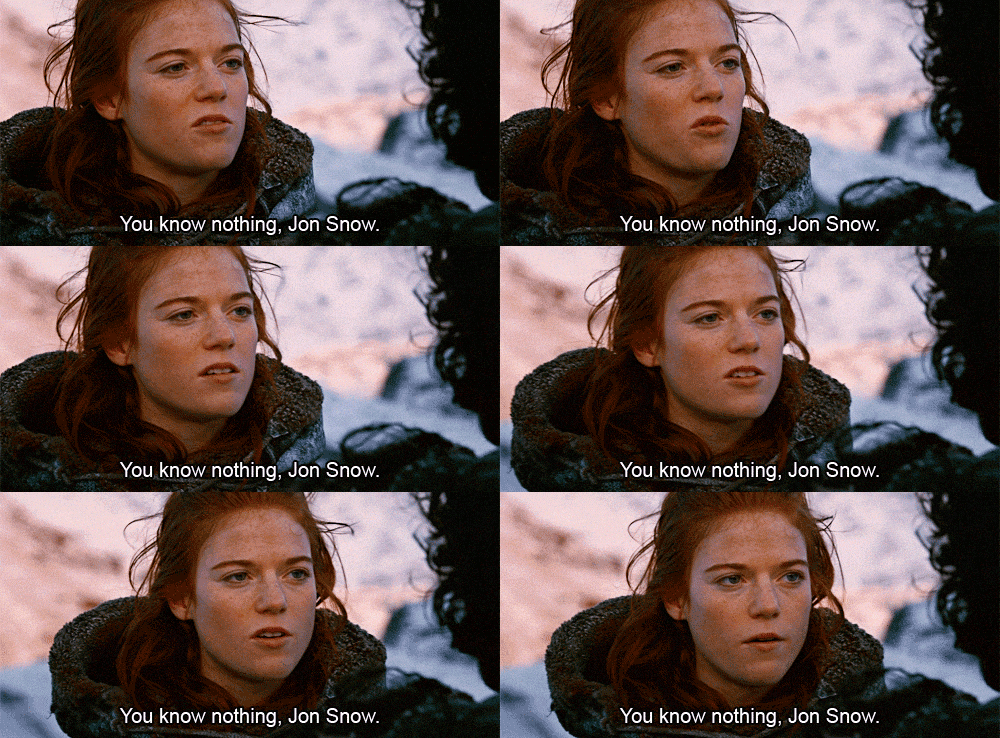 |
| I don't see this ever growing old, but you never know... |
