Showing posts with label perception. Show all posts

Saturday, May 18, 2019

Strong Women in Fiction

I'm probably going to beat a few dead horses here, but I feel like I need to repeat an oft forgotten sentiment that I'm rather staunchly standing by.

Strong women, by the standards of what makes men strong, are not that strong.

Often, we see authors trying to remove 'weakness'. Keep her away from the kitchen. Remove any sense of shame, kindness, submissiveness, or display of excessive emotion. If she's fat, she can't dislike her body. If she's muscular, she can take on any man in battle. If she's skinny, she's faster but God forbid she's ever manipulative or seductive or uses her looks. She's never illiterate and she never uses drugs. She can drink anyone under the table but she's not an alcoholic. She doesn't have kids, but if she does, she's not a nurturer. Tough love only. She can use sex to get her way, but is never used herself. She can't have been raped or otherwise traumatized because that would make her a damaged prop, a cheap piece of plot, rather than a fully-realized character.

See where I'm going? Contradictions abound as the list goes, somehow making a 'strong' woman into no woman who can ever relate to her. In trying to steer clear of the Stepford wife, we're left with another Barbie, more plastic than G.I. Joe. We're suddenly making the broken women who build their own lives up again, not giving the supposedly submissive-seeming character the room to reveal that she has the agency to wear a mask to build up her empire. The 'weak' woman is dismissed as flat before her layers are shown. She is no longer allowed to be mysterious because her perceived weakness will be consigned to satisfying the male gaze, to being nothing more than a punching bag, to not having her own mind or dreams.

Time and again, you see the nervous writer asking how to write a woman and you get the floods of defensive women looking to cut them down as sexist or misogynistic or shallow if the woman isn't some ideal that removes an feminine trait they consider weak. And I didn't gender the writer because, yes, they will even presume to infantilize a woman who isn't sure how to write female's of a certain level of socialized femininity. Maybe she was raised around men and just has no idea how women socialize or never uses make-up but her character does. The problem with their advice is that their increasing departure from socialized femininity begins to villainize any women who personify that role, as if to invalidate them as real women.

The trend is even to protect trans-women, gay women, women of color. Anything but the feminine aspect. In fact, the idea that we can't even define the feminine or masculine aspects because they might cause offense are what really end up causing the confusion. So instead, anyone who finds comfort in gendered roles becomes part of the problem and....

Ugggghhhh, no more. Really. 

People will continue battling this out, but as a writer, at some point I learned to just write. To look for the logic in a character's build and see if their actions, reactions and personality are plausible for themselves. To remember that I am misunderstood, that I am perceived as both weak and strong, that my stories will always display vulnerabilities and impassable walls, that those walls will crumble and when people feel safest with me, they'll sometimes hit invisible walls that confuse them as well.

If you want a strong woman, look at a characteristically weak one and ask what she might be protecting, what might be motivating her, what she is waiting for. Don't be so quick to dismiss her as weak or a victim. It's not always her failing that makes you uncomfortable but yours. Give her time to seem shallow, give her some time to be annoying and mysterious and able to change.

A strong character will not say all the right things, know all the right people, be confident in every room. They will also not be endearing in all their faults, be the pariah surrounded by peons, and suffer greatly just to prove a point. If they are any of those things, there's an organic way to get there without punching your reader in the face.

If your character is constantly signalling that they are kind but are actually stone cold assholes, then tell narration should at least be aware, making it comedic, creepy, or ironic. Otherwise, the reader just thinks you're ignorant of any device to drive the disparity.

I've said it before and I'll say it again, just be aware. At every stage of their actions, you as the writer should know what history or fears or delusion drives it. That is what keeps them from being flat. Don't try to be safe. Strive to deliver honesty at every dimension and you'll be all right. If you don't trust what you know of people, observe (but don't stalk) people who fit the bill. Don't always worry about being right. Sometimes the story is about your perspective or how others react to them in general. If you have a specific trait in mind, ask someone who has it rather than general forums that will confuse it with assumptions of their ideal.

Oh yeah, and have fun. Exercise your own strengths and enjoy the process.

Friday, April 26, 2019

There Are Worse Things to Be than a Disney Princess

My hair was strawberry blonde when I first bleached it. Why I thought bleaching hair a few inches short of my ass was a good idea is a mystery. Not-so-great decisions usually accompany periods of increased anxiety. I kept it in a braid so it was less obvious how much of a calico blonde I was.

The second time I dyed it, I got most of the darker red out and started using purple shampoo. In case you have no clue what the hell that is, purple shampoo is formulated to deposit pigment that takes the brassy red out and neutralizes all warm tones. Cooling it makes it a more silvery rather than yellow blonde. My nephew's friend started calling me Rapunzel. Yup, blonde hair, braid, got the reference.

This time, I went full attack. Full cover bleach, pure white toner. Sigh, okay, toner is also a 'huh?' for some people. You add a chemical toner to a weaker developer and it does much the same thing as the purple shampoo. Whatever default a dye leaves you in, a toner will repigment it where you're aiming. You can get these in all ranges of colors, they foam up like shampoo and you leave them in for maybe a half hour.

Anyways, it's Elsa. I've gotten many compliments... From kids. Because my hair is mostly snow white and trapped in a loose braid with those tendrils that don't stay in the braid. I wasn't really aiming for that, but I got comfortable with the braid over the past few months and I'm not out to avoid it simply because Disney hijacked it.

I used to dye my hair damn near crayon red and I got 'Little Mermaid' or 'Ariel',  the first if that person was trying to seem too mature to remember her name.

8 year old me would be psyched. I would memorize Disney songs then run outside to sing them with my friends. I'm not going to pretend to be embarrassed simply because PC groups want to turn being a Disney princess into an anti-feminist or white inclusive fantasy. Nor do I care that it's sometimes considered an insult, since I'm a 37 year old woman so shouldn't I grow the fuck up?

Here's the difference. It's not what I set out to accomplish. I found my first white hair and rather than mourn it like most people would, I was ecstatic. I wanted to go platinum! It's not my attempt to recapture youth. It's my attempt to embrace aging. Braids aren't just a young girl thing and it can't be helped that I have a young face. I'm not mortified by the princess comparisons.

I'm an artist. Comparisons are how people have always tried to break me down and if I let it get to me, I wouldn't have pursued anything. Creative pursuits are open season for critics that, even if they could do what I did or might have even done it better, still can't do what I do. Sometimes, all you have to back up why you do what you do is that you don't for yourself. While I don't owe everyone that story of my first grey hair or the braid, I'm well aware that no matter if I do or don't give them the long or short version (if I don't shrug them off entirely), people tend to fill in all the blanks or take their own creative liberties. In fact, the more thorough my story, the more likely the person is to be suspicious that I'm lying to cover up my real goal of looking like a Walmart Disney Princess, because why not also throw in that I'm always wearing pajamas if I'm not in a work uniform.

Crazy world we have, where people are so adamant about redefining what girls should want to be. Just the other day I saw this winner:

Sigh... Even though, yes, overwhelmingly, the princess trend took off. But it wasn't forced on us and some of us even played with our brother's GI Joe's without our parents smacking them out of our hands. My generation did have a lot of princesses, but we also had Wonder Woman, She-Ra and Xena Warrior Princess. We had plenty of strong women characters but princesses were more popular to young girls begging for toys.

What irritates me is this idea that women would be more like men if we were allowed to be. In truth, sexuality and identity is neither that oppressed nor that fluid for everyone. Some people know they're straight or gay pretty clearly. Some people know which side of gender roles they feel more comfortable in. I mean, it does suck for the rest of us that aren't so neatly in those comfy niches, but part of what drives me isn't expecting a niche to form for me. It's my ability to adapt, to carve little dimples for other wanderers to find peace with being different.

Every little girl won't want a general either. Don't discount the princesses nor forget the value of warrior princesses. We can't lose masculine and feminine entirely. Those are someone else's comfort zones. I'm not out to take those away from people just because I'll never have a niche like that. Transsexual men and women often find comfort in the polar opposite sex to the one they were born into. Regardless of how you feel about their appropriation or adoption of gender roles, reducing all humans down to what is appropriate (rather than harmless choice) is not the solution anyone could think it is.

Of course people will bend what is good into something twisted and foul. Setting up unreasonable 'safeguards' doesn't really make it harder for predators to find a way. Desexualizing women role models doesn't make rapists forget that women have vaginas. What message really needs to get out there is that what is typically considered masculine or feminine is not a cage for boys or girls. People will judge and people will attempt to define things for everyone's (no one's) benefit but it's also okay for those roles to exist.

Some of the harder issue lie in Latin American culture, where the superiority and inferiority of masculine and feminine is hardwired into the language so much that we're getting the Latinx label so that neutrality doesn't create labels to assume such gendered ranks. I don't pretend to understand this entirely, but yes, culturally, North Americans have the most wiggle room in these gender politics. Everyone in the world wandered here to escape some form of oppression, yet the divisions aren't so easy to whittle down. Here, we're carrying all of those biases and still clinging to some shitty old cultural baggage.

It's not easy, deciding where princesses and warriors and generals fit. In my own experience, those types don't wait for permission--they go with their heart, their guts and their instinct and make their path. Pretty or gritty, she'll find her way.

Saturday, February 16, 2019

Ageism? It's Just My Opinion.

I turn 38 this year, which means the same thing it does every year: people older than me may devalue my opinions as inexperienced and childish, people younger than me may dismiss my opinions as jaded or over saturated. As we get older, there are less of the side that looks down the age ladder and more of the isolation and accusations of the younger set.

Believe me, I do plenty of asking myself if perhaps my saturation of experience makes me harder to please, but ultimately, when I'm actually accused of this, I balk at how ridiculous this is. The idea that I can't enjoy anything because my tastes have gotten too specific or impossible to please is not implausible, yet as I run around collecting 100 of the same item I already have in a game I've already done everything else in or watched a new movie three times in a row, I can just as easily say the exact opposite. I'm also quite easy to bring into a new loop where I don't ask much at all.

As for preferences, I don't really have a set area. I'm no more a hardcore fan of fantasy than I am opposed to all things sports. I find I read more thrillers, watch more action and comedy themes and I love the Summer Olympics, even those less popular events like fencing. I don't spit on mainstream as hype nor do I swear that the lesser known are underrated because you're all uncultured swine.

Of course, when playing Kingdom Hearts 3, I wondered if I'd just aged out of liking the story. I could rephrase it to sound more empowering, but I was so uncertain of my own opinion, that I turned to the Internet to see if it was just me. No, like many other gamers and fans of all ages and backgrounds, there was something missing in the magic of the story. It was a beautiful game with great gameplay, but again, there was an overwhelming outcry of 'what happened to the story?'.

We're not morons who are too old to follow or remember the so-called complexity. For one, it's not complex, it's just layers and layers of the same boring casserole. It's Sailor Moon, Dragon Ball, Pokémon--the same concept over and over with a new car smell in the same vehicle.We're driven towards shiny new characters and outfits, but there is still something sacrificed for the cosmetic. The devices become frustratingly simple and never lead to any new concepts. The fan is in the know but the characters conveniently lose their memory, their powers, their achievements and potential. Sometimes, entire plots and subplots are dropped and because they're too complex and rich to keep afloat in the distraction. Instead, it's rinse-repeat of the simpler ones. I too often felt encumbered by a snail's pace and a tedious repetition as if I were a stupid child that hasn't been paying attention. I'm paying attention, I just feel like it's not actually earning my attention.

In return, I started skipping the story scenes. As a gamer, there was no penalty for this that detracted from my enjoyment of the game itself. As a writer and storyteller myself, I was chagrined that I wasn't engaged in the story.

This isn't a one-off occurrence either, which is why I questioned whether I was becoming jaded. Final Fantasy and Dragon Quest's latest entries also left me baffled for a similar reason. While Final Fantasy XV started out rich and fun, the last third of the game was just bad writing. This is especially true if you watched the anime and CG movie leading up to it and wondered why the build-up led to absolutely nothing at all. Why even write an epic where there is no point? It's about as exciting as the neighbor passing out from heatstroke while mowing their lawn. It's not newsworthy, so why tell the world like it's worth everyone's time? Dragon Quest's usual fun romp with puns and cheesy goodness just felt corny and flat. While there were moments meant to captivate with emotion or drama, the light-heartedness of the presentation didn't fit these themes. Yet games like Dragon Age, Witcher 3 and Skyrim, despite or maybe because of their lack of endless cutscenes, still top my best games list, and not because they were flawless or even innovative stories. 

Uncharted, despite being accused of being playable movies, don't feel like a hostage situation to me. The cinematics always built the right amount of tension and I felt the flow when it was time to mash buttons again. I was embedded in the same way Marvel movies hook me--there's serious choreography and strategy to what makes the action so engaging that I hate to blink and miss the fluid transitions in every movement. There's a real sense of the genuine in the conversations and the plots. It's even possible to forget that these are grown-ups in silly costumes at times. It's not small talk and there's nuance and subtlety beyond the surface.

Hell, I've even been accused of cultural snobbery. Despite being otaku to Japanese everything for much of my fandom, some people still insist I don't understand the cultural preferences of small talk and storytelling of Japanese culture. However, I can just as soon point out what I consider to be successful in many Japanese stories that I still enjoy. The absurd part is that this accusation almost always comes from white men. I like to remind them that my opinion isn't representative of all American white women, but while we're there, does my taste and opinion become less valid if the story just doesn't jibe for me? Trying to invalidate my opinion by pointing out my race, gender, etc. is a strawman argument used to make me defend myself rather than accept my skills and talents are adequate to hold the debate. I am a storyteller, a creative, an editor, a professional in many creative fields, if not an expert in some, yet an unfavorable opinion can lead to a question as to all of that. Fuck me for choosing a field rife with subjective opinion, but let's not attack my character for attacking the build of a fictional one. When our tastes don't match, it too often becomes a personal attack, so I often go out of my way to talk about the work, not why your opinion doesn't match mine.

I want to love everything I try. It's for that reason that I am probably going in too soft, giving something more credit than it has earned from the onset. It's not easy for me to ditch nostalgia or feelings because I want to be loyal. I'm not even relieved when I'm not the only one to just not love something anymore. I'm crushed when sequels don't improve on something I love. When I write, I know personally that I want each story to be better and, hell, as of now, I have no great success of popularity to even bank on, so I absolutely don't feel like I can coast on a great beginning. Yet I can't eschew honesty when I'm falling out of love. I would rather hand in my fan card than pretend I love current trends.

I can live with being the jaded old fogey. It's not worse than being discredited as inexperienced or ignorant. Sometimes I'm easily amused or entertained and other times, I'm over-critical and impossible to please. Perhaps I'm also lucky that I'm in the position of a creator, that rather than getting burned in the search for the next best thing, I can hunker down and fulfill what I want to exist. I'll probably always be discredited for really absurd reasons. I'm even in a place where I have to protect young white boys from being discredited because everything white, male, ableist, straight, etc. is being called to task. Their fight to have respected opinions is often going to be a struggle not to fucking offend everyone and assert themselves as individuals, not representatives of all that is wrong with white men. Ageism is the least of their problems, but certainly a part of it, because there is no golden age for being universally respected.

Why are we called to task for perceived advantages? It is an abyss, really, but it seems ever more absurd that just the act of liking something superficially often comes with the burden of questioning if it's 'okay' to. Does it make us a stereotype of our age or gender, etc. to like or not like anything?

Yup, it's exhausting. An unavoidable burden of living. We wish we could be as stupid, ignorant, or shallow as we're sometimes accused of being, if only because there's peace in emptying ourselves of the burdens of so much dead weight. 

I can't say I don't care what people think. Yet I can say that we can't afford to care about everything. We sometimes have to clear our caches and be content with ourselves, to quiet our brains and accept our own opinions before we seek to bring others in. We do need to bring in opinions and be validated and share and give and take, but wisdom teaches us that if we can't face ourselves once we act and think and share, we must adjust what we allow to take in and put out there.

Age does not assure wisdom, but it also does not assure senility. To discredit someone, especially yourself, because they've cultivated years and routines and selectivity in what goes in and out is a discredit in itself. 

Learn to smile or laugh in the face of words used as weapons. Don't let people put words in your mouth that make you mute towards your own potential. Defend your right to be what you are. Walk away if the time isn't right to mount a defense. Don't let someone else's ignorance of what is important to you dissolve your ability to enjoy or dissect it for your personal growth. People have bad days and it makes them petty. Don't give that shit real estate in your head.

And when people arrive at a point where they antagonize, patronize or condescend to throw off the argument, they've already lost. You don't have to invest in that snobbery. Walk away, add a dash of 'fuck you' and move on to greener pastures. You're only getting older and there's never a good time to endure heaps of the same bullshit.

Saturday, October 27, 2018

The Way You See the World

There are some parts of self-discovery combined with studies where the knee-jerk reaction is resentment, defiance. Studies, no matter how extensive, are always isolated to their unique circumstances, yet some are immediately observable without confirmation. The 'why' of these conclusions is by far the most fascinating so, no matter how you feel, trudging on to look at where you land is how you'll make firmer assessments of yourself.

In case that's too vague, look at it this way. You read a study that says most people that aren't you are better at what you love to do (men have better visual attention to detail and reaction time). The knee-jerk reaction is that men would be better artists and gamers. However, when you actually read it rather than decide the world hates women, you see that we're talking micro-measurements in depth and reaction time. Do these studies account for the competitive nature of the subject? Do they look for the lifestyle or career choices that would put someone at a practiced advantage rather than natural? These are questions that may skew the results. Societally, some traits are simply hidden when undervalued in their communities. Men are less likely to admit they kick ass at crochet. People in poor neighborhoods are less likely to be praised for being good at chess. Not to mention, a competitive nature could be more distraction than a boost to focus in some cases. This is why it's important to look at how thoroughly these studies really dig.

However, in my case, I already knew my disadvantages. Doesn't mean I didn't experience the defensive rise of objection, but it's not a rarity. There are some people that can't see 3D effects in 2D formats. Having eyes with two different vision levels is one such reason but there are other brain and sight impairments that factor in. In my case, the world isn't really 3D to me. 

It's not a disadvantage, not really. I've always had an easier time of drawing because the world is shapes and shadows and lights but if I catch something or don't flinch, it's more luck than skill. 3D animation looks different to me because I see the more sophisticated color palettes, effects such as ray tracing which capture the movement of light on simulated objects nearly perfectly flat as opposed to struggling to translate them as such. However, a lot that moves is also lost on me. I miss a lot of what people call badly done effects in movies. Call it a choppy mental frame rate, but I knew 3D modeling would be a colossal challenge for me because I would have to micro adjust like crazy every time I moved the sculpted model.

That's not to say I could never enjoy sculpting or modeling. It mostly means that my standards and perceptions wouldn't hold up to elitism. As with most creative pursuits though, it's still blissfully (and woefully) subjective and you're often either a hack or a genius as fast as the critic blinks. Not seeing as 'masters' do doesn't necessarily put you at a disadvantage. A different perspective can mean a different workflow. You can make amazing music when deaf because of studies in music theory. A missing element also means removing it as a distraction. If everyone who is considered a master has a common workflow, that doesn't mean there aren't pioneers ready to crash through the walls and rethink how it's done. We're often seen as collateral damage at first, but if we stick with it, amazing things can happen.

Over time, my worst self-criticisms just don't keep me down very long. Being the exception to what is considered the rule can be isolating, a source of pride, insulting, motivating... maybe it's old school, but the way I grew up, it was always in noticing gendered differences, both biologically and societally, that I found the most comparisons. Things like racial/cultural behaviors are social and learned. You start to see that general perceptions are the crutch of invention.

Some people stumble on this one. Biologically, race is real. Forensic anthropologists can tell your race and gender with skeletal remains alone. Artists can regale you on the finer points of anatomical structure. It's not just a skin color. Living in different climates and altitudes and so on, have shaped us. Gravity and habits shape us. Whether you like it or not, the Y chromosome tends to produce those long eyelashes women want and male pattern baldness is inherited through the maternal genetics. Nowadays, even racially isolated areas carry migrants of other races and tourists will always be our best economic boosters. Isolation makes cultures stagnant yet people still develop tribal mentalities.

That being said, it's still possible that we acclimate our views not solely on accurate perception but rather by the things that leave the biggest impression on each of us. In an area where mostly Japanese people live, you're not likely to noticed there are Chinese, Vietnamese, etc. there as well. But if an Asian person is the only one of their ethnicity that walks in, you're likely to mentally attempt to discern which regional Asian features they most resemble. Our brain does tend to blend like objects into patterns to locate exceptions. It's true enough that with ethnicities outside our own, all of another actually does look alike unless we are making a concentrated effort to override that primal adaptation.

Brains by default are ignorant, but that's not a dirty word. There are some things that we can reprogram if we find it worth the effort. You could parse those priorities into ethical, moral, etc. standards, but as an individual, this is your call. See the world, experience the world how you will. Choosing a livelihood counter to your ability may be fruitless or very near to impossible but I think we all know to some extent why it might be worth pursuing against the odds.

Somewhere out there, I see someone who probably has the same if not similar issue that I had to come by the hard way. I wonder, if we can remove those obstacles, let someone else skip some steps, could we offer others a chance to realize more in their lifetime? At the same time, there is just no way to really understand some lessons until you've lived them in your own body.

Monday, September 3, 2018

Hooray! First World Problems

I know. I'm first-world broke, not third-world. I have basic needs covered and then some-- not just food and water (and coffee), not just electricity and sanitary, not just technology and time to chase dreams. But it did take me three weeks to save up Amazon giftcards, small royalties, and a few bucks I had on my dresser for the $40 I needed to use my laptop, scanner on my printer and make sure I don't starve my fish.

Can't say it doesn't wound me that I don't have a reliable income for working. That I can't brag about being a steady entrepreneur or a successful freelancer, that my contributions are still in infancy even though I'm a workaholic towards my goals. It does suck and it isn't a place that people really relate to (never mind that they also can't claim working 15 years in retail hell like I can). Even though I can say I avoid disability and welfare and only have health insurance (at least until someone butchers healthcare again), I don't pay taxes. Not as fun as you think since my city still requires me to file with my zero taxable income (you have to make at least $3000 a year to be taxed-- I don't come close). I don't even get the excuse of being a housewife, just a caretaker of two young boys. Like a parent but without the legal perks. I'm pretty much an au-pair that is related to my charges. 

While I don't like excuses, I don't have neat little labels. I even brag about how well I avoid them and adapt to what I am without resting on any laurels. I don't even know how to classify my health. While my work is sedentary, two hours of every day is dedicated to brisk walking and I mind my diet (while not restricting that either). When something isn't flaring up, it's good/great. When it's bad, I still want to say average/fair because I've known worse.

On a scale, we're always kind of fucked. There will always be someone who has it better and worse. It's actually possible to be grateful it's not worse but wishing for something better. I once considered myself a liberal because of this variable thinking and in the purest form, I am. However, moderate is what I call it since the far left and right have ruined what it means to be conservative and liberal, even for themselves. I haven't gotten narrow-minded, I'm just less tolerant of thought-policing for some perception of the 'greater good'. I'm not intolerant, just not willing to accommodate the power dynamics of complete strangers. 

As a writer, original pronouns best serve their purpose. Throw on some more adjectives and I'm good, but pronouns don't need more distinctions. Stranger, you are that person over there. First world separations are not being inclusive but creating exclusivity, demands that require people to perform mental and social gymnastics to accommodate you. To someone like me, (and to use one of your stupid fucking words) YOU are an ableist. I can't wrap my literal fucking head around it and it's just NOT useful to anyone.

Of course, I can be a dreadfully passive writer at times to form the general example. (Although 'you' is mistaken for direct, it's one of the subtleties I CAN wrap my head around.) 

People should not support your delusions though and it's something I came to understand when battling my own mental issues. If people had always just waved off my bullshit, supported it, I never would have learned how to confront it. Being completely intolerant was hurtful, but there's a difference between what you put your family and friends through and what you expect from strangers. We, as a society, should understand the presence of mental illness but it is still partially the responsibility of the affected to genuinely attempt to adapt to it themselves, not place that burden solely on the world around them.

I know. First world problems are laughable in comparison. They're still a real aspect of the individual and it's not too much to allow each person some sense of dignity and benefit of the doubt without expecting the world to bend over backwards and kiss your ass. I did not save up $40 the smartest and fastest way possible. But I fucking did it and I'm psyched that small things can feel good too. Easier writing, easier scanning, happy fish. One to three things at a time.

And a happy birthday to my 13-year-old nephew Dameon who changes my life daily and someday may change the world. I'm so proud of him.

Saturday, August 18, 2018

Editing Under the Influence

This probably comes off as a fuck-you-Hemingway or a threat to the virtues of sobriety, but in truth, I'm talking about an uglier influence: negativity. Normally, I'd say that this is is the time I'd rather divert to another task. I've also said that it's good to hate your work sometimes, so that's where I'll poke at this thought.

Some people poke bears. Some people get drunk and sleep with them. I'm looking at you, Hemingway.

It's impossible, for whatever reason, for me to like my work right now. I know it's not a genuine disconnect because these are ideas I was just recently excited about so they don't just magically suck-- all of my open projects at the same time? Something's up that has nothing to do with the quality.

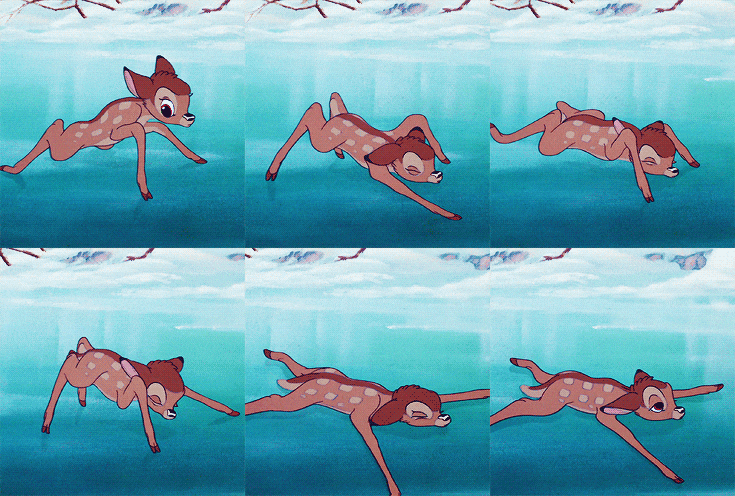
However, these feelings can be paralytic. This is where I read about people going through what I am, always insisting to the blogger-- no, it's worse than everybody else's! I can't physically move, there's a weight on my chest, it's hard to breathe, my heartbeat is sluggish or feels like it's stopped, I'm numb. I used to be one of those insistent assholes so I'm calling your bluff. Despite loving my friends, my social anxiety doesn't just extend to stepping foot outside but to them as well. Despite the heaviness or chronic pain flareups, I can put one foot in front of the other (even if the results are a bit Bambiesque).

I'm pretty sure Hemingway wrestled Bambi too.

In these long slumps, unmedicated and encapsulated eternities, it can all feel pointless and hopeless, but it's not. I'm not irreparable, I'm not worthless, and I have to fight the damn goblins with those platitudes to the point of exhaustion, but guys, they're only as 'real' as we encourage them to be. For many of us, the price of immersion and imagination, the mania of it, just has an undesirable downside. I've even said I would trade the ridiculous highs for a serene middle ground, but that's also not a choice. How dare I simplify a complex problem? Well, would you rather give it validation to continue or kick its ass and belittle it? I'm a nurturer, but when it comes to negativity, I'll be a sadist any day.

Get out your gimp mask, depression; you're MY bitch now.

I know that it's not about choosing your attitude. I'm not belittling it that way. But I am saying you have to stop treating yourself like you're so precious too. What? You hate yourself and all you do? How is that precious? How is contemplating ending it all precious?  Even with your survival instincts going full retard, it's there and it's not valuable like hope. It's dismissive and catastrophic. It's telling you to nurse your pain and wallow in it because it makes you deep and strong. Like a vagina. You're a pussy. No matter how you feel about those words or their connotations, the fact is you're reducing your own potential to heal, becoming one piece of yourself when you're better than that.


Also, don't be a dick! Unfortunately, there are zero pictures of people giving a thumbs-up that don't look like total tools.

It took years to admit that those stupid exercises the therapist had given-- take a walk, don't eat garbage comfort foods, focus on breathing-- all of them were legit parts of ending sabotage loops, treating myself like I matter so I'm not encouraging more self-destruction and health issues to feel sorry for myself with. If you're still thinking about editing in this state, it may actually be valuable, but don't neglect self-care, don't use it as an excuse, don't make big permanent changes, and be okay with reducing your workload even if you are used to being a full time writer. Again, these are the sort of don't's integral towards my experience but do try them anyway. Also, probably don't confuse this with burnout for writing. I don't know if this is what people refer to as burnout because I know it's neither about the writing nor the passion or it wouldn't make sense to pine to write again, but no matter what depression or anxiety latches on to, this specific burnout isn't only solved by being able to work.

(*I'm going to add here that my perception of real burnout tends to be a complete revulsion or disillusionment, a lack of finding any value, not just enjoyment or state of mind. Burnout is something that you see in retrospect-- where you walk away and don't come back after an extended period of time. Perhaps this is why we fear it. The distance had to be established to realize it's not just a regular block.)

Writer's block?
 Facts-- while I haven't been able to pen my creative projects with any success, it does make me turn to blogging for introspection. I have been able to edit in short bursts (I do have more advice on this coming up). I'm hiding it from my friends, even though I probably shouldn't. Everything I do requires exhaustive effort but doing nothing is worse. So how do I function?

Not writer's block.
Well, I started by trying to find the emotional connection with my work, but it's pointless (try anyway). If I insist on loving it, I'll fail and get frustrated and it won't happen. Guess what? Don't need it. Instead, I do some joyless line editing. Look for grammar issues. It's a perfect time to outline because you're better able to be concise, grab important story points rather than thinking everything is important. This is where I do continuity checks, look at vocabulary, decide what points I might want to revisit later, creating turning points or Easter eggs.

And yes, because it's loveless, there is no marathon editing. I'm lucky if I can pump in two hours at a time. However, when I'm in a state where getting up to pee or eat is a huge effort, I'm not going to get militant with any other aspect of my life either. 

I might be talking semantics, but I'm not *really* saying force it. One of the reasons I juggle projects is because I often have to juggle basic needs with great effort. 'Nudge things around' is more like it. Shuffle it around. You're not trying to force it or snap out of it or even beat it out of yourself (no, Krista, no more misleadingly hot pictures of sadism). You want to be as firm as you can muster, which requires caution but diligence nonetheless. I know-- it's not easy. It's the hardest thing you will ever do in that moment. But you matter enough to try.

One thing about my issues is that I avoid medication at all costs. I have addiction in my past (present and future, but I'm not abusing/using now) and the side effects are worse than the problem. So yes, holistic means I have to feel the whole damn thing, not just the tip.
I'm trying to be serious, I promise on my pinky. But just the tip.

Medication numbed it but it also made me numb and apathetic and immobile. If you benefit from medicine, make sure you're keeping that a part of your self-care routine. Be an advocate against being a guinea pig if it's just slowly destroying you. This isn't a one-size-fits-all. It actually took my friends and family to point out I was getting much worse. Please make sure you have a support system that can point out how medication is affecting you because you might be too zombified to see it.

Being open to yourself about what you're feeling and what you need is a big part of learning how to walk yourself through a slump/depression. And I know the lows are terrifying and make you feel fragile and they ARE dangerous. We just don't always know what will trigger us into giving up. Celebrity and success clearly doesn't make you immune. It's okay to ignore social media or refuse to look at reviews or critiques, to avoid bad vibes or the risk. However, I do insist you find a way to exercise, mind your diet and kick away your crutches. Limp around, wobble and fall, but you CAN move. I'm not speaking from a pedestal or a safe place. I'm even more certain that you need tell yourself this at ground zero.

Regardless of whether the setback is mild or severe, you can't really actively get rid of it. There's no magic pill, no revolutionary workout, no epiphany from the work you love. Or at least, don't count on it. Because there COULD be is reason enough to work too!

But if you insist on throwing your money at something, I might have a pill to sell you. #shameless
 While there may be exceptions to what works, don't be afraid to try. Be an idea factory, write short prompts or scenes, blog, throw darts at pictures of people you don't like, stay in pajamas but still wander around the neighborhood. Because lying there, leaking and whimpering, only makes it worse. Don't nurse and encourage that fragility. Make yourself cry or get angry. Keep your lows an active forward-moving slump and maybe your work will benefit too.

There are a lot of factors involved though. The discipline may include long term attention to care, to coming to terms with setbacks, forgiving yourself the trickle of productivity. Just keep in mind that whether you're a long suffering depressive or one of them rare normal Pokemon that just isn't aligning to the task, there are methods to try.

For the last time-- not a Pokémon!
Find your strengths in your weaknesses and you'll get there.

Really, I hope I could make you laugh and cry at the same time. When you're all up in your serious feelings, a sense of humor-- I can't emphasize this enough-- is VERY valuable. I know some people like to watch sad movies, to get some good crying in, but I usually prefer a comedy, the stupider the better,  so I can look absolutely insane with the whole bucket of emotion.

Plus, inappropriate laughter is always the most therapeutic.
So yes-- edit when you're down too. Distancing yourself from things for fear of ruining them with your stupid, worthless, unenthusiastic, uninspired garbage is the exact opposite of what your work needs. If you want to be a dimensional writer, then don't tell yourself you need to be anything. You also don't need more layers to be deep. It's possible to write a phenomenal book when you're in total control; it's possible to write one when you're a hot mess. It's not the amount of strife that makes you deep or interesting, it's how you incorporate yourself into it. I get it; you don't want your sob story leaking into your strong themes. Again, when you can't trust the emotional aspect, you're still ridiculously capable of finding focus through surrendering to apathy. Rather than being critical of content or tone, remember to be a boring grammar nerd or a fact-finding vulture.

You're never completely useless, I promise you. Every aspect of humanity is tailored into a creative pursuit. There will be days when you can go above and beyond, days where you can meet expectation. So expect many many days of slumps too-- just... well...

MAKE THEM YOUR BITCH!