Tuesday, November 13, 2018

Boo, Sick...

Still a bit too dizzy to stick around to write very much, but I caught the nasty cold that's been going around my area. This is precisely the reason I was writing so much for NaNo to begin with-- I knew I might need the leeway for just such an obstacle. I might be another day or two off with frequent posting and I do want to discuss the latest Pep Talk in the NaNo mail when I get the chance. There should be the usual two-a-week scheduled posts coming up though (I wrote enough to fill November anyway). 

Can't wait to get back to writing though. It never fails that the brain is always most active when you can't really do much about it. On the upside, I'll have total balloon-head, which is the end part of a cold where I'm really giddy and oddly focused, so I'm looking forward to bringing that to drafting.

Sunday, November 11, 2018

I Don't Consider Myself a Feminist, But...

Feminism used to be a word that empowered me. I was a precocious child and at times, I slip into a sort of naïveté and disbelief as an adult. In the 80s, feminism was such a positive idea. Mary Lou Retton was my role model. It had little to do with her being a woman. Like her, I was muscular and I was mesmerized by gymnastics. Women role models were ever more precious, not because they were rare but because they were still women, not 'women who thought they had to be like men to be important'-- if anything, they were masters of a craft and happened to have a vagina. Their strength, at least in my eyes, was not because they were women doing what only men could, but because they always seemed detached of expectations, truly passionate and focused on what they wanted. They drowned out all the voices that dismissed any failure from women as proof they weren't as good. In fact, because of that immediate dismissal, the inner drive had to be that much stronger to keep going anyway.

As a child, I wanted to try everything. My dad always had a 'stick with it' mentality and became exhausted with how something I begged to try wouldn't stick. Maybe it was the way he was raised, but he always gave me the impression that you should know if you want to do something before you've even done it and that was horribly confusing for me (and still is-- I never know if I'll like something until I try). My father also introduced the first edge of doubt about what I could do. His ideas of women came from the oppression his mother accepted, his ideas from a long string of traditional abuse that was simply historically accepted. So what he would even let me try was often restrained to what girls were supposed to be doing. When I wanted to be physically challenged, I begged to do karate and that was shut down-- instead I was signed up for dance class or Girl Scouts and only stuck it out because I thought I was supposed to. While I loved doing gymnastics and my first gym teacher even begged my mom to train me, it was too expensive and I doubt most of my family even remembers I was really fucking good at power gymnastics. In fact, they'll always mention my older brother and even my niece, but never me. When I wanted to be in band, I'd really wanted to play drums or trumpet, but I was told to chose between clarinet and flute. While I was damn good at flute and eventually did enjoy it, I never fully mentally embraced it since it was yet another thing I was 'supposed to do.' What I gathered early on was that what I wanted wasn't what a female was supposed to want. It caused a sort of melancholy and self-doubt that never quite went away.

Was art and writing and creativity in general a place where I could shed expectations? I can't deny that the appeal was there. I showed an aptitude and love for it long before anyone noticed, so it was always mine first. People would tell me I should do it for a living, but that's often where the support ends. It was beyond who I was as a woman though, so certainly it was almost otherworldly in its distance from reality. In fact, art was one of the few places where I wasn't so fervently compared to men. I wish I could say the same for writing, where I've heard the gripe that people can tell the difference between male and female writers because women 'write about thoughts and feelings' where men 'write about actions'. I'm still on the fence as to whether it insults men as being shallow and oblivious or women for not getting to the point. Either way, it assumes too much that men and women can't just fucking do both to tell a story... Whereas the art world has thrived well outside of any mainstream, the literary world is still a bit archaic in its growth. Nevertheless, I think indie/self-pubbing will help transform that.

If anything, my ability as a blogger to be wholly unable to stick to a single point brings me to the next point rather nicely.
I don't think women naturally overthink. I look at women, of all ages, and I see the wheels spinning, talk to them about why they are so cautious, obsessed over dates and details and even habits. Overthinking, for me and many other women, became a byproduct of attitudes wherein others have attempted to define us or guide us. Yes, women are naturally sensitive, but even that word is misused. There's a power in the sort of intuition and adaptability that is overlooked. We're no more hormonal than men but one of our few privileges was always that emotional outbursts were not unusual for women. We just discharge hormones in bursts, powerful but very short-lived, where the male hormonal consistency tends towards aggressive grudges. However, the second edge of that sword is that we're also demeaned as showing weakness for it. We've had to consider whether what we wear will excuse how we're treated, if our emotional outbursts will give people reason to disqualify our body of work, whether we should be given opportunities or whether we'll 'flake' and let a man take care of us as we become wives and mothers. We can't not think about it when it's brought up in nearly every environment we challenge ourselves in. In fact, supposed 'philosophical' or 'psychological' thinkers even dangerously peg women as having some innate biological need to prioritize the creation of more human beings. It doesn't matter how many women drown their kids or never bond with them, there's still the general consensus that we're all magically built to be mothers and the failure to do so makes us just defects to the natural order. So, if anything, overthinkers (male and female) are more often the product of expectations that they have to battle to claim themselves. We have to analyze to pick our battles lest we waste too much damn time trapped in the absurd noise.

Society as a whole has always pegged genders too rigidly-- I have never denied that men have their own struggles and there was even a time where feminists didn't get pissed that men have had their grievances from societal and legal expectations either. When I speak of female empowerment, it's because I have a horse in this race. A society that treats men fairly is also extremely important to me since I'm raising two bright young boys who will be the men that are shaped by it. It becomes extremely important that they don't think of women as weaker nor underestimate the danger that jilted women can have them charged falsely with rape on a whim. They are about to navigate a world where alibis have to override hormones or their futures could be bleak. I have to find subtle ways to convey this without discouraging them from the amazing things they're capable of. They are encouraged to notice how men and women are different without assuming those things are exclusive. They do know that biologically, men are built stronger so the 'no hitting' rule mostly applies to women that aren't kicking your ass or trying to kill you. They have an aunt who struggled with gender identity, not because she ever doubted she was a woman, but because she defied anything that was expected of her because of it. They know that not all women crave being mothers or wives, that they can love crochet and video games and abhor skirts and pink. Women are also not just men without a penis. I can't properly convey how I teach them these things-- some are serious conversations, some are laced with my sense of humor. I find the opportunities and can see when they are ready (although sometimes it can't be so organic if it's overdue). It's tough work, this maternal role. I have to find a way to show them that my needs and desires are empowering and important while helping them build confidence and a conscience as young men.

Don't get me wrong-- I don't blame men, but there's still something that stings about how much 'they' try to speak to what a women can't or shouldn't do without at least allowing her a fair attempt at it. I don't want a world where things are dumbed down or adjusted just so women can participate. What we need is the sort of opportunity that doesn't make us settle for being taken care of because opportunities come too scarce out of fear we're only doing it until we find a man to take care of us. Yes, it's circular like that. I can't tell you how many older women have let loose a heavy sigh of regret following by wishing they hadn't started a family or that they'd followed through on something they were good at. Many of them hit brick wall after brick wall and the enormous pressure to fulfill roles they didn't wholeheartedly want. And yes, I know that men fall into these traps too from the other end-- they are forced to become providers in jobs they don't really want that women would never do. Still, this is why the backlash has been so misguided in trying to squeeze women into high-paying STEM fields rather than opening opportunities in more fields that women actually tend to aim for. While there is definitely a need to open up more professional opportunities to qualified women (hell, people in general need more fulfilling careers), I think that reform tends towards short-lived extremities doomed to failure. STEM fields aren't even what all men are drawn to. Those are highly intellectual fields that still exclude people whose strengths come from their physicality or opposing interests.

We don't have to live in an either/or world, but it can be disheartening how often we're expected to fill the pettier parts of societal roles, gender laced or not. Now, as I've aged and found more mature friends, this sort of thing is less likely to happen. Yet it still happened in my 30s that a man tried to bargain for my time and my body by using the 'nice guy' bullshit that 'not many men will be as patient with you as I am.' Some things you think were just part of the manipulative tactics of youth are more present than you know. A woman often has to learn the hard way-- through trial and error that some men will say anything to get sex. Even if they think their intentions are good because they want to stick around, the dishonest way some people use to trick people into a relationship they don't want is a thing. I flipped that to 'people' intentionally because I've seen just as clearly that women manipulate (although it's less about sex and more about power, the procurement of wealth and/or security). Men should be cautious of women as well, and largely because there are man-hating feminists hiding everywhere. It does make me sad that there is a culture of distrust and segregation so prevalent in American culture, but I do my best to counter it with my constant brand of plain honesty. Not brutal, because that shit is exhausted, but I don't give people room to misinterpret.

I'll continue to have struggles that are unique to women, just as I'll also care about and attempt to understand what affects men. I'm not under some illusion that our lives will be magically better if only I could shape society or remove false expectations. I'll be frustrated and angry in my own way, not because of people failing to meet my expectations, but through professional obstacles that will probably always exist and I will always need to overcome. I still live in a country where education, healthcare and the economy is a bigger struggle than just how my gender factors in, yet it still needs to enter the discussion lest government ever think that it's okay to cover pills for erections but not give women, even in marriage, the power to decide when she's ready to bear children. Maybe these men are terrified that just putting a ring on a finger or their cocks inside unwilling women doesn't guarantee their genes will continue, but it doesn't change that women, no matter their intent, should have this agency because their actual lives matter over a theoretical one. Aside from bodily autonomy, I live in a time where full time work doesn't generate a comfortable living wage and those jobs are scarce even with experience and education. Women's issues are not 'the biggest' but they aren't inconsequential either. All special interests balance precariously on the borders of regressive extremes and actual reform but it's extremely important that handing out advantages does not cripple someone else. Children will inherit our bullshit economy, our bullshit attitudes, and yes, even our bullshit ideas. Say what you want about millenials or gen x'ers and so on, but they have every right to bitch, expected to contribute to a society that asks so much of them and doesn't make good on the return.

I need to add that I never wanted to be a mother, but somehow I'm one hell of a parent to my nephews. Nurturing was never really an instinct for me, but I do have the more masculine-edged 'protective instinct' in my favor. I was the reckless one that stood between my friend and groups of angry bullies without batting an eye. I'm less likely to kiss boo-boos, more likely to follow a wry laugh with 'you won't do that again, now, will you?' I get why women might prefer to be stay-at-home moms (stay-at-home dads, I feel you too). It's tough, handling how kids navigate through life, figuring out how to discuss these things without indoctrinating them to our own pain and struggle. It's tough just stepping outside, trying to figure out how we can not fuck things up worse or dealing with people who just don't give a shit about the world at all. To be a working parent, it's a huge mental leap between the big bad world and translating that into what it takes to introduce a kid to it without fucking them up. I'm sure some people can 'have it all'. In fact, most families I know, it's even impossible to survive if both parents don't work, so single parents are hardly enjoying the jet-setting life.

Seeing how inglorious 'having it all' was, it had always been the plan to choose a career. So yes, it was a big blow when my nephews needed a stable parent. Yet, maybe because I saw my role had the loophole of not being borne from my own body, I so stubbornly decided that I would still chase my dreams around the role of a parent. The sacrifice was that I couldn't just go get a job after college. I had to take on the unconventional sort of stay-at-home role as an artist and writer. Freelance was a headache (take note: work at home jobs are fucking exhausting. You think it's all pajamas and choosing your hours, but more often than not, it's negotiating with nasty hateful people that don't understand you have no 401K, insurance, have to pay full-price for all equipment and materials and do charge for labor). However, this meant I could focus on being available for my dad and my nephews while gaining every available opportunity to just self-educate and work on my own projects. It's not wonderful. I miss making money. I mostly spend every available dollar on fish supplies or writing supplies. My computers are on their last legs, inching up on being ten-years-old. Even though I deal with chronic pain, I'll probably have to get a shitty job within walking distance just to scrounge up enough money to replace them when they give up on me. I don't have a set dream. Secretly I hope I can make something of myself as a writer and artist, but realistically, I still have to stay sharp and look at graphic design jobs. Being a parent with a job is one thing. Being a parent with a DREAM job is another.

I'm swirling around these ideas just to warm up for another round of the 'WriMo, but I balk at the idea that women need feminism. Feminists don't need feminism. I even watched 'Feminists: What are You Thinking?' on Netflix, prepared for a cringe fest. Instead I found it delved in to the actual lives of strong women, the ideal that banding together as women wasn't about forcing society to bend but about being true to themselves and genuinely lifting each other up. You just don't see that much in modern feminism. You see women who either parrot flimsy extremist ideas or damn near excommunicating and devaluing women who don't fall into step. Women don't need another oppressive regime, least of all from other women. We need to pool our individual strengths and work WITH men to reach understanding and fair reform.

I don't need to be a feminist to understand that I, as a woman, have unique struggles. Yet I just can't prioritize it over the blanket of human rights as a whole. I can't choose atheism or my own sexuality or any categories of identity as more important than the next. They coexist within me and I'm going to prioritize them differently than you will. What is most important is carving out skills, to find some sort of independence. If not financially, then at least let me be the pioneer of my own thoughts. Least of all do we need telling people how to identify nor expecting total strangers to fall into invented vocabulary. I may not be a feminist, but clearly bodily autonomy is important to me. Opportunity is important to me. Being a woman for exactly what I am is important to me. So if I adopt a feminist issue, don't group me with every feminist issue. I have agency to pick  and choose my battles and I will damn well do so.

What we need is to stop fighting the tides and learn how to work with the ebb and flow. The ocean itself doesn't need to be anything but what it is. However, trying to dam it or still it or swim against the undertows does not make it better. The problems exist from always fighting it. We don't need to work on control, but on releasing the grip. Humans are born to certain proclivities and there's really not shit you can do about that except punish and reward; it could reform them, it could set an example. The best we can do is learn to stop valuing wealth, stop rewarding people for the shitty ways they obtain it, stop placing people in power who can't even handle their own shit well. We have too many self-serving people in power, not enough public servants. Try and correct why these attitudes are abhorrent and you'll get some smug moron pointing out that an idiot sits in the White House, as if that justifies it. Because, see? Malignant narcissists, psychopaths and morons are successful! Annnnnd that, kids, is why you CAN'T use society as a mirror for personal fulfillment! On the very, very slim chance you might actually find a loophole, you'll sooner see the underside of a more successful person's shoe kicking you back down than helping you up. By all means, find hope that you don't have to be super smart or strong or beautiful to get ahead. Shit, Trump is zero of those. Still, I hope you realize that is a very fucking unfortunate exception rather than a model that will gain you any happiness. Not being smart, beautiful or strong more often benefits from humble strengths like kindness, patience and effort. It's really dumb luck to get anywhere in life if you're dumb, ugly, weak and a lazy, impatient asshole.

Build your own ladders. Whenever possible. Even dumb-dumbs can do it and it's not beneath the geniuses either. Seriously, how many fucking seminars will you buy on FaceBook ads before you realize their 'secrets' are that they can convince gullible, desperate people to buy their seminars? Don't trust that there's an easy way up. Not a single high-paid author I like ever caught an easy break. (Keep in mind that despite success stories like Paolini, the author of Eragon, I never got into it, hence the 'I like' part. Also, the whole rich white supportive parents thing certainly didn't hurt.) We take some sick pleasure from that-- that many of our favorite artists were the 'grin-and-bear-it' sorts that bled sick and dark until stumbling on good fortune. We even learned that you need to bank on your name to continue your success, that JK Rowling was rejected as 'Robert Galbraith' (but of course revealed her game so she could capitalize on it later).

Maybe it's because of attitudes of the literary crowd towards what and how 'women' write, how traditional publishers still tokenize women with the double-edged message that women can write too, or that trad-pubbing representatives have gotten lazy about marketing period... maybe those are the reasons my old-school feminist roots are so attracted to the risks of circling the gatekeepers, pecking at the broken order of things. I'm wary of 'how things should be done.' Because the ones I admire most always proved that wrong, always got me more than those who should have. When I felt isolated from family and friends, it was books and games and movies and improving myself that paved the way to those shining nuggets of happiness. None of that was ever handed to me in neat little packages and I don't know how to trust anything that is.

I don't hate the ones that want to claim that f-word positively, by the way. How do you use your position as a 'feminist' to help others or empower yourself? Do you enforce your beliefs rigidly or allow room for discussion?

Saturday, November 10, 2018

Thought Dumps

I'm going to enjoy a little aimlessness here. Let's start with the NaNo word count: 34,477. That's twice the minimum daily average still, but I'll keep it up (and more) as much as possible. I don't hate reaching goal halfway through the month, for sure. I do have a couple of Thanksgivings to tuck in and if I'm mentally done with drafting, I can take a break or switch to editing or designing.

Moving on...

One thing that is becoming a habit is the increasing amount of time I'm spending coming up with back stories or subplots. Even as a gamer, these were always my favorite parts of gaming. The parts that were rarely ever told through action or skill-- just the emotional, intense, sometimes even vague developments that don't always reach the page. I more often use these rough events to internally explain why and how my character reacts as they do.

I'm not a stickler for the 'show, don't tell' nonsense, which I've explained before often seems too coy and just as repetitive as saying things outright. SHOW me how their feeling, don't TELL me they're happy. SHOW me the atmosphere of the bar, don't TELL me what it looks like. 
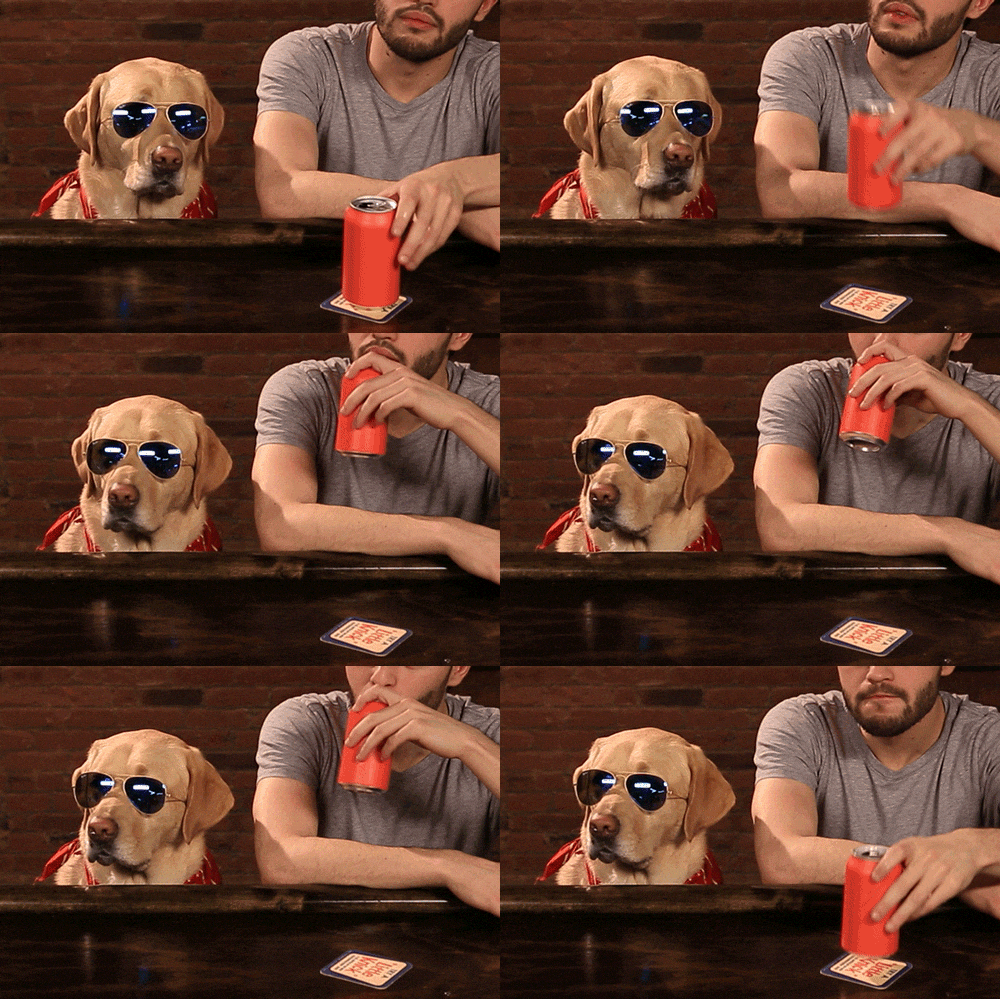
SHOW me there's a dog with sunglasses at the bar, don't TELL me...
I've heard that Steinbeck's work is to blame for this 'rule'. I can't hate the guy because he's a fan of quick, cool moral quoting like I am. I don't avoid showing and certainly, sometimes it's more effective to create a mood when you describe being swallowed in a man-shaped shadow rather than saying a tall man stepped in front of you. Still, more often than not, those that take the advice start to stack up a bunch of these: biting lips, balled fists, clenched teeth. These details can be fun to roll out for a scene where someone is pretending to be unbothered, but they keep telegraphing physical signs of tension. Other times, there's no build and these repetitions are doing quite the opposite. Unless it's truly effective, sometimes 'she was nervous he wouldn't come' is a-okay. Unless holding out that she is 'waiting on someone' or 'who it is' happens to be a good build, I'd push it through.

To be honest, there are just some genres where it works nearly every time, like mysteries or crime. When you want the reader to have to figure out the details before they are 'revealed' then it's perfect for this. I've heard some fantasy readers say they like it, but I find fantasy a place where dragging through every scene this way is tedious, both as a writer and a reader. Fantasy is more fun as a roller coaster, one where you change pace, structure, intent-- all at the drop of a hat for the sake of the story. You want those blockbuster twists. I'm definitely a fan of slow builds, but it has to stay relevant and hopefully interesting. There are many fantasies I just couldn't stomach unless they come out with an abridged version, because it became just as tedious with exposition as it did the very, very showy shit. Which is terrific if you're writing a proposal as a project manager. As a novelist, that shit needs polished up.

Here's another thing: like any writer I can talk a big game, but there's a big chance I'm breaking my own so-called preferences and rules. I'm probably leaning on a bias due to taste and experience. This is why it's okay to call my bluff. In fact, I appreciate being told where I've slipped up. It gives me a chance to reanalyze it and either defend why I did it or mentally seal in what to avoid in the future.

I wandered off of talking about back stories, but it came up because I was looking at my notes today. I haven't looked at them since I started drafting and realize I deviated a bit and still like the original ideas more. So I'll need to tweak the draft on that account, but at least it didn't deviate much. I certainly had the intent in line, so it's minor. 

There are some back stories that just don't fit into this series the way I intend it, but they also fit into the prequel area, a time long before any of the characters were alive in this story, back to where the trouble originated. I had originally gone with the name UnQuadrilogy with the intent to do more than four books anyway (because who doesn't like an intentional Douglas Adams-style gaffe, oxymoron intended?). So I think once I write the last of the main series, I want to go back and play with that prequel! I warmed up to some flashbacks in UnSung and I'll continue to throw those in where they fit, but I think there's a depth I want to reach that would just throw the main series too far off track to try to squeeze it all in.

So I'm thinking of a name for it already. UnFinished? UnEnding? UnTold? Perhaps I'll poll these later, but it's still quite the task to get these all tied up.

Chime in on this one, if you like. After UnNamed, UnSung, UnHeard and UnVeiled, which name do you think might make for a great prequel name?

Friday, November 9, 2018

Mad-Libbing It Up and Skipping Ahead

While I can't really talk about my stories while writing them, there are certainly some techniques for fast drafting that I can share with you. This is assuming you're up to the challenge or it's already a method you enjoy but are curious to see if there's some angle you haven't looked at.

Most fast work is sloppy work. Even people quick to whip out books and articles run the risk of putting out work chock full of errors. If your plots are simple enough or if you have a decent handle on grammar, you might be the exception. However, when drafting something trickier, it's entirely possible you can do a rather impressive job of getting it down and making it comprehensible for editing to iron it out.

Hell, I'll even add a bonus section at the end, showing how to throw out quick notes using Scrivener.

Mad Lib!

In a carefully treaded story, you probably stop, research, play with names, formulate those plots carefully... Do none of that; try this instead.

In place of the name or place or other unknown, plug in a word you absolutely won't use anywhere else. Persimmon, whorebag, igloo-- just grab at something off the wall and let it fill the place of something you might hang up on. Not only is it a quick creative nibble, it's a tried and true trick that makes replacing it later super easy. I usually advise to put it in caps too. If you accidentally misspell it then you'll catch it easier on a manual sweep. Keep a notepad or a plain text window open to record the word and a description of who or what it's filling in for. It might be a mini break in the flow but I've never had an issue with it taking me away as long as other options.

Skippy Dippy!

Sometimes, you want to form a subplot, some fun little opportunity for a bond, a development or a murder. You know the transition needs something but the inspiration isn't hitting, even boring you just thinking about it. In Scrivener, I sometimes create a whole new scene tab and leave it blank for later and move to the next solid scene, but if you're using a simple one document WP like Word, just double space, center text in CAPS along the lines of FIGHT SCENE #1, double space again, return to body format and move on.

If you have a solid lead on a subplot then give it your full effort, but if you're not quite into it, either give yourself time to warm to it or ditch it. Trying to force it out is mental constipation. Don't be afraid to rush on parts you're unsure of. You're going to edit later and you won't easily miss a spot you rushed through. You can always use a word processor feature like highlighting if you're sure you want to find it faster to fix up.

Bonus: Quick Scene

One thing I do with Scrivener is take my bare notes and throw them down right away. In a folder I start a bunch of new unnamed scenes, then take that document notes section and jot down any notes relevant to that scene. If you didn't plan, just jot down the quick version of what you hope will unfold. Name each scene something fun and relevant. By default, those names aren't going to pop up in your main document so you can give them spoiler names. Fall of the King, Poison Ivy is Terrible TP, All the Butts are Itchy, whatever. The idea is to set up scenes like you would for a play or movie. I usually stick to staying on one scene block until they change settings, but you can use them to isolate specific plots and perspectives as well.

Use each scene block's note section to type up a rough synopsis. You might be surprised by how fast you graduate into each transition when you've got the general idea peeking on the side. Mostly, I just type up a rough synopsis, but it's a good place to jot down new appearances or places and possible subplots. The Novel template contains subfolders for Characters, Places, and Research but you can make more of these 'hidden' folders to jump to while writing and refer to those as well. I usually find it to be more work than needed, filling all of that out and keeping it updated, but it can work as a style sheet or database just as well.

------

No matter how you write, I'd always suggest doing a rough outline of what you think you want from the beginning, middle and end. All stories benefit from structure and you might get stuck a lot if you don't give yourself something to shoot for. In the past, my unfinished stories were often due to running way off course. They would become boring or muddy and it would be difficult to find where I jumped off course because I didn't have any idea what course I was trying to take.

At the very least, do some basic linear plotting. Think of it like a pitch. It's okay if you end up diverting as long as you still have a destination plot. If you originally planned for the hero to die at the end, but eventually formulate a much better idea that you need them alive for, then adhere to the new plot, even if it's as rough as 'hero lives'. You don't have to write everything down. Even if you're pretty forgetful, once you light a fire, you can keep rough notes and still be on a clear path. Even if you're blazing full speed, you may hit lulls. I do this from time to time, where I think the path is clear, but the transition starts to feel like it could be weak or dull no matter how you swing it. You might need to work in a subplot or jump to another character. A chapter jump (switching to another character or even a memory/flashback/dream) can be a natural transition when you need to move a character to another scene. If one path seems stale, go ahead and cut it short and move ahead. Don't come back to it until the idea of writing it is appealing. You may need to rework something before it or find some clever transition. Remember, you can use other characters, scenes, timelines, etc. to blend subplots relevant to the main plot. Sometimes you get caught up in detail you can do without. It sometimes needs help by moving ahead without it. That's the beauty of drafting though. You can write it in any order you need to, so there's never a need to force what isn't working.

Wednesday, November 7, 2018

NaNoWriMo Doesn't Have a Difficulty Level

I'd like to sincerely apologize if, at any time, I made what I do seem easy. In the spirit of sharing Kryptonite, here's the reality. Other than being a queen of symptoms and few working treatments (the physical and mental concerns will always be playing a role), there are a lot of factors that come in between me and superhuman awesomeness. So many factors can make one story harder than another, no matter where you are as a writer. Maybe you changed genres or you're aiming for a novel when you usually write short stories. Maybe you're finally ready to work on something you hope to publish.

People will perceive that you're more experienced or successful based on preconceived notions of what you've done so far, but writing is one place where we're all not that much different. We want to shout it from the rooftops when we're doing well, but any momentum is something we may exaggerate because we know we could hit a block of some sort or life will just make it impossible to get to those ideas we're itching to nail down.

Like most people, I battle with tons of ideas with no sure-fire way of communicating them and struggle to find my strengths and weaknesses. I also believe in setting clear boundaries, which means I don't trust total strangers with my unpublished work, always building cautious friendships and talking about personal issues with a measure of earnesty and reservation. For every milestone, there's another unknown looming and at no point did what it behind us make it that much easier to take the next step or repeat something we've done before.

As much as my blog is about introspection at times, I'm terrible at keeping in the first person tense when writing because my mental headspace keeps panning outside of the character and ends up in third. No one wins baseball going from first to third. I have some odd preferences in writing as well. I try not to start paragraphs using the same first word of the one before it. I have a tendency to use the British 'grey' and 'glamour' while every other word follows American English. It's not something I do to stand out, but one of those things I've done as long as I could remember. My English teachers always wanted the double space after every sentence. That took a lot of work to kill that habit (and I still use Find to locate any, just to be sure). Given, these are small things and nothing that would shatter the story. However, you may have noticed, I'm an impulsive thinker. I do often have to put my story back on track when I start chasing shiny objects that don't need to be there. I spend a lot of time editing because there can be a lot to clean up.

Showing a few of my obstacles shouldn't give you grounds to compare. Oh fuck, if it's hard for her and she's done this much, then what hope do the rest of us have? (I've heard this a few times directly and it's mortifying to be regarded too loftily.) If you want to know the truth...

Exactly as much as everyone else. Call it being unable to take a compliment but you can call me amazing and I'll find some way to make myself seem ordinary. Even though I might know I'm amazing, it's a hollow victory if I give the impression it's au-naturale and you either have it or you don't. I had a lot of things working for me, but just as much working against me. Just like you. There are insecurities and egos-- the perceived good and bad can flip around, but you know what? Taking note of the way things slip away from you are nothing to be paralyzed about. Those are the key to your unique insight, where people will start to find you relatable.

I struggled a lot the first time I did NaNo but not because of the word count. I tried to write a book that an agent might look at. I looked at it the wrong way and even though I was satisfied enough to release it, I wish I had stretched it out more, let those characters shine more. Its sequel UnSung was where I resolved to ditch word count concerns and just write the story as broad as I needed the characters to be. It took eight months to draft because I needed to plot, plan and unify the details. Since I originally planned UnNamed as a standalone, I didn't bother styling it to continue. UnSung was born of what I wanted UnNamed to be. UnHeard will continue on the same way. If I thought for  one moment that the next book in a series would be worse than the one before because of forcing it, I wouldn't write it until I felt it could be better. Yet UnSung will wait to be completed because I wanted to see if leaving it open might benefit it as I continue. My first series was one I wouldn't release until they were done. It gave me so much room to go back and change things. While I didn't want to do the UnQuadrilogy the same way, I think that between UnSung and UnHeard, mutual contemplation might benefit them both. So I set UnSung aside to throw in a new approach for NaNo.

The first time I neglected the free-writing part. Don't edit as you go, don't stop to plan, just wing it and learn to clean up the mess later. I was curious if I could not only wing it on a complex fantasy but do it on a third book when the second was still in edit. Not only is it freeing, I don't feel tethered to notes or plans that I can always work in later if I like the original plan better.

I'm going to cut into the fat here-- I used attitude and mentality to create the hurdles of difficulty. If headbutting the challenge was working against me, I could change tact. It's not the same as quitting or admitting defeat. Writing isn't factory work. It requires very volatile things that demand only flexibility. The only failure is killing your drive by slaughtering your talent. You do not enjoy your favorite things because you think you should. It doesn't matter if writing falls under work or play, you are ultimately in control. Even if your characters run amuck, you get to grab the reins of the story and the edit and the vision. It's not censoring them or watering them down; it's bringing them to harmony with the elements.

(This is especially true when I've written something too quickly because of a great mood and momentum. You think it's untouchable but it's actually where you really want to dig in.)

Every character doesn't need to be wise or quirky or fucked-up or deep. Loving them too much will squeeze them flat. It's probably hard to face your own mortality, especially when you superimpose yourself on to a character. But...

Read the 3 Faces of Eve. Do yourself a favor and read an account of a woman who had to kill aspects of herself to assimilate them. Killing your poster child can be a sign of metamorphosis, not self-loathing. If your writing suffers from overloved characters, understand that killing them, either literally or figuratively, is about growth. I didn't die when my mom did. When I die, I won't be around to care that I did. Even the Death card in a tarot deck is about change, the end of something and the birth of another. It doesn't matter if you tend to be hypersensitive and empathetic (guilty of both, believe it or not), if your characters are really independent entities meant to show off their humanity, making them superhuman does both you and them a disservice. No one expects you to extol the virtue of your beliefs through every character.

Whether life or change or NaNoWriMo is difficult is up to how you learn to adjust it. Even in the throes of a panic attack, I once stopped it by thinking "you gonna cry, Barbie?". Hyperventilation turned to laughter and I like to believe I forced a chemical I lacked to release and counter it. No, depression doesn't disappear with happy thoughts. While I know how to trick a lot of moods now, some are still dangerous and stubborn. I have a mental medicine cabinet that must be tried every time, but until I do try everything I can think of, I can't give up. Don't say you can't until you've tried all of the things you can.

You don't get to always decide when to be happy, when to write, how much to work. Americans have been groomed to think we should do things anyway, even if that path is a long walk off a short pier. No. Just no. There are choices and consequences. Don't let people shame you into being who aren't you. You know you'll be the one to deal with it so weigh it as only you can. Tell the Captain Obviouses to fuck off.

I'm gonna be a tireless cheerleader this month. As much as possible. I know what it's like to be low. Doesn't matter if anyone reciprocates it on my low days. I always find a way to crawl out and fight. What matters to me is people finding the joy of writing. People often get lost in that when demanding something from it that isn't guaranteed no matter how much you suffer. It's never a more important time in history for people to learn to reconnect with purpose and one another.

It's easy. It's hard. It's up to you. Whatever you do, do it with an open mind.

Underwriting: Don't Skimp on Learning Grammar

You don't have to be a spelling bee champion or an English major to be a decent self-editor. While I encourage all writers to find their own paths to fulfillment, I see far too many who are really poor with words who simply think that passing it through Grammarly or paying an editor will clean it all up.

However, first and foremost, it's your job to convey meaning in those words you choose. Just like it's a pet peeves when someone asks a writing group to come up with ideas for their plots, the expectation that an editor with even survive a couple of mediocre paragraphs is delusional. If you find you're severely lacking a basic essential skill in a career path, there's only so far you can rely on co-workers to cover you before they start to resent you, avoid you or warn others to do the same.

If you're a hobby writer, it's good to announce that prior to asking for a critique or edit. The occasional misspelling is forgivable in most cases but I've seen sentence structure with nearly incoherent wording do nothing but confuse. If a writer defends it as a style choice, I'm wary of their ability to take criticism. I won't point out awkward wording if it's consistent to the conversation, but calling it style in narration that otherwise never supports it is a red flag.

I may have said before that this is why editors offer 'free' introductory readings. This is the place where they can decide if your work is something worthwhile for them to continue. Finding an editor is about building an honest relationship so if you can't seem to get one based on the mess your draft is in, consider it free advice that your writing needs more self-improvement.

Certainly, it's disconcerting how many people get frustrated that they can't find readers when their message to ask for them is a grammatical nightmare. How many people think ideas alone are strong enough. If you have ever checked out comments sections alone, you'd be aware that grammar ninjas are in no short supply. Sadly, that's about the extent of free advice though.

You don't have to labor through excruciating grammar courses to improve. Grammar Girl's Quick & Dirty Tips is a fun site to pick up rules. When you use programs like Grammarly, assess what it is telling you and further research wording arrangement and structure. You will learn over time that passive voice and ending in conjunctions do have their place. Find what exceptions work. 

It almost sounds like some writers are bragging or making light of being poor at grammar. I'll never understand the culture of dumbing down as something to be proud of. As a hobby writer, feel free to never improve. I don't get it but it's your party. However, if you claim to be a serious writer, get a decent fucking toolbox. Otherwise, don't be surprised no one is interested in it.

Tuesday, November 6, 2018

Passed the 21K mark!

NaNoWriMo is one of those occasions where you're missing out if you don't try something new. Sure, it's great if you have your tried-and-true processes on lock, but it may be a great opportunity to leave a comfort zone if the confidence is there.

This time around, I'm doing the free-writing thing. In the past, I've always sworn by planning carefully and getting it all mostly right as I go. Less to do, more confidence, right? Well, no, not really. I didn't actually save myself from any work. I would still have to go through the steps of editing and redrafting several times to refine it, no matter how carefully I approached the first draft.

I've found a new sort of confidence. While I definitely planned since my NaNo draft is continuing a series, I decided to abandon things like getting the names of side characters right or fully sticking to a plot if I was uncertain. Rather than dwell on feeling great about it, I wrote a rough idea for what might take place and moved ahead. I thought this might mean that I'd constantly think about it, but instead I'd find where my brain wanted to be and it was quickly forgotten. I found that conversation was coming more organically (something I struggle with) and that plots were more exciting to me, even letting me take quick notes to go back and add later, but flying ahead almost seamlessly.

What I thought would be messy is actually pretty damn efficient in a story and world I've now gotten to know from the 300K+ words in the two previous books.

If your book doesn't need planning (a simple quick standalone or short stories, for instance), then this is the place you're probably writing from to begin with. You'd probably think it gets harder to keep track of a world that is filling up with rules and logic, but I've found that I can rely on my creative memory more than I thought. I'll definitely check for consistency later, but right now, I've got my fingers on the pulse of an erratic unfinished series. Just like checking a heartbeat, you have to keep your fingers on the pulse diligently lest you miss the delicate signs of a problem.

Editing might mean a lot more red pen, but it's no more intimidating than getting a funny story stuck in your head and finding the right words before you run into someone to tell it to.

In fact, I overheard a really stupid end to a phone conversation yesterday and I thought about how to tell it as I was walking home. The more I played with the words, the more I knew where to add emphasis and by the time I delivered it (to my sister that morning) it was way more successfully told than it might have been if I'd stumbled through the recollection.

Walking for inspiration is a tried and true buddy of mine. Combined with the spur of the moment and planning, it can be a long-lasting marriage.

I'd love to tell you the very short story, but wow, my alarm went off. Time to get the boys from school already? I totally got lost in my writing goals today! Excellent!