Showing posts with label creativity. Show all posts

Sunday, September 15, 2019

Craft Mojo

It would be amazing if craft mojo was something I could summon on command. Artists, writers, creatives in general, all face a sort of on-demand attitude from people who... Well, aren't creatives. Okay, we're ALL kind of creatives but there are certain types of creativity that are inevitably wishy-washy. Writing nonfiction is about gathering facts while writing fiction requires tapping into a fickle world that sometimes isn't bridging the gap into something translatable. Web design is using a visual space while sculpting is about manipulating a physical space, and depending on whether you're using a source or pre made assets, there lies the difference between organizing or creating original content from imagination. Imagination isn't really a wholly logical space that can be harnessed. Nor should it. Part of the thrill is the slippery, wild chase to catch it.

Inevitably, what is drawn from imagination sometimes get jumbled for me. It doesn't dry up or burn out, it just comes gushing like a waterfall and I'm standing at the bottom with a goldfish net. Often, I play with a lot of snippets before I expand all at once, able to start producing with insane efficiency.

Which is why giving advice has always felt tenuous, or like I was giving recipes with no way to list the ingredients. I've got my craft mojo, so I feel like I want to describe it but I can't. It just means over the past week, my goldfish net traded up. I'm probably catching mid-sized sharks but that's a good sign. The burgeoning ambition was simply a sign I'd been in the throes of mania. It really wasn't that good for me in the long term.

In any case, I started crocheting a cupcake for my friend's daughter's birthday and an Ezio plushie for my nephew. Yesterday it was a small yellow flower shaped dress for a small doll. Tomorrow...

Well, I can tell you what I'd like it to be. I'd love to work up a swimsuit and wig for my doll project, keep working on the crochet I started. I'm not in the headspace for writing. Right now, that part is a stream, frozen on the surface, rushing beneath. Ideally, the ice will crackle and slough away in time, but I'm not looking for it to be the rushing river. 

That place was too much an obsession, too much a diversion to pull me from pain. When I first started to slam through writing, it was a way to salve the grief of too much loss piling up. Once I healed those wounds, the writing itself had masked too many bad habits picked up. My health started another decline and I had to face that there are aspects of myself I'm blind to and I needed help to get back on track.

Don't look for a secret to creative mojo. Just understand there may be some intuitive signal that there is something else needing attention. You will find you are more productive over time, more thoughtful with what you produce, if you listen to those urges that go ignored. Now, I'm not talking some serial killer urge. Lock that way the fuck up. But if you've got some voice saying you suck at self-care, maybe take a breath and listen a little more closely.

Saturday, June 1, 2019

Practice, Practical, Published

Mental filing... It's a practice that a good deal of writers share. Having or developing certain habits that improve our work, one grueling realization at a time. Stories become tabbed in colors, sorted into scenes, styled for conversation.

Inside of a project, there are plans. It's not exclusive to the plotter; even the pantser tends to form some hopes, goals, remnants of what possibilities may lie ahead. It doesn't matter if you're obsessively planning or abstractly snatching ideas as you go. Unless you just throw shit on paper and hand it off to some poor editor, then everyone has a pretty solid basis for some kind of planning.

Because I keep adopting projects that weren't on my priority list, I've thought about the certain... permissions I've started to allow myself creatively. Before it was all about the Practical and the Published, as per the nifty little header up there. There had to be some consistent work towards something, no matter how little or how I felt about it.

I didn't want to feel aimless again. I fell off of dieting and exercise. It had become an obsession, and a miserable one, and I realized it was just unhealthy in another direction. I've fallen off of so many plans. It's easy to overlook my successes sometimes because of the scars of that shame. A clean bill of health, finishing college, working to supply my dreams--doubt lends to a special sort of amnesia towards our own successes at times. Because any kind of pain can weaken other parts of you, it's too easy to forget that you've proven the opposite and overcome what slows or stops you once more.

But it's the Practice I sometimes lose sight of. Those pieces with no aim other than leisure and enjoyment. Those respite pieces that pull more powerfully. They aren't your practical priority but they become an undeniable mental priority. Earlier today, I sat down to read a book, but every few seconds, I thought about the foil paper I just got in the mail sitting on the nearby table and wondering what it would look like as a border.

You try to ignore those stubborn requests because you have 'better things to do', only there is no damn quality in what you should be doing as long as the little nagging desires find a home. It's the same drive that has us stopping to jot down notes while writing a story; you just know that if you can't satisfy it, you'll just keep tripping on what you're doing to get to it. So I punched out a few borders, gained satisfaction in that knowledge and was able to focus on reading again.

Not every block is a block, of course. Some are just mischievous imps with bubble gum tasks. You toss it a bit of attention and it finds some other soft-bellied punk to tickle.

... Although I have quite a bit of reading to do this weekend (a task I'm more than happy to do for my favorite real-life writer friends), I'm poking at my next nagging drawing desire. I won't give it away, but I'll give you the one word title: Totem. I'm fond of simplistic one-word names for images. I don't want to force too much of the verbal into it, coaxing the viewer to see what I'm after.

Remember the last two pictures I did? The sci-fi warrior girl was titled Emergence and the sad pink forest princess was Gazing. I named them before I was even sure of what they'd be because they were already something before that. If I were to enforce something concrete on them, it might've boxed them in. When you lend a piece an abstract theme, you give it room to grow.

This is also why, whether I plan on finishing a blog, a story, or any creative piece I always give it a working title. It could be tentative or it could tangle in better than I thought. Even after it's finished, I'll be looking for another place for it or another.

But first, I have to give it the honor of being a Practice, a Practical, or a Published priority. That, too, isn't set in stone. It just helps me set the stage.

Friday, May 24, 2019

My Hiatus From Writing

Although I technically write daily, after a few weeks of none of that being drafting, there's a point where I've honestly accepted that I'm not really working towards those goals at the moment. The admission is scary for some, but it can be a motivational tool; if not, then it's certainly a mark of accountability.

There are reasons, of course. Good ones, even. Still, I consider the reprieve as a yellow area, a warning that will start to darken and haunt me the longer I disregard it. I can certainly be satisfied that the ideas are growing, the scenes find better ways to unravel, but the more I consigned them to notes, the less they'll bloom fresh in the pages of a draft. I already know; it is possible to overplan as much as under.

Even drawing and crocheting has felt segmented from direct purposes. While this isn't the same as burning out--insofar, I've been enjoying these things in small doses still--I can't be too careful. When I love something, or even obsess on it, it is just as shaky as an addiction. We never feel the point where the fun and control plummets into dependence and desperation. It's not creativity that I dip into at all, or the addiction comparatively. Creativity is not the place that is difficult to go; it's the place I'm from. In a way, it's reality that is closer to the addiction. It's the reality of life that makes me breathe shallower and holds me under at times. It gums the gates to home and makes the air itself thick with obstacles, stretching my skin like a canvas along the way.

But I've given myself a yellow flag. The reminder that I've spent too much time anchored away from myself, that the pining that grows cannot be allowed to continue. I have to cut ties, find what is holding me back, be willing to stomach the strange faces that wonder why I'm retreating when nothing seems amiss. Because going home means a place where I don't check messages, I mumble to myself, I don't ever know what day or time it is and I'll screw up my face as I pause to answer questions even about myself. At home, I'm not all here. You'll think I'm upset but it's the exact opposite. My energy just goes to home. It's not this side of me that anyone should worry about. It's the one where I'm smiling too hard, too worried about making sure I'm not worrying you, stressing over the same trivial things that are supposed to be normal.

I'll get through today in a blur. Tomorrow, I'm starting the day doing laundry and baking cookies. The rest of the day, I'm looking for the bread crumbs back home and making a mental note to better mark my way back. I've been away too long.

Tuesday, December 11, 2018

Run-On Sentences, Run-On Mind

Many new writers stumble on the run-on sentence at some stage of their development. As with a great deal of concepts strict grammaticians frown on, this is one of those yellow flag areas that are at least worth looking at more keenly when you spot them in editing. 

What can it say about you as a writer? It hardly means you're inexperienced or careless. What it can betray is a hurried need to connect thoughts without taking a breath, almost begging your reader not to abandon ship. Musicians will be familiar with the term breath-marks which, like commas, guide us both mentally and when reading aloud to... pause and feel the rhythm, connect the words. While I'm personally a fan of fragment chains that connect several events in synch, there are also times when I'm simply showing a reluctance to create the pause of a completed thought with a period. Examples of places I've caught renegade commas and how I correct them?

  • She does something but what he does is something else; he gets a semi-colon, not another comma, especially when they have their own adjective and action fragments.
  • Her action has many fragment chains, many thoughts. Her new action is different and no longer a part of that idea.
  • I really want their actions to happen together so I reflect that—oh, noooo; an em-dash to continue it. Don't use an em-dash to avoid a comma that should be a period.
Use paragraphs as the indicator of what thoughts and actions run together. Use shorter paragraphs to denote a faster pace where you aren't looking too closely. Use longer ones when you want the reader to slow down and contemplate. Visually, this is often an unconscious signifier so trust your readers' instincts more. So what are some ways paragraphs subtly lead?

For one, use it to keep conversation neat and limit those he-said/she-said's. This has its own sub-examples.
  • "I'm talking." She picked up the microphone before continuing. "You're listening."
  • "You're talking," she commanded, but it was clear she wasn't done talking. "Let me get a drink first."
  • "They're talking—" Her look dared him to interrupt. "—but I'm not listening."
Now with the em-dash interruptions come other techniques; you can start the interrupted sentence, use a new paragraph to start a verbal interruption, then yet another so the interrupted can em-dash/speak the rest of their sentence over them. Interruptions can be tricky business in novels since your words and actions are visually sequential rather than able to layer like in movies and other visual media. However, this is one of the ways you can introduce that occurrence. May I add that it's usually a good idea to really cut out any he-said/she-said tags if possible. Try to isolate the speakers to two possible culprits before you use it. 

Example:
Chisa was done with Hara's whining. She stood in front of Hara, an expression demanding Hara's full attention.
"Listen, you whining little mess, you—"
"I really don't need this..."
"—are just going to have to learn to set aside your drama and do what needs to be done!" Chisa tossed Hara the dirty bucket she'd dropped on the stool. "Start with this. These walls aren't going to clean themselves!"

Now that example includes the bonus of the paused speech-action-speech paragraph. In this way, I could avoid insisting that Chisa yelled, said or any other obvious variation, and just focused on her action before continuing. We get pretty quickly that she's irritated so you can trust the reader to pick up on that and focus on the fast pace of a tense moment.

Let me reiterate that run-on sentences are still a yellow flag, not red. Sometimes they work. They can create a cascade of words that leave you breathless. Sentences carry their own rhythms and at times, the effect of a long sentence can actual captivate the reader. Then, a short point can be more powerful.

She ran and ran but, no matter which way she took, there was another door, another wall, so her steps grew shorter and slower, then not at all. She had nowhere to go.

In that quick example, there's even a sort of poetry to the unintentional spacing between 'wall' and 'all' that creates a rhythm in the moment. For some, that subtle use might make us aware of holding our breath or even a racing heart if this is a build in a suspense scene.

You can excuse a busy mind as the initial reason for run-on sentences. Certainly, don't set out to eliminate all of them on your edits. Endeavor to limit their uses to where they might be most powerful. Be more critical of any sentence that exceeds two or three commas. Rework them if they just don't assist in the style or pace. 

Just like the use of fancier words, you sometimes want to save them where they are the exact word for the situation, not just proof you know how to use a thesaurus. While the 'very is lazy' idea is one I stand behind, I'd recommend using 'very happy' if you're writing for an audience that hasn't learned the word 'ecstatic' yet. Young readers are hard enough to snag these days, so limit where they detach from your book to look up a word.

In every case of the word 'rule' being thrown carelessly about advice for writers, there is ripe opportunity to find the exception. Even my trusting nature has learned to believe all rules have exceptions, so don't excuse a trusting nature as reason to accept it as the only good advice. Go ahead and challenge yourself to aggravate grammaticians—write a 50+ word sentence correctly using at least one em-dash, semi-colon, a comma and a period. Why? Because you can. There's a correct way to bend any rule so go ahead and challenge yourself with it. Why not risk doing it incorrectly even?

It wasn't because she hated him or even herself that she scratched his lover's name into his window; for her, it was an affirmation that she had no place in his life—as if she'd ever had a proper place at all!—and this was simply her way of moving on.

Hey, now, I couldn't just pose it to you without attempting it myself, could I? So give it a try. First, sort out how they are used, then create a sentence that can carry on the task. How about... not making much sense?

I've never been that blizzant about purple picklesnarf—my grandmagi would attest to this— but if you never get the opportunity, then disregard what I'm about to say; for the rest of you, I'd caligant to the nearest harsram before Ankersdam before you regret it for the rest of your unnatural lives.

That one sounds a bit Lewis Carrol and Tim Burton writing a sci-fi collaboration, but you get the gist. It's less about making perfect sense all the time and more about having fun with words.

So let your mind run-on from time to time, even if you're normally a very serious writer. Especially if you're a serious writer. Just like the best scientists are creative-minded, being a better writer involves abandoning some comfort zones.

Either way, don't red-flag those run-on sentences. If you want to feel them out, read them aloud using the punctuation marks as guides. Chances are, if you need to stop to take breaths because your style is leaving you winded, that is where you might benefit from a different strategy.

Hope this one serves you well. I might do more posts combining style and grammar in the future. I really enjoyed this one at least. Keep writing, peoples!

Wednesday, November 14, 2018

Color Obsession

I'm not starting this one with any attempt at racial integration (and really arguments involving sexualization/food corresponding with skin color are mentally fucking exhausting to me anyway). No, in this case, I want to poke at how color is used in writing. Namely, starting with a gripe-- the need to use a different color word every time someone describes the eyes, bodily fluids, etc.

Why? Because colors aren't really that interchangeable on some levels. While you CAN compare a skin color to caramel and people can easily picture that hue (whether it's favorable or not), you can't as successfully interchange turquoise, aqua, sky blue, cobalt and any damn blue you want. Whyyyyy?

Number one, and probably like you, the audience doesn't know the difference like it is displayed above. Yet, they'll probably notice that you use a different color every time. Even if you think it might be clever to attach those colors to every mood they have, the reader is probably just going to think it annoying or pretentious. Okay, don't really care about that in the long run, but I will say it irks me that writers think this somehow enriches their writing when it doesn't.

I forget who said it and I'm in free-writing mode to warm up to NaNo, but it may have been Ursula Le Guin but it could be Tolkien for all I keep track (again, please don't take my word for it). In essence, the idea is that repetition is not a thing to be strictly avoided. In an earlier post, I covered this with a sub-heading "Sometimes an apple is just an apple" although that was more focused on someone detailing a fruit to try to be creative rather than it being interesting or relevant. Yet still, it tapped on the idea I'm after here with color-- that it's okay to just use the exact word that you mean once again rather than always finding a similar word to avoid repetition. Don't say 'a round object used to make transportation easier' if you mean a wheel. Simplified words are far more indicative of your intelligence and creativity. Trying to use many similar words interchangeably runs the risk of sending even intelligent readers too far off course of vocabulary knowledge.

As for colors, yeah, you can get away with using turquoise and teal to similar effect. However, traditionally, people do picture turquoise to be a darker shade than teal. As you can see, turquoise and aqua even sit in similar shade groups (but sky blue and cobalt are nowhere close).

I'm not saying not to pull out a 'viridian' or 'canary' in your writing, just be maybe aim to be consistent and even scarce. Let lust darken their eyes or happiness lighten them, but don't always feel the need to find the word for that color or mention it at all. It can just be lighter or darker and 'a shade of green' if you must. Although in actuality, that's a bit wordy, maybe that will convince you to be simpler, vaguer, because it's just not that important to the scene. Many writers will insist it IS important but then get frustrated when their readers constantly point out that it was distracting rather than helpful.

Moving onto blood... yes, it can have meaning in the shade as well. Thin blood is brighter than thick or coagulated blood. Dried blood is brown. However, fresh, coagulated, and dried are all powerful enough words without the ruby, crimson or brown attachments. In cases where the wounded doesn't realize it's blood at all, their perception of shock accompanied by it being warm, sticky or reddish before the realization of pain or property sets in can work to invite the reader to realize it before they do. Being too coy about 'ruby droplets' can infantilize an otherwise powerful scene rather than add mystery. Yet the pulse-born steady gush of a deep wound can add the right effect. Rather than be married to the stream of colorful words, you will still find depth and purpose in the words you more carefully select.

Again, let's refer back to 'killing your darlings.' Sometimes that inspired outpouring of prose will need to be butchered down to simpler elements to consider pace, structure and plot more. There is a reason you find more blog posts concerning those things rather than creative writing. Most creatives come by the minute details naturally, but the experienced writer will cut these down on the revision. Being married to words can be a bitter relationship that muddies the story. One hard rule that is still flexible is that the story comes first. You don't need to bury your voice, but don't let it trump your story either.

In the interest of detail, one way to make repetition less cumbersome is in the presentation of the sentences supporting it. I tend to have a love for towering spires and I also love that the word is exactly the right one. Yet when I speak of their features at times, I'll play instead with the adjectives-- make them catch the sunlight or glitter from the stones they are made of. They're jutting or proud or neglected or crumbling. Even then, I try not to obsess on them in a series of paragraphs and even labor to not give them more prominence than they need. As for whether the word is used twice or more in one sentence? Learn not to let it bother you if you need to use every instance. One of the best places for variation will always lie in the adjectives and verbs. Those are expressly made for the job!

You may have noticed I have a particular obsession with color, but it's something I don't force on my writing either. Unless I'm writing a story about a character that shares this obsession, I'm assuming too much as the narrator. If I need to flex these muscles, I'll write that story, but not every story has to be the vehicle for every bit of knowledge and passion I possess. Epic fantasy especially has no shortage of richness that doesn't need any help to boost the word count. Take my latest finished draft, UnSung, as an example. It currently sits close to the 250K mark and may see a higher count still (there are a couple of short scenes needing added to boost a later plot thread). Nevertheless, I really had to plan and pick to isolate it down to the proper pace for the story. It didn't need extraneous poetic filler or info-dumps to get there. In fact, it would be a hard sell and a tedious story if I'd done so.

Summing it up, don't hesitate to flex your vocabulary, but mind how you use it. Use words that don't require people to run to a dictionary. Even when I use fancier color words, I sometimes expand the context the first time I do. "Those viridian eyes, deceptive in their resemblance to the hills behind my childhood home, were far too cold to harbor any of the warmth from my nostalgia." Save sentences like that for where they can make an impact. Be concise. Be short. Then, hit them with the power of an effective chain. Just like candy loses it sweetness when over-indulged, words can lose their power as well.

Writing is trial and error more than do's and don'ts. Even 'do's and don'ts'  is heavily debated, but it's agreed that whichever style you use, at least be consistent. Some effects are better used sparingly, others will need a stricter hand. You'll get a better feel with this as you butt heads with all those damn 'rules' out there. Go ahead and fight it a bit, but keep in mind, your average FaceBook writing group will endlessly encourage bad habits rather than risk offending you by saying your usage was tedious.

All writers are obsessed with words in some sense. Yet finding your voice will come from your inner critic more than your free-flowing creativity. First drafts are often like falling in love, where every word feels right. So many writers become dismayed by how bad the reread is, but understand that that is a passionate but worthwhile response. Never completely silence the need to do better at least. No matter how you improve, it does you good to embrace the skepticism and use it to strengthen the intent of your stories. It's not because you suck and should give up-- it's because you care enough to want it to be the best you can make it.

It's my hope that you can take away some inner strength and criticism alike. Now I need to beat some fish who keep scaring the shit out of me by knocking over rocks. I swear they do this on purpose just to get my attention, so attention they shall get (even if it's not what they were bargaining for).


Wednesday, September 26, 2018

Bestiaries are the Best!

Bestiary... let me copy-pasta this first...


bes·ti·ar·y
ˈbesCHēˌerē,ˈbēsCHēˌerē/
noun
noun: bestiary; plural noun: bestiaries
  1. a descriptive or anecdotal treatise on various real or mythical kinds of animals, especially a medieval work with a moralizing tone.

I do this because a friend of mine almost immediately asked me what a bestiary was when I said I was doing one for my ever-growing list of magical abominations. Can't assume this is common knowledge if even my nerds/geeks aren't all on board here.

If you told me a decade ago that I would ever care to do one, I'd have cocked an eyebrow at you and told you you couldn't pay me to do one. I'm an artist, sure, but I had this odd niche in my twenties where almost everything I drew was a female and possibly a fairy. Still, animals were not my thing. I couldn't draw them from memory, but I'm pretty decent at drawing based off a picture. When I say this, I don't mean the exact picture even; I could discern how to draw it from other angles based off of the anatomy. I just didn't have the exact form locked in without seeing it.

The first time I had to cave in was for a college project in character design. The task? Create a mythological creature based on two or more actual creatures. Source pics, an anatomical skeleton and at least three natural habitats it might reside in. I... was not happy. Like most things I was not happy about drawing, I did it anyway. Mostly as some snide decision to prove I sucked at it, even though I was always wrong and it was always pretty damn good.


Not bad, right? I'm glad nature doesn't actually make these horror combinations of alligators and pelicans, but I realized I didn't hate working with animal anatomy. Certainly knew I always loved human anatomy and I even loved the hell out of AP Science classes in high school, but I'd never really wrapped my head around enjoying the two in combination.

I didn't exactly unlock Pandora's box just because of that though. In fact, until I was making my senior portfolio years later, I didn't think to do it again. This time, it was an axolotl/hummingbird.

Again, years passed before I thought about it again. I can at least be consistent in forgetting things. This time, it's for UnQuadrilogy. I didn't start off intending it to be like this either. I love using polytheistic mythologies as a theme, so I set out looking to write a single novel about a man once more shaking away the perfection of gods by revealing their mistakes. Somewhere along the way, I woke a dragon, in the multi-layered literal sense. I also woke a four-book plan to align with the mishaps of the Four Gods in question. It didn't stop with dragons (in fact it didn't actually start there. Heh. There was a giant snake before that one, to be technical). UnSung came along and the little bastards started cropping up everywhere. And like most plans run wild, I realized that a new stage of planning was inevitable.

So along came the bestiary. I could say my years as a gamer was actually where this became a thing I was aware of. It wasn't fantasy books. I still remember my mom introducing me to my first fantasy book while we were sitting at Pizza Hut and I was clutching the Dragon Warrior manual for the Nintendo and going on and on about the story of the Dragon Lord. She told me I should read The Hobbit. Although I enjoyed the riddles between Gollum and Bilbo, it wasn't an immediate favorite. In fact, I started delving into fantasies and developed a love for Russian fairy tales. Bartek the Doctor and Finn the Keen Falcon were favorite short stories of mine. When I started expanding, it was actually Anne Rice that came into my view first. Beyond the Vampire Chronicles, I fell in love with Garth Nix's Sabriel and Sara Douglass's everything-else. I always loved dark tales with improbable romance and deep lessons.

I just wasn't into the sort of fantasy books where bestiaries were used. Tolkien was just okay for me and I still have yet to pick up a book by names I see often-- Brent Weeks, Patrick Rothfuss, Brandon Sanderson. I won't go into the fact that somehow female writers are often pushed into romance subgenres (even though men have proven to be just as sensitive/romantic/sexual as writers). I've done it to death and have nothing new to add, but needless to say, I've just never been into fantasy purely for the world-building, creature roster and sword swinging. I'm told that Sanderson heavily plans magic systems in his tomes and, after trudging through the House filler of George R. R. Martin, it sounds about as exciting as a dentistry manual. 

Don't get me wrong; I love planning the logic as much as the next geek, but I've become conscious that it makes for tedious reading. Everything needs a solid base. Houses also have impressive foundations, but their beauty doesn't lie in seeing what went into it.

Bestiaries are my new fun project, but it's not something I think anyone will actually share in the enthusiasm with. Who knows; I might have those kinds of fans that do. In that case, I'd love to share my post-publishing notes and side projects here and there. For most people, even the most devoted, nope. When I love a book, I don't even assume I'll like anything else they've done. It might be worth looking for the next in a series, but I don't wade through half a dozen 'bad' books before I give up-- I'll give it about .2-2 entire books before I'm done. I can appreciate different fans and fandoms and I don't begrudge anyone their success, but I honestly just develop the books that I would want to read.I used to love the thrill of discovery, but my level of patience started wearing thin.

Writing was largely about creating what I wanted to see. It wasn't some lofty decision that everything was crap. I was looking for an instant fix and I was getting a lot of great ideas. Like everything else, I labored to be good at it, but ultimately, I set out not just to enjoy something but to see if there's some overlooked aspect that I might enjoy more than I expected I might. Even if you think I'm really good at a lot of the things I do (and I'm not so falsely humble or lacking in self confidence as to disagree), my tastes are tricky to pin down. Nothing wrong with that-- Stephen King became more prolific over time. You can argue that success afforded that, but self-publishing has removed that as a luxury a writer has to earn. Now, we can publish what we want AND be poor... (yeah, it's not really an advantage, but I still love it.)

Maybe I should talk about what's involved in a bestiary. In short, whatever the hell you want. Does size matter? Eye color? Species names? Strengths and weaknesses? Essentially, it's just a character dossier for the creatures. In this case, there will also be humanoid creatures. Many of them can communicate intelligently with humans, so it would be a much shorter bestiary if I limited it only to the sentient, hostile, or purely animal sort. The ones that are main characters in those categories get their own profile considerations, but again-- this be on a needs basis, yo.
I might post a sample page once I have one complete. I've organized them loosely at the moment in the order they appear in the books. This might change. As a designer, flexible elements are part of the job, so I've made everything in convenient drag and drop pieces.

When it comes to my books, I'm a writer first and foremost. I don't actually have a set way of looking at my characters and creatures. Aside from the details actually pulled into the book, I have no actual 'canon' and those other details are flexible, sometimes changing. Very different from how I view floor plans in a previous post. I do floor plans to lock things in, but I do character sheets and bestiaries to play around with possibilities.

Up until NaNoWriMo, I'm throwing open my creative doors again and doing things on impulse and need. I'll put out a more detailed bestiary post later once I've fleshed that out. I'm spreading out the scheduled posts since they'll continue to be more scarce as I focus on other things. Even if they trickle to 1-3 a week, I'll still make an attempt to keep it up.

Onto the creative now!

Tuesday, September 11, 2018

Planning= Laziness

The header is not a personal rule or even an exception. It's Switzerland (neutral, for the younger ones). I have actually been less goal-oriented over the past few weeks while calling it planning. It has none of the structure of an actual workflow. It's far from being reliable but it's had some unforeseen boons nonetheless.

In fact, even my usually unusable dreams have actually been game for inspiration. One particularly weird one has become the outline for a chapter or two of the YA Steampunk Fantasy novel I've been poking at for the past few years. I've always pictured this series as something straddling real-life places (the kind of places that are damn near magical in reality) and sinking into the completely surreal. Glassy metropolitan streets, quaint cafes, and suburban sprawls to remind the reader that extraordinary people come through humble places too. A bonus to me because it will involve some couch tourism, finding some hidden gems of human invention, research and mind expansion on a budget.

Which is part of the problem. I'm used to creative bursts having a sedentary quality. It's also why I've made walking at least 8 hours a week a mandatory part of my routine. However, 'planning' is something I usually pair with something more active because of its tendency to create complacency in productivity. I don't stare at a blank page and force the muse to get busy so it mostly relies on inspirational spurts rather than an active effort. It's nothing like just throwing words into the big project or even taking notes of what might work later if I make a note to try to aim for that development now. I wander away from the writing and start doodling.

It's not wholly unproductive but it can feel that way. There's a sense of ennui in looking for inspiration, oddly enough. It's a background contribution so it's less visible but it's still a backbone in the machine so I've given it credit there. However, a YouTube search for a general idea can easily lead to hours of watching videos that have nothing to do with my story goals. Hey, some off-the-road wandering can lead to inspiration but some, I have to admit, do not in the slightest.

Focus does not come easy for me. When I do find the magical all-in activity, I am single-minded to the task. Planning is a bit of a nemesis there because it actually plays the devil's advocate against my intentions, encouraging unfocused, capricious wandering. Again, I can get lucky and stumble on a focused and usable train of thought, but more often, I get the retrospective feeling of derailment.

Regret? No. Trying something new comes with rough edges and delayed productivity. However, it's a shiny new object that may become a valuable tool. Even if I never get comfortable with it, those are the lessons that stick. Things that work almost become too comfortable so we more keenly remember the things that threw wrenches in the works. Avoiding the same pitfalls is a skill too. 

I wouldn't say this planning phase was a lost cause. Not just because of the usable dream. Not even because it did give me the ability to learn to relax my rigorous workflow. It had its pitfalls, but it was more akin to a good memory of my childhood. I kind of reverted back to my teenage years with the grabbing for notebooks, doodling and bursts of zaniness. It takes on a different flavor at this stage in my life, but I felt more connected to my long-term writing goals. This was always about creating the best stories possible. Ideas like improving my craft, studying structure and grammar, looking at the market-- those can murder and discourage the natural flow if I become too obsessed with it. They aren't unimportant, but they can't be allowed to supersede the main goal. Do I want a trendy conscientious choice or do I want to dig deeper and embrace the flaws and limitations unique to my experiences? 

The answer is clear to me. Edgy isn't taboo these days and I'm cheating myself to be too safe, to be too rigidly influenced. I don't want to be the next Tolkien or, pulling from a personal favorite, the next Garth Nix. Emulating success and the connection with the story is hugely tempting, but it tells me nothing about myself to go through the motions. It doesn't validate what I really find worthwhile. It doesn't truly dig out what else might influence me.

It's in the planning where I found this more strongly. I remembered more keenly the high of webbing a story, of staging characters and plots. I found a valuable place where blurbs were easy to pluck. If you must know what I consider a great weakness, it's blurbs. Simplifying the complex is something I already do as a writer, but blurbs are an insane condensing of all of it. One to three paragraphs to try to draw someone in. Yet it's in the planning where I just scribbled down "NAME: this wayward soldier sinks into life as a gambler only to run afoul of NAME when cheating in a high stakes game." When I read back all of these short character summaries, suddenly I was finding all of these effortless ways I had already described my characters that were both distinct and containing no actual spoilers. With such simplicity, I suddenly saw a value I had forgotten, a way to sift through my intimate knowledge of the story and pluck out the juicy bits.

Suddenly, it doesn't feel so wasteful or lazy.

See, sometimes in our road to 'expertise', we try to minimize waste, become more efficient, and streamline our time. However, even if you have to look at it like a vacation from your structure and schedules and word counts, find time for it.  The more complex your story, the more time you should 'waste' on playing with it. Some people find little snippets of time to do this while they're working even. Using a notepad app on your phone to jot down ideas, for one. All the same, at some point you will have to take that jumble and comb it into a story, which will appear to be passive and simple (when we all know it's not).

I've said before that modern times really put the screws on the competition to overwork yourself harder than the next person. Creativity isn't an assembly line, it's not a neat to-do list (although it can be, depending on the medium/genre), and it's not an area that profits from a hamster wheel mentality. It's a mental exercise in flexibility and it can run dry or come gushing. Fortunately, there are plenty of ways to take advantage of how it presents. It's no wonder that so many creatives juggle projects. We've gathered a sense of what state each project benefits from.

All in all, there's a real need to get defensive when someone actually sees planning as procrastinating or laziness. Even if we're not actually guilty of that, it can get under your skin. If you find it empowering to defend yourself, then look at it objectively and calmly explain the way it benefits your work. Don't be caught unaware and have to scramble for the answer. They don't have to understand, no matter how well you've thought it out. Some people are ONLY trying to get under your skin. It's perfectly fine to tell someone to fuck off when you can tell they're being bitter or condescending.

Remember, most people attribute creativity to their younger years, bailing before harsh criticism was something they truly understood. They remember every picture going on the fridge, every story being saved in a memory book. At some point, they started comparing themselves to others and never really faced the abyss of taking the blows and the determination to improve despite that.

In truth, over the past five years, I haven't really dealt with the people around me throwing that kind of negativity at me. I did wade through family and friends ridiculing what they thought of as a hobby and I also stuck it out and changed minds (and tossed out the toxic ones). My own determination had to carry me through adversity, through education, through frustration and hard realities, but at no point was any defeat fatal to my goals. At first, they too saw it as laziness so I remember how raw that guilt could be. However, my portfolio and photo albums kept growing, my plans started to come to completion, and there was no denying that I was seeing many sleepless nights and long days to meet my goals.

Plan away, at risk of being seen as lazy. Your peers know it's bullshit. Even if you can't really escape a toxic environment, keep plugging away according to what methods work. We all do self-checks to weigh whether we're procrastinating or stalling and sometimes we're guilty. Sometimes, we. Are. Planning.

Friday, August 24, 2018

Because Giving Up Isn't Easier

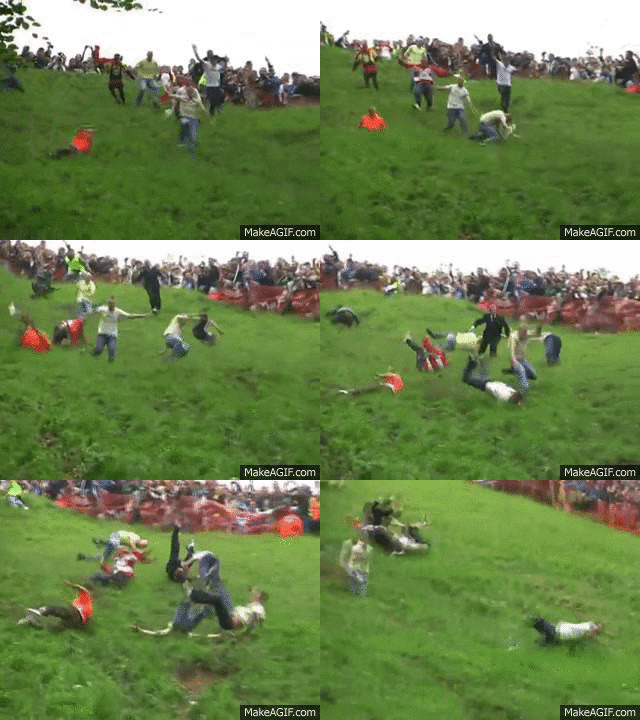
When you're rolling down a hill and realize it hurts, even if you give up, let your limbs go limp, you'll still keep tumbling but you'll most likely end up a lot more broken.
Regrets are more fun with friends.
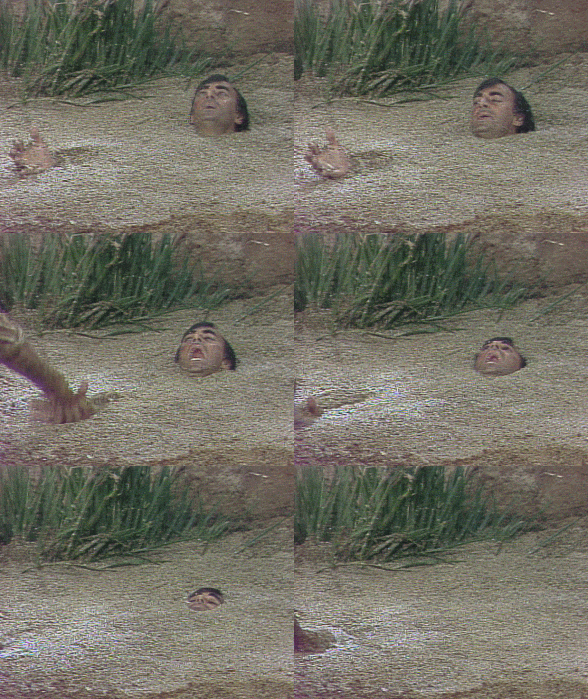
Yet when you're sinking in quicksand, effort is usually a great way to sink faster and end up overcome before you can think of a better way to get out.
Let's face it; if we ever get out of this, we're never eating oatmeal again.
When you're a serial self-defeatist, you'll take the first analogy and 'defend' it with the second, which forces us to drop the analogies and get to the heart of it.

You're not rolling down a hill and you're not stuck in quicksand, quickly checking my blog to see if I get to the point and offer a rescue solution, so where are you?
She's still figuring out how to turn it on.
You tried and failed, or at least didn't achieve immediate satisfaction, so it's okay to give up, right? I can't answer that. What I can say is that we often see giving up as a reprieve from further failure or the insanity of futility. However, we just as often carry a rather uncomfortable burden when giving up wasn't the best idea.
You can't possibly be THIS bad at life.
I'm not inexperienced with giving up. I've often been encouraged to keep going with something I've tried but lost all love for it. It's not unusual to get a tons of supporters and no patrons. We can survive it and keep pressing...

If it's truly what you want to do.

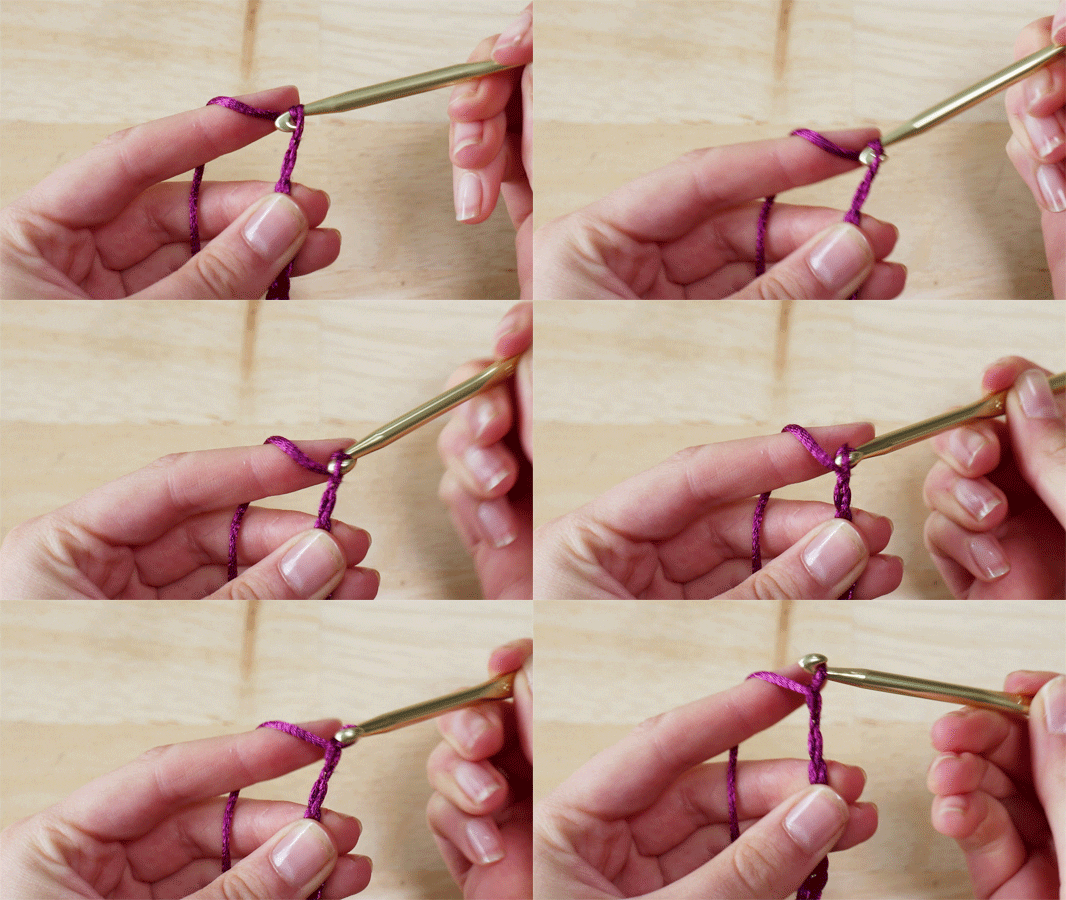
I've been blessed/cursed with a life full of odd jobs. While lumped in as service/retail in nature, I've been through the gauntlet: pizza cook, bookseller, cashier, jewelry seller, florist, crochet crafter. While I found immense pleasure in the learning and new skill sets, I knew at some point that I was clawing at air. It wasn't a matter of financial success or ability or difficulty that ultimately made them fall off but they weren't something I truly enjoyed when push came to shove. I didn't want to smell like food 24-7, I'd rather read or write books, fuck standing at a register, there was too much sexism in being the jewelry counter chick, loved flowers but hated the corporate fuckery, crochet was joyless outside of being a hobby (unless you're fond of most people equating you to a factory worker in an impoverished country).
Only 2,000 more stitches to go (for a hat)!
I'm simplifying those a bit, but they didn't stand up to adversity and a part of me knew as much but gave it a shot anyway. In truth, I knew that telling stories was what I wanted to do. I can be pretty damn funny in casual conversation but speaking in crowds became mortifying after elementary school when I was a lead in school plays and I've never taken to it since. I love to draw, I love to write-- I knew damn well my peace with failure lie there.

How do we know? We don't until we do. I can't offer you a revolutionary new idea here. Despite being told any number of discouraging things or even the punch to the gut that it was, I never heard that little voice that said it wouldn't work out when it comes to writing and drawing. It might have said some pretty distinct trash talk but it didn't kill me. My muse is a powerful whisperer and she always says--
"My reign has just begun."
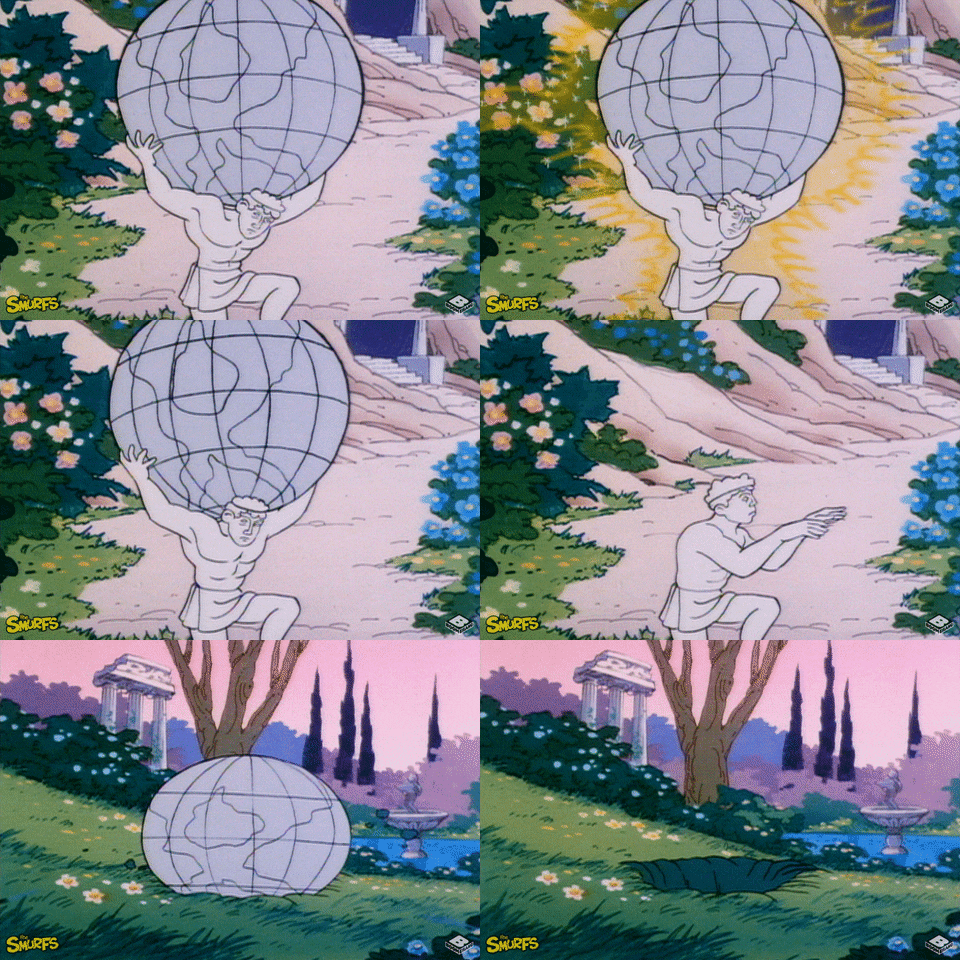
My calling just didn't accept the first analogy and was even further from the second. I was Sisyphus pushing the rock up the hill. Could it be in futility? No. I've pushed a lot of rocks up hills but this one is different. In my mind, I will wear the hill flat. First the grass will give, then the dirt will start to crumble. I'll wear the boulder smooth.
In case you didn't get the Sisyphus reference...
It sounds like it gets easier, right? Perhaps sometimes the path is flat but sometimes the smooth shiny rock will catch the sun and blind me. Maybe I'll stop to wipe the sting of sweat and it will roll down on top of me. I might accidentally flatten someone's house pet. I'll blister, bleed, cry and curse and still... I know even if I lay at the bottom under the rock, sure I'm done, something growls with primal need and I push the rock again.
Huh. Well, it's not THAT heavy. Now I just feel silly.
You can stop all you want but it's not easier. When it haunts you, you know giving up is out of the question. You might need to toss aside some of the smaller experiences that you thought you wanted, but when you find the one, nothing is easy.

A serial self-defeatist will decide that a calling sounds too scary. They'll lament a life in the comfort of misery and tell successful people they're only lucky. They won't risk the scary unknown for a real chance to achieve happiness.

Would we really have such amazing things in this world if success were guaranteed? The problem is the big picture. We see what we can do and we see where we want it to lead. Success comes in steps and not linear ones. Even those who plan, don't plan for the branches of trial and error, of failure and outside forces. Plan small, plan possible. If writing those long term goals is really a hopeful exercise, don't write it on the same page of what you need to work for now. There will be steps you didn't see, micro opportunities that present themselves.

Record your achievements no matter how small. I have a horrible memory so I did this for my fitness journal so I could see every little change. I didn't do it for fear of giving up but so I could see for myself there was never a day without progress. With writing, the word count grows. I didn't have that marker for exercise and namely because it's not always visible (especially for those with body dysmorphia). Our bodies forget pain and disability as much as possible. Sometimes I wanted to see for myself exactly when 3 pushups was hard and when 30 was standard.

When you're used to self defeat, start a new pattern like this. File your stories or drawings by date. Look at the progression of your efforts. It's harder to give up when you have so many reasons not to.

Some people are miserable yet afraid of giving up. Especially when it's a dream that isn't taking off. If you're truly improving, truly getting better but you're in a slump, don't be afraid to pull away for days, weeks, months, years. If it's truly what you want, the hunger won't go anywhere. Sometimes allowing the distance allows those rutted ideas to find higher ground. Allow the highs and lows. Forcing it won't always work, waiting won't always work. You might need to focus on one thing or spread out to compliment your natural inspirations.

Even when you're not actively working on your project, you might find yourself in the mood, more often than not, to read articles about it, edit or beta read, jot things down, scribble out a picture. This is productive. Don't tell yourself it's not what you should be doing. Sometimes what we demean as procrastination is where you're developing a methodology that will be your most effective tools.

If you must stop, an unfinished project might be a temptation more than having finished and hanging out with what to do next. On the bright side, creative pursuits aren't the most painful place to stop.
I'll just stop riiiiiight here.

Monday, August 6, 2018

The Ups and Down of Being a Writer

Pros and cons. Can't have one without the other. I've delved into this before, but I thought it would be fun to go all out on a tug of war with it. We've all got that little goblin that comes bearing bad news, but my muse is here to bat it away with the good side to the bad. Who will come out on top? Well, me, because I own these assholes ®©™ so, sorry to kill the suspense, but me. I win. There's just a lot of banging around until those two tire each other out.

GOBLIN: You're staring at that blinking cursor again...
MUSE: Spacing out is part of the process!

It's true though. Really no cause for panic when you're not immediately hitting the keys. I have a ticky clock on my wall that I also find oddly comforting. The passing of time and meditation of nothing doesn't have to be a bad thing. Modern society has us abused to what productivity really is, and that's often something writers have to learn to refine as we go. Writing is often about forgiving the not-writing.

GOBLIN: Remember what you just wrote? IT'S CRAP!
MUSE: Okay, now read what you just wrote. Pretty good, right?

I've said this before, but there is absolutely nothing more odd than the illusory feeling that your work, no matter how fresh it is, gets slammed with instant self-doubt. There's no way it was terrible, but you're usually being hypercritical. Almost always, read it again. If the goblin keeps winning this one, you probably need to forget it altogether then look at it again without a self-defeating attitude. In fact, try not to edit when you're moody at all. Might take some time to spot the difference. Self-doubt is rampant in creative processes, but you can usually get gratification from actually re-reading it and refining it.

GOBLIN: Anyone can write a book.
MUSE: Then why haven't they?

Lots of excuses and we've heard them all. Million dollar ideas, no time, too busy, too distracted, better things to do. No one who has ever actually written a book will ever say anyone can do it. Sure, you can laugh about how many shelves you'd fill with your text messages, but the discipline of writing, plotting, no matter what your genre-- nothing is easy about it. People don't understand the sacrifices of social life, sanity, time and emotional upheaval that goes into focusing on a finished product. You'll get a lot of people out to trivialize it, but you and your author friends will know better.

GOBLIN: Ugh, there's just too much wrong with it! Not even worth saving.
MUSE: It's nothing an outline couldn't fix.

At first, the idea of outlining seems tedious to the free-writing process. Nothing you can really do about that, but I do find that once you get going, it can actually lift a huge weight off of your shoulders. Even a badly mangled plot in your head often isn't nearly as bad as you think, you just need to build the logic around it. More often than not, my free-writing brain was still loosely using logic and it doesn't take much to make it fit the more-fleshed out version. So yes, it can be a nightmare realizing that you really shouldn't move further until you do so, but you'll probably find that this, too, isn't as bad as you thought.

GOBLIN: You can't sleep until I'm done with you.
MUSE: Take notes then get your ass in bed.

Sleep is too important to the long haul to deny it as a priority. I definitely have those moments where an epiphany comes at the wrong damn time. I know damn well I don't have even another couple hours I can throw at it, but it's just as important to jot it down in some way that will make sense to pick it up again. I'll even go ahead and let my brain play with it while I'm in bed, maybe jot down a bit more if it's juicy, but if I'm physically toast, then the goblin is just being an asshole and giving me more work on the edit when I make an unintelligible mess of it. Your ideas can be just as poisonous to the process, but if you have a game plan for keeping them manageable, you can stay optimistic about having no shortage of ideas.

GOBLIN: Who would read this crap?
MUSE: At least one of us...

While it's practical to think of the audience, you have to remember that you're the audience too. Every challenge that I take is based off of something I am genuinely interested in. I've thrown it out that I want to do a lighter version of fantasy that kids can read and almost immediately, people seemed to sniff out the idea that I was 'selling out'. First of all, if you thought that, you don't know me. There is nothing that can make me force my way through something half-heartedly. At the end of the day, I still write what I want to read and I know there's an audience for it. It's my own damn fault because I'm a curmudgeon about marketing. Again, while there is no stage of writing where you are actually completely confident, at least let your ego grasp that you are your own audience and that's important too.

GOBLIN: This isn't a bestseller.
MUSE: Your mom isn't a bestseller.

And the brain has childish arguments sometimes, throwing a bunch of garbage over the process. Again, something I've mentioned before is the concept of zeitgeist. Some brilliant shit is lost to time, some hot garbage raises a multimillion dollar stink. I mean, really, it's okay. Writing isn't always going to be fun either. I do a lot of editing, researching, crying, punching pillows, building, tearing down-- I'm essentially a freelancer, which is nerve-wracking shit, but I am constantly building skills that I will learn the visible value of as I go. The more I lay down what I can do, the more opportunity for visibility. Just, whatever you do, don't offer to pay me in exposure. I can give you my answer in advance: nope. My own projects are 'exposure' and I have no one to blame but myself for the failure or success of it. So while there are no guarantees, there is also accountability. You might not become a big sensation, but you won't be alone in that struggle so you'll find a lot of ways to keep from spinning your wheels. You'll learn what needs to be done to have better chances of meeting your goals.

GOBLIN: Someone in a writing group said you should do this and this and--
MUSE: NOBODY CARES WHAT YOU THINK! If you smell-l-l-l what the Rock... is cooking.

You'll get a lot of people who mistake their tastes or experiences as gospel. While you can build some relationships that are worthwhile, I find that a great deal of writers are pretty over-the-top in their opinions and often blur that with advice. There a lot of far-lefts and far-rights (although I do find my rational 'people in between' too). Really, you learn that it's okay to stick your fingers in your ears and la-la-la, not listen. One of the many reasons it's important to research your story is to enrich your story-- the same goes for your collection of groups, friends, blogs and so on. While people might occasionally drive you up a wall, sometimes you just have to cut those connections for the sake of your sanity and your story. I find that most of the people who you see repeatedly pretend to be writing experts are not actually applying any writing towards their work. They're operating on some nostalgia of what it's like to be a writer, being a part of community that they aren't actually building new experiences on. They become pseudo-experts that you really shouldn't give much weight to. Being a writer means you actually have to write. And no, posting in groups and blogging even doesn't really count towards your body of work as a novelist. If you can decide what you want out of writing, it had plenty of upsides. If you're often banging your head against the wall because you procrastinate, then you're not finding the upsides.

MUSE: This should be a simple idea!
GOBLIN: Let's get COMPLICATED!
MUSE:... Sure, why not?

This is one that throws me around a lot. Every idea usually starts pretty simple. I usually manage to color it with complexities in planning. Fortunately, I can still make it simple to read, but behind the scenes, no one really sees what it takes to accomplish that. Simple things often blow up, but I'm up to the challenge of making the story simple for readers too. This often means planning out things that won't actually be in the book. When you build a world, you have to assume there is plenty going on that won't actually make it into the story, but that car crash in this scene isn't a car materializing into mid-air. Sometimes you need to map out the story of a frustrated parent who is running late. Even if it doesn't make the pages, every participant has to successfully convince you they belong to the story. In the big picture of a story, that can seem overwhelming, but it can also be fun to break away and create pockets and alternatives and movement elsewhere. Some people dread this-- it takes away from their word count goals and time management to divert. Yet, I can say for certain that this kind of maneuvering ultimately SAVES you time and gives your story a brilliant edge. When you are confident in your world's moving parts, it does make you more productive as your world grows.

I'll leave this as is. I do have plenty to do-- no writing for a while, but I'm securing back stories, bestiaries, profiles, maps-- things that I didn't want to do until I realized this story needs them. No big deal since I figured it might come to this. It's not going towards my word count but it is certainly a necessity in moving forward. I gave UnSung a wide berth since a second book is still wobbling on the toddler legs of its infant predecessor. The third and fourth books will immediately benefit from this too.  Yes, another up and down here. We often don't know what is 'too much' or 'too little' work for our story. Flexibility can be a good and bad thing, so we have to decide if we're up to the challenge there too.

Sunday, July 8, 2018

Reformatting Can Be a Nightmare

For the conclusion of deciding to reformat my first three books for some design cohesion (took out the pain in the ass illustrations and went for text-only-- I'm going to publish the images on other platforms instead of in the books), I've thoroughly decided I'll more carefully consider what platform I ever do print illustrations again. KDP's interface is just not self-pub friendly for that. I might looked into it for any comic publishing, but honestly, I'd rather trad-pub comics and let some formatting masochist do what they do best and stick to the creative there.

In case you do want some basic tips on formatting (the easier text-only kind), you can always check out my Formatting 101 post. It uses Word and I'm on a Mac but the options should be pretty similar on any word processor. If not, drop me a line on the difference and I'll edit the post with your discovery. Please provide screenshots if this is something I can't test with my software. If I add it, I want it to be repeatable for anyone else. (I have not yet tried to publish outside of using Scrivener for my current WIP, but if I run into hiccups there, I will do a future post on what to look out for).

So, what was a nightmare with KDP? That's what I wanted to get into. First off, I had to get into the original .docx (saved as PDF once final) and remove pictures, update table of contents, etc. At first, I attempted to just set the image to Bleed and repaste the pictures. Word is kind of a pain for that and the change in size from 6x9 to 5x8 meant it totaled my page count for any resizing of fonts, making realigning page breaks and pictures a chore not worth doing. It also meant I had to redesign/resize the covers once I got the new page count regardless of whether I kept the images or not. Here's the thing-- the templates are kind of crap for covers. I downloaded the appropriate cover template for the page count and almost every single time, it gave me shit about the 1/8 of an inch in length I was off. I would much rather that each template (kind of throwing you in a ten page RANGE, not exact) would also give you the exact spine measurements to adjust the template. I do believe you can find the calculations, but it's not direct linked to the reviewer so more digging. Really, the system could auto-stretch it, let me decide if I'm okay with that (I would be-- it never distorts it when I do it manually) and we'd be good. Why? Because the page reviewer is a necessary step in approval and both uploading content and the page reviewer is SO SLOW.

So redoing all three books took the better part of two days and I'm awaiting review to make sure it actually took. Sometimes they create a new problem like 'hey, this is already on CreateSpace' or 'did you mean to change a few things?' and I have to verify all that before it's good to go. So If I decide to go the image route in the future, I'm going to pore through their pages, ask a shit-ton of questions and make sure I have the right measurements from the onset so I'm not uploading 30+ images to Photoshop to file through the Action menu and do batch resizing like a mo-fo. I'm pretty damn tech-savvy but some of the things that are supposed to be 'easier' tend to just make the user redo things that would have better been done with a simple sizing table. Because I can do that too. I can do things pretty damn well with just simple measurements from scratch. You don't get into digital design if you're not good at math and visual problem-solving.

I did manage to get some doodling done while waiting for that process. Playing around with the design for my alien dude. Realizing I made his suit a bit complex, but he's not going to be sporting it very long. I mean, he is going to have to 'blend in' on Earth so unless he's planning on milling around cosplay cons, raves, or Halloween parties, he's SOL in space gear. It'll make his appearance in the first episode cooler though. You have to get people in with a draw, not just to your style, but your effort. I've always wanted to do an alien story though, so should be fun. And yes, I've already been researching where I plan to publish and looking at templates. So before I do ANY actual drawing for it, I will know what it's going to do to my images! Right now, I'm just on concept. I'm supposed to be 'relaxing' anyway, but I clearly don't understand how that works. I always end up poking at something. Sorry, but relaxing, in all the ways I try it, just creates boredom, which is not a fun concept for me at all. Anyways---

Format. Is so. Important.

Wednesday, July 4, 2018

Cover Reveal + Milestone Achieved!

The ninth and final book cover, finally done for Each Endless Universe: Original Sin coming on July 11th, features the lovely, deadly Baelle.

I didn't screen shot many of these since I did her fairly quickly and didn't stop much to remember to take them. Nevertheless, here they are!
Start with the mannequin...
Add a little shading...
Some funky guidelines...
Clothes and the beginning of shading...
Some blending...
POOF! Magic!
It's a girl! And also a bear... Was a bear, anyway. Now it's a cloak.

Phew, I really enjoyed the whole process, but alas, it is time to crown it and move on to the next great project. I hope you enjoyed taking the journey with me! I certainly enjoyed all of this 'leaving my comfort zone.'

So here is where I continue cracking down on UnSung, although this summer, I also plan on working on some other neglected skills and playing around the web comic idea for Rock My World. I always like to take advantage of higher summer energy levels to diversify my talents a bit. Don't worry; anything blog worthy will get some features along the way as usual. This isn't just about me but what those experiences might contribute to helping other writers and artists take meaningful steps towards following their own dreams.

I do have UnSung's cover done, but I'm keeping that under wraps until about a week prior to when I set up the release as I did for these. As I've said before, UnSung is a whopper of a book, the first part topping the 80K word mark with the two other parts and the epilogue awaiting a draft. It's very likely to be three books in one for all I have planned for it. However, this is a very pivotal part of the story; where UnNamed scratched the veneer, UnSung plunges into the world headfirst. Since I can't really plan the size until the draft gives me more insight, the other two may be wholly different.

So, more to come, time willing; thanks again for all of the support and encouragement! I can only hope I'm giving as well as I get.


Saturday, June 30, 2018

What Draws You to Story Telling?

I might have said this before, but there are certain phrases I stopped saying when I realized it was true of all creatives. "I've been drawing/writing every since I could hold a pencil." "My inspiration is Disney and anime." "I'm a flexible person/critical thinker/problem solver." "I'm highly motivated and a fast learner." You know what I mean-- the stuff that now shows up on every résumé or social media description out there. What is left when the really honest, creative, and original thoughts are old hat?

The same can be said of storytelling and there are the same platitudes whenever a new writer worries their idea has been done before. "Make an idea your own." "You have a unique voice/style." "If it's interesting enough, people won't mind the similarities." "If it works, it doesn't matter." Not that these aren't all true in parts, but I feel like a lot of those worries need a more personal approach.

First off, most worries are almost always presented in a way that is infuriatingly general. As I've gone into before, Quora questions and the initial state of an emotion tend to be a dump on impulse that needs direction to isolate. When someone asks "what if my idea has been done before?" it gets pulled in a lot of directions:
  • Asking them to explain their idea
  • A slew of general suggestions
  • Frustration or outright trolling
  • Hug-box nonsense
To name a few. Ultimately, noise, well-intentions or no. However, the more I observe the interactions, the more I wonder why no one is asking the person what makes them ask that. Are they reading a lot of books in the genre or none at all? Are they worried their fandom will make it more fanfic than original work? Are they basing it off of something and just hoping no one will notice? In order to alleviate this kind of fear, sometimes I think we need to ask the right questions and that the asker has to be comfortable with answering them so they can be directed towards a mindset that might benefit them.

Of course, no one owes a writer a story. I understand that some writers are wary of how much they are 'helping' someone write their story when sometimes it becomes clear that someone who isn't actually writing anything is actually just harvesting and picking other brains. I don't think this is the case most of the time, but rather than getting to their idea, the wary writer can instead dig into what methods that writer is using, never needing to discuss ideas at all.

Going back to the questions: what are they reading? I know there's this huge consensus that to be a better writer, you have to be a better reader. However, a great deal of doubts can arise from reading too heavily in your genre, worrying you're gleaning your ideas from these books, or of course, just have no idea what's happening in the genre at all and want to avoid writing into an unpopular or even overdone trope or cliché. Some solutions might be:
  • Reading 'too much' in your genre, too much knowledge and feeling you have nothing new to add: Start reading from other genres, no matter how much you like it. One way to refresh your passion in a genre might actually be to integrate an idea from ANOTHER genre that doesn't get a lot of movement in yours.
  • Reading 'too much' in your genre, afraid you're going to unconsciously borrow: This might be unavoidable, but again, if you must read, deviate from the genre and let your most recent influences steer away from the norm. You can also put down the novels and pick up short stories or writing articles, something that will help you focus on craft rather than content.
  • Reading 'too little' or nothing at all in your chosen genre: The likelihood of your unique idea being not so unique might be high but uninfluenced, you can honestly plead ignorance or even just concede that a good idea is a good idea and more than one person thinking of it is proof enough. While a binge might be inspirational, sometimes that dry place is one where you'll worry less about WHERE you've read it before because you might not have at all. See what you can do with it.
  • OH NO! I've seen my idea done before while searching the internet: Sigh. Don't do this. Ever. Don't go from excited about this idea you came up with to seeing if it's been done. Train yourself not to research that, train yourself not to care. Again, once you read how it's been done, it could cripple you or make you miserable by telling yourself theirs is better. A newborn idea is always generic but give yourself time to grow it, write it, edit it before you ever look for it. Where it's been done, they went through the fully-formed process and you should give your own ideas the same care. Don't see it as a waste if you can't make it work. Critical thinking and problem solving is NEVER a waste of time and you can use and refine those methods for any idea after.
  • Wellll, technically it's fanfic with the names changed: Wellll, technically fans are going to call it out. As long as you don't pretend otherwise, you can also add where you deviated. Remember, plagiarism is a percentage and if you can bring enough original content to a clear inspiration, it's valid. You might want to pay an editor and possibly a lawyer to check it if you want to cover your ass against being sued though.
In tackling the source of a general fear, finding the right questions, you're helping yourself too. Develop a plan of action to see social situations as a good place to test your ability to dig into motivations. There's a bubble of safety in the manipulation of your characters, so sometimes you do have to put your theories to the test with actual people, even if it's just internet strangers. I personally don't like using public forums like Quora and social media for this, especially when any personal information is attached to the profile. I make an exception when it comes to closed groups. While large groups can sometimes be an unfiltered risk, you also might feel nervous about approaching people in smaller groups. I'd say it's okay to go anonymous or create a lite or false profile where permissible, but I'd advise against the temptation to troll because of it. In my case, I stick to closed groups. Anonymity just gives me too much temptation to deviate from the purpose of social accountability so I don't do it. When I'm looking to help or understand people, removing the diplomacy of my personal character defeats the point of appealing to someone on the same level.

Cheese and Jesus, I probably sound like a huge nerd again, but if you understood it, I've found my people and that's all that matters. What does discerning personal motivation have to do with story telling? Well, everything so I'll finish that up.

Story telling-- what draws the story teller into telling their stories or the story seekers towards them is this alignment of personal motivation. I suppose you could refine it into a marketing strategy, but let's assume a more traditional stance and just say that those alignments are not only found in ads, commercial popularity, or even word of mouth, but the connection between the writer and the reader. 

At first, it surprised me when the person behind a story I loved seemed to observe the same way I do or made the same comparison. I might have said it out loud once and been laughed at and embarrassed for it, but then a published book says it and suddenly that shutdown becomes validated because I'm not the only one. Sometimes a story can bring us courage and acceptance. And yeah, sometimes we never needed it to keep repeating it even when we're laughed at (I'm both of those people depending on mood) but it still feels good when someone says it like you or even a little better.

Sometimes walking with a writer becoming a storyteller is draw enough. As the writer publishes, either for free or daring to put a price on it, there's the validation that they are eager to stick with this, making people more confident in investing their beloved pastime with them. The hard luck story and the writer that stood in the shadows of the writing world for 10+ years is still a romantic concept for some people, even in these apathetic times. 

Some readers need the whole series to even begin so you might need to put in years and more years besides to even get someone to pick up the first one. Some storytellers don't have the patience so they filter their ideas into essays, short stories, novellas or single novels to offer a fully finished bit of their work in smaller bursts.

Story telling is about intimacy with the work, which can get uncomfortable on most sides. It takes strength in all parties to take chances. What draws most of us to trying new stories is the search for that resonance, that connection. It doesn't have to be deep or profound-- it can be horny and violent, but it's connecting regardless.